
En la imagen
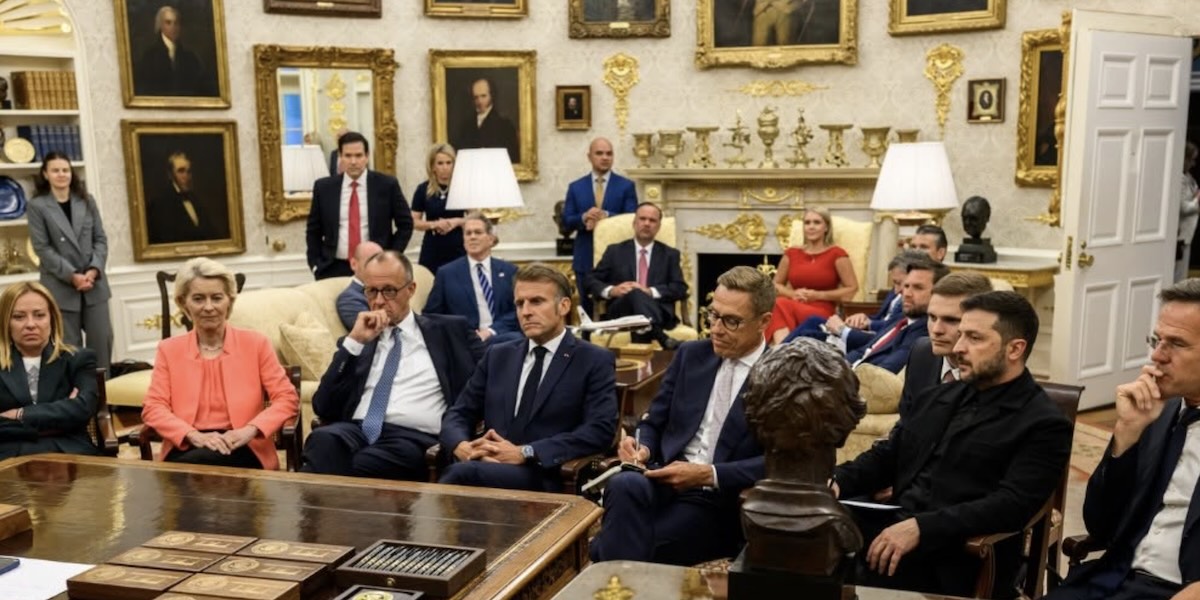
European leaders during a meeting with Donald Trump in the Oval Office, in August 2025 [White House]
[Version in Spanish]
1. Introduction
The question of the European Union’s (EU) strategic autonomy has become central to debates about its role as a global actor. In defence and security, the EU has long remained dependent on external actors, particularly the United States and NATO’s defence framework.[1] Although this dependence has not prevented Europeanstates from developing closer defence cooperation, it has constrained their ability to act independently when their security interests or those of their allies require it. Donald Trump’s return to the White House in January 2025 intensified these concerns. Within weeks, the European Commission presented the ReArm Europe Plan, while Germany approved a constitutional reform exempting defence spending above 1% of GDP from the debt brake. These developments reflected a growing recognition that continued reliance on American security guarantees carried increasing political and strategic risks. They also raised a broader question: to what extent could this pressure translate into greater European strategic autonomy in defence capabilities?
This essay argues that, although the pursuit of strategic autonomy predates Trump’s second term, his return has accelerated it by raising the cost of dependence on the United States. However, this acceleration has been uneven. The essay first examines the conceptual foundations of strategic autonomy and its evolution as an EU policy objective. It then traces the consolidation of European defence cooperation before 2025, focusing on the effects of earlier developments, including Russia’s annexation of Crimea in 2014 and its full-scale invasion of Ukraine in 2022. Finally, it examines the impact of Trump’s second term across three dimensions: financial resources, operational capabilities and the European defence industry. It argues that the clearest acceleration has occurred in financial mobilisation followed by more limited progress in industrial policy, while operational autonomy remains the most significant unresolved challenge. Ultimately, Trump has increased the urgency of an existing European project, but national control over defence and persistent capability gaps continue to limit its implementation.
2. Defining ‘strategic autonomy’
Strategic autonomy is not a new concept.[2] It owes its origins to the military branch wherein it refers to a long-term vision of conditions allowing the establishment of military independence in relation to other actors.[3]Historically, it is noted to have first been used in the 1998 St. Malo Declaration, where France and Britainjointly worked on developing the foundations of the EU’s defence policy, paving the way for what is currently known as the Common Security and Defence Policy (CSDP). In the recent period, it has been invoked by different politicians, at least since 2013. For instance, on 6 March 2025, at the EU leaders meeting in Brussels, Greece’s prime minister Kyriakos Mitsotakis stressed “the strategic autonomy of the European Union must be a non-negotiable priority”.[4]
Despite serving defense purposes, strategic autonomy has expanded into covering virtually every EU policy with an external dimension. A common problem arises, and it is that providing a clear definition is a hard task to develop due to its ambiguous character. In this sense, one must first consider the two faces it possesses; understanding it as an academic concept can reveal its theoretical foundations, yet, strategic autonomy should be also analyzed as an European policy, orientated towards the development of binding decisions, joint programs, and international agreements.
i. Strategic autonomy as a concept
Autonomy has been for long understood as the ability to set one's own course and self regulate.[5] In fact, the word “autonomy” is derived from the Greek stems for “self” (autos) and law or rule (nomos), meaning literally “the having or making of one's own laws”.[6] Despite this, we must consider that achieving autonomy does not mean solely operating in a completely isolated environment where the influence or concern for other actors is disregarded.[7] In reality, and when bringing this concept into practical terms, we mustconsider autonomy as the spectrum going in between the “freedom to act” and “freedom from dependencies” which tells us of the degrees of autonomy existing in between.[8] Distinguishing these degrees is important, as the EU's trajectory towards strategic autonomy in defense capabilities can be understood precisely as moving along this spectrum.
ii. Strategic autonomy as an EU policy
Beyond this conceptual understanding, strategic autonomy has progressively evolved into an official EU policy objective. The term first appeared in official EU discourse in the Council Conclusions on Common Security and Defense Policy (CSDP) of December 2013.[9] At this point, strategic autonomy was limited to a narrow military sense. Since the 2016 EU Global Strategy the term has acquired a more decisive character.Strategic autonomy, as an European policy, can therefore be described as the ability to act autonomously, as well as to choose when, in which area, and if, to act with like-minded partners, characterized by a politicalwill, common strategic vision of the region, and the capacity to act. Its implementation into EU external action serves as a double political objective: to ensure not only that the EU is able to shape the course of international relations through its external action, but also that it is able to act alone and uphold its own external policy choices if needed.[10]
3. The consolidation of the EU’s strategic autonomy before Trump’s return
The EU’s pursuit of strategic autonomy did not begin in 2025. By the time Trump returned to the White House, it was already a policy in the agenda. Progress, however, was fastest where autonomy could be pursued through industrial and financial instruments, and slowest where it required member states to transfer control over their armed forces. The consolidation of strategic autonomy before Trump's second period can be therefore observed through a strategic, institutional and industrial lens.
First, from a strategic point of view, the 2016 EU Global Strategy turned strategic autonomy from a narrow defence-industrial notion into an overarching objective of the Union’s external action. Its importance came from the fact that different actors could interpret the concept in different ways. As Helwig and Sinkkonen argue, strategic autonomy is not a binary choice between dependence and independence.[11] Because the term could be read differently in Paris, Berlin and Warsaw, it allowed member states with divergent views on NATO to commit to a common direction without first settling what autonomy ultimately meant. This ambiguity explains how the term could become official policy while remaining politically contested.
The second aspect was institutional. In December 2017, 25 member states launched Permanent Structured Cooperation (PESCO), undertaking 20 legally binding commitments on defence investment, capability development and operational readiness.[12] PESCO had been available since the Lisbon Treaty entered into force in 2009 but remained unused for eight years.[13] Its activation only eighteen months after the Global Strategy suggests that the obstacle had been political will rather than legal capacity. Together with the Coordinated Annual Review on Defence (CARD), PESCO created a permanent framework in which nationaldefence planning became subject to collective review. Denmark’s decision to join in 2023, after threedecades of opting out of EU defence policy, confirms that this framework had become the main reference point for defence cooperation within the Union.
The third, and most transformative aspect, was industrial. The European Defence Fund (EDF) was announced in 2016, tested through two pilot programmes and formally established in 2021 with €7.953billion for 2021–2027.[14] It broke with the long-standing practice of keeping defence research anddevelopment out of the EU budget. In fact, it was framed as research and industrial policy rather than defence policy. This allowed the Commission to take the lead in a field traditionally reserved for intergovernmental decision-making.[15] The creation of a Directorate-General for Defence Industry and Space in 2020 then institutionalised this new role within the Commission.[16] Strategic autonomy thus advanced towards the transfer of a high-politics security logic into lower-politics fields such as industry and technology. This move opened windows of opportunity for EU policymaking that direct defence integration had never achieved.
In addition, Russia’s full-scale invasion of Ukraine in 2022 accelerated all three at once. Strategically, the Strategic Compass translated the 2016 ambition into a concrete plan of action, including a Rapid Deployment Capacity of up to 5,000 troops in the face of the war.[17] Operationally, the EU used the European Peace Facility, an off-budget instrument created in 2021, to finance the delivery of lethal weaponsto a country at war for the first time in its history. By 2024, the Facility’s ceiling had been raised to over€17 billion.[18] Industrially, the Union shifted from long-term capability planning to production. Here, The Act in Support of Ammunition Production allocated €500 million to expand Europe’s munitions capacity, and EDIRPA introduced incentives for joint procurement.[19] Lastly, in March 2024, the Commission and the High Representative presented the first-ever European Defence Industrial Strategy.
Taken together, these developments show that before 2025 the EU was already pursuing strategic autonomy. It defined autonomy as a strategic objective, built institutions to coordinate national efforts, and created supranational instruments to strengthen the European defence industry. Despite this, some limitations to European integration advanced least where it touched the core of national sovereignty reflected in the deployment of forces and the size of national defence budgets.
4. Trump’s second term as a catalyst
Trump’s second term did not create a new threat to Europe; Russia already was one. What it changed was the cost of relying on the United States to manage that threat. Days after the Oval Office clash with President Zelensky in late February 2025, Washington suspended military aid to Ukraine and paused intelligence sharing with Kyiv. Meanwhile, Defense Secretary Pete Hegseth warned that allies failing to contribute to collective defence “will face consequences.”[20] For European governments this translated into the guarantee on which decades of dependence had rested could be suspended overnight and used as leverage.
This rising cost of dependence accelerated the EU’s existing pursuit of strategic autonomy in three fields: financial, operational, industrial. It must be noted that Trump did not cause each decision single handedly. Russia’s continuing war against Ukraine remained the underlying driver, and domestic factors also played a role. Rather, his return raised the political urgency of acting and narrowed the room for further postponement.
i. The financial dimension
Before 2025, the main obstacle to European defence investment was not the absence of a threat but the persistence of fiscal constraints. Neither the annexation of Crimea nor the full-scale invasion of Ukraine had led to changes in EU fiscal rules or in Germany’s constitutional debt brake. Trump’s return changed this within weeks which were evidenced through a sequence of events. On 4 March 2025, the same week that Washington froze its aid to Ukraine, Commission President von der Leyen presented the ReArm Europe Plan, declaring that Europe was “ready to assume its responsibilities.”[21] On 18 and 21 March the German Bundestag and Bundesrat approved a constitutional reform exempting defence spending above 1% of GDP from the debt brake.[22] Finally on 19 March the Commission and the High Representative published the White Paper for European Defence.[23]
Within weeks, measures that had previously faced political and fiscal obstacles gained momentum. This rapid sequence suggests that uncertainty over US security commitments helped change the political feasibility of increased defence spending. The design of ReArm Europe also reveals what kind of acceleration this was. Of the roughly €800 billion it promised to mobilise, close to €650 billion depended on member states usingnew fiscal flexibility to raise national defence spending by an average of 1.5% of GDP over four years. Only €150 billion took the form of EU-backed loans.[24] In July 2025, the Council activated the national escapeclause for fifteen member states, allowing them to spend up to 1.5% of GDP more on defence without triggering an excessive deficit procedure.[25] Moreover, at the NATO summit in The Hague in June 2025, allies committed to spend 5% of GDP on defence and security by 2035, including at least 3.5% on core defence.[26] For instance, in Germany the reform negotiated by Friedrich Merz reversed decades of fiscal backwardness and left only defence spending up to 1% of GDP subject to the debt brake. It wasaccompanied by a separate €500 billion fund for infrastructure and climate protection, not for defence.[27] Yet it was a national decision, financed nationally and justified in national terms.
The same reluctance to Europeanise defence finance appeared in March 2025, when the Dutch lower house adopted, by 73 votes to 71, a motion asking the government to stay out of ReArm Europe, arguing that the Netherlands opposed joint European borrowing and that defence spending should remain a nationalcompetence.[28] The Dutch government ultimately kept its support for the plan, but only after committing not to accept further common debt without parliamentary approval. In this sense, Trump’s return helped make higher defence spending politically unavoidable and loosened fiscal constraints that earlier shocks had left largely intact, although it did not remove them altogether. However, the resources mobilised are overwhelmingly national, and the willingness to pool them remains limited. In terms of strategic autonomy, the EU moved to resource development yet more money spent separately by twenty-seven governments does not by itself produce European autonomy.
ii. The operational dimension
When the US suspended intelligence sharing with Ukraine in March 2025, France said it would continue providing its own intelligence insisting that French intelligence was “sovereign.”[29] However, this did not fully replace the support Ukraine had received from the US. For example, Ukraine also lost access to satellite imagery provided through a US government programme involving Maxar.[30] This showed that, although European countries could continue providing some intelligence, they lacked the capacity to fully replace all the resources supplied by the US.
In response to these weaknesses the EU 2025 White Paper identified seven critical capability areas. These included air and missile defence and a category of strategic enablers covering strategic airlift, air-to-air refuelling, maritime domain awareness and the protection of space assets. This matters because these were the areas earlier frameworks had largely avoided. In October 2025, the Defence Readiness Roadmap 2030 took the White Paper priorities into four flagship projects: the European Drone Defence Initiative, the Eastern Flank Watch, the European Air Shield and the European Space Shield. It also set concrete deadlines,including an initial capacity for the first two by the end of 2026, a fully functional drone defence system by the end of 2027, and an operational Eastern Flank Watch by the end of 2028.
With this scenario two observations follow. First, the change is qualitative. Compared with earlier frameworks, the Roadmap ties concrete delivery dates to specific projects in the domains where dependence on the United States is most severe, rather than funding cooperation for its own sake. Second, this is also the dimension where acceleration remains most limited. At the time of writing, the flagships remain plans rather than capabilities, and their delivery dates extend to 2028. In some of the most critical areas, such as intelligence and strategic airlift, the EU has identified the gaps without adopting collective decisions. Where substitution did occur, as with French intelligence support to Ukraine, it was national rather than European. Military capabilities take years to build, and money approved in 2025 cannot produce satellites, tankers or air defence systems overnight. Operationally, therefore, Trump accelerated the EU’s prioritisation of autonomy rather than autonomy itself.
iii. The industrial dimension
The industrial dimension addresses a paradox, and it is that until 2025, spending more on defence had increased Europe’s dependence on the US rather than reduced it. According to the Commission, 78% of member states’ defence acquisitions between February 2022 and June 2023 were made from outside the EU, with the US as the dominant supplier.[31] SIPRI data, which cover European NATO members rather than EU member states, indicates that the US supplied 64% of their arms imports in 2020–2024, compared with 52% in 2015–2019, this was its largest share in two decades.[32] Russia’s invasion thus produced rearmament without clear autonomy since under the pressure to deliver quickly, governments bought off from American systems.
The Security Action for Europe (SAFE) instrument, adopted by the Council on 27 May 2025, was designed tobreak this pattern. It offers up to €150 billion in long-maturity, EU-backed loans, but at least 65% of the components must come from the EU, the EEA-EFTA states or Ukraine, and the instrument prioritises joint projects over individual purchases. By the end of July 2025, 18 member states had expressed interest, with combined requests of €127 billion, and nineteen eventually submitted national defence investment plans.[33]
While having some major developments, limits can be evidenced. In the case of SAFE it consists of loans and not grants. Member states must repay them, and the instrument channels European preference through national purchasing decisions rather than replacing them. In addition, considering that only 65% of the components must come from EU countries, the 35% threshold leaves room for non-European suppliers. Significant non-European content, including American content, remains eligible. And finally, the legal framework protects national decision-making powers. Article 346 TFEU allows member states to shield defence procurement from internal market rules to protect essential security interests, enabling them to favour national industries over joint frameworks. The industrial dimension therefore shows a partial acceleration marked by EU money now being used on an unprecedented scale to influence who supplies Europe’s armed forces, but the decisive choices remain national.
5. Conclusion
This essay has argued that Trump’s second term acted as a catalyst rather than the cause of the EU’s pursuit of strategic autonomy in defence capabilities. Since 2016, European defence cooperation had already advanced in response to successive security shocks, particularly Russia’s invasion of Ukraine in 2022. However, Trump’s return increased the cost of relying on the United States, raising the urgency of reducing European dependencies and narrowing the room for further postponement.
The acceleration has been uneven. Financially, it has been clearest, with new measures expanding the scope for defence spending. Industrially, instruments such as SAFE and EDIP have strengthened the EU’s ability to steer procurement towards European production, although national purchasing decisions and continued reliance on external suppliers remain important constraints. Operationally, progress has been more limited. In this sense, the EU has identified critical capability gaps and established plans to address them, but significant dependencies on US intelligence and space-based surveillance persist, while other capabilities remain underdeveloped.
These differences reveal that European governments are mobilising resources faster than they are integrating their defence efforts. National control over spending and procurement continues to constrain collective action, while the development of operational capabilities requires time and sustained investment. The EU has therefore advanced further in reducing dependencies than in acquiring the capacity to act independently. Ultimately, Trump’s second term has accelerated the means of strategic autonomy more than its practical achievement. Whether this acceleration endures will depend on governments’ willingness to channel national resources into joint initiatives and will in much extent depend on the Union's capacity to implement and translate announced plans into usable military capabilities.
[1] Draghi, M. (2024). The future of European competitiveness: Part A — A competitiveness strategy for Europe. European Commission. https://commission.europa.eu/document/download/97e481fd-2dc3-412d-be4c-f152a8232961_en
[2] Council of the European Union, Analysis and Research Team. (2021, February 5). Strategic autonomy, strategic choices [Issues paper]. General Secretariat of the Council of the European Union. https://www.consilium.europa.eu/media/47867/021-02-05-strategic-autonomy-issues-paper.pdf
[3] Charlotte Beaucillon, “Strategic Autonomy: A New Identity for the EU as a Global Actor,” European Papers 8, n.º 1 (2023): 417–28, https://doi.org/10.15166/2499-8249/664
[4] Kassab, H. (2025, March 12). A pivotal moment for European strategic autonomy, courtesy of Trump. Lowy Institute. https://www.lowyinstitute.org/the-interpreter/pivotal-moment-european-strategic-autonomy-courtesy-trump
[5] Ibid.
[6] Treiger-Bar-Am, K. (2008). In defense of autonomy: An ethic of care. NYU Journal of Law & Liberty, 3(2), 548–597. https://www.law.nyu.edu/sites/default/files/ECM_PRO_060976.pdf
[7] Burchardt, T., Evans, M., & Holder, H. (2010). Measuring inequality: Autonomy — The degree of empowerment in decisions about one's own life [Research report]. Government Equalities Office, UK. https://assets.publishing.service.gov.uk/media/5a79d4b240f0b66d161ae739/measuring-autonomy.pdf
[8] Fiott, D. (2018). Strategic autonomy: Towards 'European sovereignty' in defence? EUISS Brief, No. 12. https://www.iss.europa.eu/content/strategic-autonomy-towards-%E2%80%98european-sovereignty%E2%80%99-defence
[9] Charlotte Beaucillon, “Strategic Autonomy: A New Identity for the EU as a Global Actor,” European Papers 8, n.º 1 (2023): 417–28, https://doi.org/10.15166/2499-8249/664
[10] Ibid
[11] Niklas Helwig y Ville Sinkkonen, “Strategic Autonomy and the EU as a Global Actor: The Evolution, Debate and Theory of a Contested Term,” European Foreign Affairs Review 27, número especial (2022): 1–20, https://doi.org/10.54648/EERR2022009
[12] Council of the European Union, “Council Decision (CFSP) 2017/2315 of 11 December 2017 Establishing Permanent Structured Cooperation (PESCO) and Determining the List of Participating Member States,” Official Journal of the European Union L 331 (14 de diciembre de 2017): 57–77, https://eur-lex.europa.eu/eli/dec/2017/2315/oj
[13] Council of the European Union, “Permanent Structured Cooperation (PESCO),” consultado el 29 de octubre de 2026, https://www.consilium.europa.eu/en/policies/pesco/
[14] European Commission, “EU Defence Gets a Boost as the European Defence Fund Becomes a Reality,” 29 de abril de 2021, https://defence-industry-space.ec.europa.eu/eu-defence-gets-boost-european-defence-fund-becomes-reality-2021-04-29_en
[15] Pierre Haroche, “Supranationalism Strikes Back: A Neofunctionalist Account of the European Defence Fund,” Journal of European Public Policy 27, n.º 6 (2020): 853–72, https://doi.org/10.1080/13501763.2019.1609570
[16] Ester Sabatino, “The European Defence Fund: A Step towards a Single Market for Defence?,” Journal of European Integration 44, n.º 1 (2022): 133–48, https://doi.org/10.1080/07036337.2021.2011264
[17] Council of the European Union, A Strategic Compass for Security and Defence: For a European Union That Protects Its Citizens, Values and Interests and Contributes to International Peace and Security, documento 7371/22, 21 de marzo de 2022, https://data.consilium.europa.eu/doc/document/ST-7371-2022-INIT/en/pdf
[18] European External Action Service (EEAS), “Ukraine Assistance Fund: Council Allocates €5 Billion under the European Peace Facility to Support Ukraine Militarily,” 18 de marzo de 2024, https://www.eeas.europa.eu/delegations/ukraine/ukraine-assistance-fund-council-allocates-%E2%82%AC5-billion-under-european-peace-facility-support-ukraine_en
[19] Parlamento Europeo y Consejo de la Unión Europea, «Reglamento (UE) 2023/2418 del Parlamento Europeo y del Consejo, de 18 de octubre de 2023, por el que se establece un instrumento para el refuerzo de la industria europea de defensa mediante las adquisiciones en común (EDIRPA)», Diario Oficial de la Unión Europea, L 2023/2418 (26 de octubre de 2023), https://eur-lex.europa.eu/eli/reg/2023/2418/oj
[20] POLITICO, “Trump NATO Allies Consequences List,” 22 de abril de 2026, https://www.politico.com/news/2026/04/22/trump-nato-allies-consequences-list-00883619
[21] Comisión Europea, “Press Statement by President von der Leyen on the Defence Package,” 4 de marzo de 2025, European Commission, Press Corner, https://ec.europa.eu/commission/presscorner/api/files/document/print/en/statement_25_673
[22] Noerr, “German Bundestag Approves Exemption from the Debt Brake for Defence Spending and Special Funds for Investments in Infrastructure and Climate Protection,” 21 de marzo de 2025, https://www.noerr.com/en/insights/bundestag-approves-exemption-from-the-debt-brake-for-defence-spending-and-special-funds-for-investments-in-infrastructure-and-climate-protection
[23] European External Action Service (EEAS) y Comisión Europea, White Paper for European Defence – Readiness 2030, 19 de marzo de 2025, https://www.eeas.europa.eu/eeas/white-paper-for-european-defence-readiness-2030_en
[24] European Commission, “Statement by President von der Leyen on the Defence Package,” March 4, 2025, European Commission Press Corner, https://ec.europa.eu/commission/presscorner/api/files/document/print/en/statement_25_673
[25] Polish Press Agency (PAP), “EU Clears Poland, 14 Other States to Hike Defence Spending,” July 8, 2025, https://www.pap.pl/en/news/eu-clears-poland-14-other-states-hike-defence-spending
[26] North Atlantic Treaty Organization (NATO), “The Hague Summit Declaration,” June 25, 2025, https://www.nato.int/en/about-us/official-texts-and-resources/official-texts/2025/06/25/the-hague-summit-declaration
[27] Noerr, “German Bundestag Approves Exemption from the Debt Brake for Defence Spending and Special Funds for Investments in Infrastructure and Climate Protection,” March 21, 2025, https://www.noerr.com/en/insights/bundestag-approves-exemption-from-the-debt-brake-for-defence-spending-and-special-funds-for-investments-in-infrastructure-and-climate-protection
[28] NL Times, “Dutch Parliament Opposed to von der Leyen’s €800 Billion European Defense Plan,” March 11, 2025, https://nltimes.nl/2025/03/11/dutch-parliament-opposed-von-der-leyens-eu800-billion-european-defense-plan
[29] Associated Press, “France Will Keep Providing Military Intelligence to Ukraine as the US Freezes Vital Information,” News Tribune, March 7, 2025, https://www.newstribune.com/news/2025/mar/07/france-will-keep-providing-military-intelligence/v
[30] Le Grand Continent, «Los miembros europeos de la OTAN dependen de Estados Unidos para el 64 % de sus importaciones de armas», 10 de marzo de 2025, https://legrandcontinent.eu/es/2025/03/10/los-miembros-europeos-de-la-otan-dependen-de-estados-unidos-para-el-64-de-sus-importaciones-de-armas/
[31] European Commission, “First Ever Defence Industrial Strategy and a New Defence Industry Programme to Enhance Europe’s Readiness and Security,” March 5, 2024, https://defence-industry-space.ec.europa.eu/first-ever-defence-industrial-strategy-and-new-defence-industry-programme-enhance-europes-readiness-2024-03-05_en.
[32] Katarina Djokić, “Are European NATO States Moving towards Self-Reliance in Arms Procurement? Q&A,” Stockholm International Peace Research Institute (SIPRI), 2025, https://www.sipri.org/commentary/topical-backgrounder/2025/are-european-nato-states-moving-towards-self-reliance-arms-procurement-qa-katarina-djokic
[33] European Commission, “SAFE: Security Action for Europe,” Directorate-General for Defence Industry and Space, accessed October 29, 2026, https://defence-industry-space.ec.europa.eu/eu-defence-industry/safe-security-action-europe_en