
En la imagen
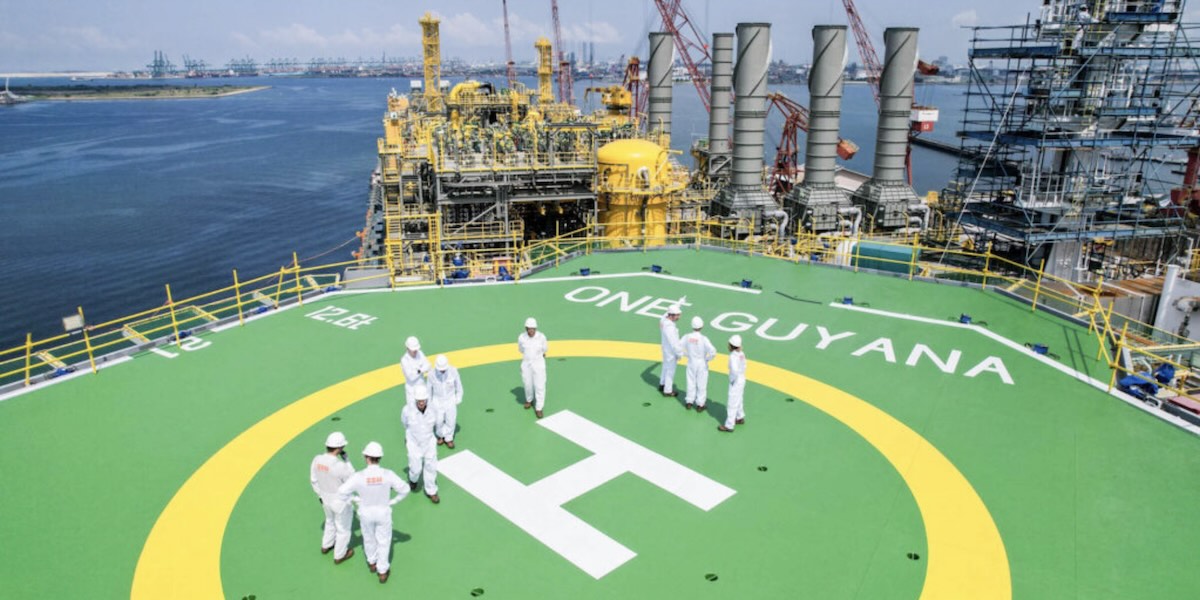
The One Guyana, a floating production, storage, and offloading essel used for ExxonMobil’s offshore oil project in Guyana’s Stabroek Block [ExxonMobil]
In 2015, a handful of drillers off the coast of Guyana struck oil, transforming a country that had spent most of its history among the poorest in the Americas into one that was suddenly sitting on a fortune. Significant oil production began in 2019, and by the end of 2023 Guyana was described here as a paradox: the fastest-growing economy in the world, yet a small nation of fewer than a million people that was now exposed to the well-known ‘resource curse’.[1] The author, Adam Mee, warned that the weak institutions, ethnic tensions within the small state and the dormant territorial dispute with Venezuela, which the oil boom had begun to revive, made the ‘resource curse’ probable, if not definite for the people of Guyana. Since then, almost 900,000 barrels of oil are produced per day,[2] and Guyana itself has become one of the world’s largest producers of it per capita.
Using Mee’s analysis as a starting point, it is necessary to reflect on the current situation that the curse has in fact created in the country. From deteriorating the democratic structure of the state, to weakening social cohesion and making Guyana more conflict prone and even leaving the economy exposed to the Dutch disease. Unlike Mee, however, it must be argued that the outcome of a possible overcoming of the curse remains conditioned on the institutions Guyana builds up to manage its oil and its production. One true question remains, will Guyana be able to overcome the curse, or is it already condemned?
The ‘rentier state theory’ is crucial to understanding the situation Guyana faces today. Mahdavy introduced the concept of the rentier state in 1970 to describe those countries which live off external rents, such as those of crude oil, rather than by taxation.[3] This theory seeks to explain how a country can become dependent on the income generated by its natural resources significantly shaping the relationship between the state and society. In oil-producing countries, petroleum is often referenced as ‘black gold’ because of its dark appearance and high economic value, representing a major source of these external revenues.
Beblawi and Luciani further developed this theory.[4] They argued that starters are characterized by three main features: rent plays a central role in the economy, the government is the primary recipient of this rent and only a relatively small proportion of the population is directly involved in generating it. As a result, the state becomes the main distributor of national wealth, creating a distinct political relationship in which governments rely less on citizens for revenue and consequently face weaker incentives to establish accountability and political representation leading to the possibility of governments to retain his revenues in order to maintain political stability and consolidate their power. It becomes the inverse relationship of no taxation without representation. This theory became central to debate about the consequences of natural resource dependency. Moreover, the ‘resource curse’ was used by Auty to describe said paradox whereby countries rich in natural resources tend to experience weaker economic growth than resource poor ones.[5]
Subsequent research was done by scholars like Collier and Hoeffler in order to expand the relationship between natural resources and conflict.[6] They argued that a dependence on primary commodity exports can increase the risk of civil wars, partly because valuable resources provide financial incentives and opportunities for armed groups. Later on, Ross explained how democratic institutions are weakened by oil wealth, highly contributing to political instability and conflict.[7] The case of the Co-operative Republic of Guyana is recent and complex. The small, yet highly diverse society of Indo-Guyanese, Afro-Guyanese, Indigenous peoples and mixed communities, holds politics that deeply reflect ethnic lines historically influencing party politics and electoral competition. This has made the topic of political power and public resources particularly sensitive, and now, with the discovery of crude oil, a new dimension has been added to the already existing tensions as the management and distribution of petroleum revenues have been increasingly important political questions.
Ross states that oil rents reduce the state’s need to tax and therefore its need to be accountable.[8] In this perspective Guyana shows several warning signs. After the elections of 2020, the results were not finalized for months because of the electoral irregularities and attempts to manipulate the vote count. The controversy eventually led to a national recount, following considerable pressure from international actors.[9] These elections proved the weakness in the democratic institutions of Guyana at a particularly significant moment, as control of the government increasingly meant control over the allocation and management of substantial future oil revenues, proving Beblawi and Luciani right when arguing that states become more consolidated in power when they are in charge of revenues and their allocation instead of being held accountable by the citizens. Mee further highlights a concern about the relationship between political parties and international oil companies, which highly contributes to the institutional vulnerabilities in the system.
More recently, the 2025 elections complicated the picture. The emergence of new parties like WIN did not only prove that the elections are now issue-politics since electoral campaigns are centered on how to distribute wealth. Even though the old ethnic two-party model has been declining, a dominant governing party, the PPP has gained strength since it now holds the largest resources and a fragmented opposition proving what the rentier theory predicts. These concerns are proven right by Guyana’s position in the Transparency International’s Corruption Index which as of 2025 held the 84th state with most corruption out of 180. Altogether, these political events raise significant questions about the transparency, accountability and more importantly the capacity of the Guyanese institutions when dealing with oil revenues. The key issue remains in the strengthening of these institutions in order to serve the wider population rather than becoming concentrated in the hands of political and economic elites.
Another of the consequences of the oil boom in Guyana has been the weakening of social cohesion and the rise in conflict. The more valuable the resource, the greater the incentive to fight over it. Domestically, the discovery of crude oil has significantly intensified the ethnic rivalry reducing the lack of social cohesion within the state. If each community, usually reflected in a party, acts out of fear that the other’s party will monopolize the oil revenues, politics becomes a zero-sum contest. According to PBS, these past elections proved how the general elections were a competition of the candidates for the control of the country’s oil.[10]
It is evident that the ethnic tensions have increased with the parties’ competition over the new ‘black gold’, fueling a serious conflict as well in other oil producers. Externally, a conflict that used to be dormant with Venezuela, has now gained relevance. Back in 1899, Venezuela accepted the arbitral award which established a boundary between them and the British Guiana at the time. However, in 1962, shortly after Guyana’s independence, Venezuela challenged the award’s validity before the United Nations, claiming that this demarcation had been fraudulent and erroneous. The 2015 discovery of major offshore oil reserves has significantly increased the economic and strategic importance in the dispute territory. Although the oil fields are offshore, their proximity to the Essequibo intensified the dispute.
In December 2023, Venezuela held a referendum in which voters rejected the ICJ’s jurisdiction and supported the creation of a new Venezuelan state, Guayana Esequiba, seeking to incorporate the disputed territory. Military tensions increased and the ICJ ordered Venezuela not to alter the existing situation, under which Guyana administers and controls the territory. Tensions continued in 2025, when Venezuela announced plans to hold elections in the region, and soon the ICJ ordered the country not to conduct or prepare such elections.[11] During the final hearings in May 2026, Venezuela again rejected the Court’s jurisdiction, while a final judgment remains pending. Once again, Ross’s argument regarding the relationship between oil wealth and conflict was illustrated. Even though the black gold didn’t originate the conflict, it raised the economic and geopolitical stakes involved, exposing Guyana not only to internal but bigger external pressures and security concerns.
The oil recently found has also had repercussions on the economic side. Guyana now holds an economy infected by the Dutch disease; when a booming resource sector draws labor and capital away from other sectors and at the same time pushes up the real exchange rate.[12] The agricultural and sugar sector were already declining before the discovery of crude oil, but this new sector, with its construction and service activity, by offering better-paid alternatives, simply reinforces the declining trend of the others.
The IMF reported that the real GDP grew 43.8% in 2024, with non-oil GDP growing only 13.7% and projected inflation of 4.1% in 2026, up from 2.9% in 2024.[13] As well, it made a warning in regard to overheating pressures, saying that if not contained, it would lead to higher inflation and a real exchange rate appreciation. Even though these are estimates, the deeper problem remains in dependence. The non-oil primary deficit is around 37% of non-oil GDP, so public spending relies heavily on oil revenues generating a vicious circle for those public officials who receive them and who have the power on how to allocate them, without the proper accountability mechanisms and institutions. This calls for a need for economic diversification.
The question that remains, therefore, is whether Guyana can escape the ‘resource curse’. One of the main safeguards against such is the Natural Resource Fund (NRF), established under the 2021 Natural Resource Fund Act with support from the World Bank. By the end of 2025, the fund had accumulated around 3.3 billion dollars, representing 12% of the GDP. Still, the effectiveness of this fund remains uncertain. The 2024 amendment to the NRF Act accelerated withdrawals to facilitate public investment, potentially supporting this development but simultaneously weakening the fund’s original saving function. The experiences of other oil producing countries offer important lessons. Norway’s case reflects the successful management of oil wealth through strong and accountable institutions that were prior to the discovery of crude oil. This case proves that institutional quality is one of the key factors in charge of determining whether resources become a blessing or a curse.[14]
In contrast, the case of Venezuela illustrates how an excessive dependence on oil revenues might encourage government centralization, although this outcome is not inevitable.[15] Indeed, Venezuela initially possessed institutions and conditions that suggested oil wealth could be able to support long-term prosperity. However, under President Hugo Chácez, the dismantling and weakening of liberal democratic institutions contributed to the deterioration of democratic accountability and economic stability. Similarly, Nigeria demonstrates how the competition for oil revenues, corruption and the unequal distribution of the resource wealth in an ethnically diverse state reinforces political instability and existing social divisions.[16] Both cases highlight the possible dangers of allowing governments to become excessively dependent on revenues and of having no mechanisms to keep them accountable. Guyana sits between these cases: even though it has a fund and a young democracy, it also has a contested contract, a polarized society and a hostile neighbor.
To conclude, the resource curse is already affecting the Cooperative Republic of Guyana. Democratic competition is increasingly shaped by the stakes controlling oil revenues, the Essequibo dispute has gained significant geopolitical relevance along the offshore development, and the economy is becoming increasingly dependent on a single commodity, exposing it to the risk of the Dutch disease. In this sense, Guyana can in fact be considered an emerging rentier state, yet not a fully consolidated one. Even though it doesn’t fit the traditional model, oil revenues are becoming central to the government’s financing, while the state’s dependence on taxation is diminishing gradually. Nevertheless, this outcome is not necessarily irreversible.
As the comparison to Norway demonstrates, the strengthening of institutions and the effective accountability mechanism can to a big extent prevent resource wealth from becoming a political and economic liability. Conversely, the case of Venezuela and Nigeria, by illustrating the consequences of a failed capacity to establish safeguards show Guyana which road to divert. Where Mee considered the resource curse probable, if not definite for the state, Guyana’s future remains conditional rather than predetermined.
Overall, escaping the curse does not depend on the quantity of oil extracted, but on the state’s ability to protect the Natural Resource Fund, ensure transparency in contractual matters, diversify its economy in order to not over rely on one sector, and strengthen democratic institutions. Guyana is therefore not yet condemned to the curse, but the decisions it makes by the day will determine whether its black gold becomes a blessing or a burden.
[1] Mee, A. (2023, December 11). ‘Guyana: From the oil boom to the risk of the resource curse’. Global Affairs and Strategic Studies, University of Navarra. https://en.unav.edu/en/web/global-affairs/guyana-del-boom-petrolero-al-riesgo-de-la-maldicion-de-los-recursos
[2] ExxonMobil. (2026, September 28). ‘One billion barrels: Guyana's remarkable journey continues’.https://corporate.exxonmobil.com/locations/guyana/guyana-newsroom/2026/one-billion-barrels-guyanas-remarkable-journey-continues
[3] Mahdavy, H. (1970). ‘The patterns and problems of economic development in rentier states: The case of Iran’. In M. A. Cook (Ed.), Studies in the economic history of the Middle East. Oxford University Press.
[4] Beblawi, H., & Luciani, G. (Eds.). (1987). The rentier state. Croom Helm.
[5] Auty, R. (1993). Sustaining development in mineral economies: The resource curse thesis. Routledge.
[6] Collier, P., & Hoeffler, A. (2004). ‘Greed and grievance in civil war’. Oxford Economic Papers, 56(4), 563–595.
[7] Ross, M. L. (2012). The oil curse. Princeton University Press.
[8] Ross, M. L. (2001). ‘Does oil hinder democracy?‘, World Politics, 53(3), 325–361.
[9] BBC News. (2020, March 6). ‘Guyana election: US concerned over 'electoral fraud'’. https://www.bbc.com/news/world-latin-america-51775111
[10] Wilkinson, B. (2025, September 1). ‘Guyana holds general election as candidates vie for control of country's oil’. PBS. https://www.pbs.org/newshour/world/guyana-holds-general-election-as-candidates-vie-for-control-of-countrys-oil
[11] International Court of Justice. (n.d.). Arbitral award of 3 October 1899 (Guyana v. Venezuela).https://www.icj-cij.org/case/171
[12] Corden, W. M., & Neary, J. P. (1982). ‘Booming sector and de-industrialisation in a small open economy’. The Economic Journal, 92(368), 825–848.
[13] International Monetary Fund. (2026, October 8). ‘IMF Executive Board concludes 2026 Article IV consultation with Guyana’. https://www.imf.org/en/news/articles/2026/10/08/pr26330-guyana-article-iv
[14] Mehlum, H., Moene, K., & Torvik, R. (2006). ‘Institutions and the resource curse’. The Economic Journal, 116(508), 1–20.
[15] Karl, T. L. (1997). The paradox of plenty: Oil booms and petro-states. University of California Press.
[16] Ross, M. L. (2015). ‘What have we learned about the resource curse?’ Annual Review of Political Science, 18, 239–259.