En la imagen
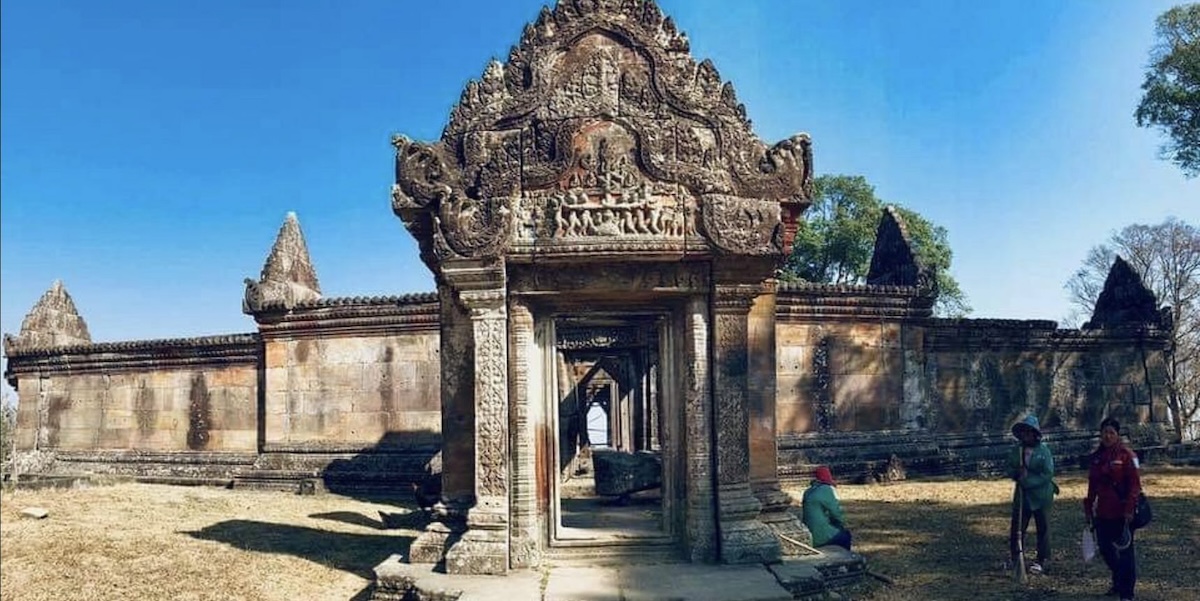
The Preah Vihear Temple [Tripadvisor]
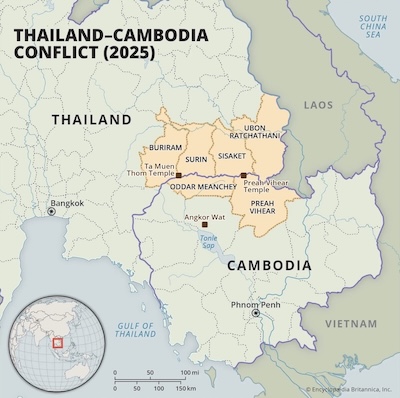
On 27 December 2025, Cambodia and Thailand agreed on a ceasefire, after four months of violence along the border, since a major military confrontation between the two countries took place on 24 July 2025. However, the situation remains fragile, as underlying tensions persist despite the absence of direct armed confrontation. Those tensions escalated on 6 January 2026, when Thai forces accused Cambodians of violating the ceasefire, after one of their soldiers was wounded in a mortar attack, which was later claimed to be caused by “an operational error by Cambodian personnel.” Despite the explanations provided by Cambodia, the Thai army warned their counterparts that in case of another error, “Thailand may be compelled to carry out defensive countermeasures.”
Origins of the dispute
The border dispute concerns sovereignty over the Preah Vihear Temple and its surrounding area. To conduct a proper analysis, it is necessary to return to its origins: sovereignty over the Temple has been controversial since the early 20th century, when France and Thailand, named Siam at that time, signed in 1904 the “Convention between France and Siam for the Regulation of Certain Difficulties,” which drew the frontier lines between Siam and French Cambodia based on the watershed between the basins of two rivers: the Nam San and the Nam Moun. The Preah Vihear Temple was situated within Siam’s boundary, and no other demarcation was established.
In March 1907, a second treaty was signed to exchange some territories between France and Siam. The treaty led to the establishment of a Franco-Siamese Mixed Commission for the delimitation. However, those in charge of the mapping of the territory were French officials, as the Siamese lacked sufficiently qualified personnel, and the map drawn in 1908 was never officially accepted by Siam. On this “Annex 1 Map,” the Preah Vihear Temple was located on Cambodian territory, and the French gave no explanations for that sudden change of the frontier line. Cambodia maintained this situation after its independence in 1953, leading to the adoption of different border maps by both countries.
In 1962, the ICJ ruled the Temple belonged to Cambodia, ordering the withdrawal of Thai forces and banning any military or police activity by Thailand that could infringe on Cambodia’s sovereignty over the Temple. The main argument invoked by the court was the tacit acceptance of the 1907 map by the Siamese Government and later the Thai Government: Siam used and published maps which show the location of the Temple in Cambodian territory, and neither during negotiations for the 1925 and 1937 Franco-Siamese Treaties, nor in Washington in 1947 before the Franco-Siamese Conciliation Commission did Siam raise the matter. Furthermore, Siam did not react when in 1930 Prince Damrong, on a visit to the Temple, was officially received by the French Resident for the adjoining Cambodian province. Only decades later, during its negotiations with Cambodia in Bangkok in 1958, did the Thai Government raise the issue of the Temple.
Although Thailand complied with the ICJ ruling, it erected a wire fence in July 1962, which separated the Temple from the surrounding area. The reason for this was that, due to the failure of the ICJ to rule on the boundary lines between the two countries, Thailand perceived that even though Cambodia owned the Temple, the surrounding area was under Thailand’s sovereignty.
The border dispute became less relevant after Vietnam invaded Cambodia in 1978. In the early 1990s, following Cambodia’s stabilization, both states agreed to manage the dispute through short, mid and long-term mechanisms: in the short-term, the two countries created the General Border Committee (GBC) and the Regional Border Committee (RBC), respectively led by defense ministers and military commanders, with the aim of containing conflicts but not resolving the dispute. In the long-term, Foreign Ministers of Thailand and Cambodia established a “Joint Boundary Commission” in a joint cabinet meeting in Siem Reap, Cambodia, in 1997, which carried out significant work in relocating boundary pillars, based on the boundary demarcations of the 1904 and 1907 Treaties and the Annex 1 Map. This mechanism was useful to build trust and confidence between the countries. Finally, as a mid-term mechanism, Thailand and Cambodia signed a “Framework Agreement on Economic Cooperation” in July 2001. Moreover, they created a shared development zone along the border, the “Crescent Opportunity,” a project which connected seven provinces of each country (including Preah Vihear Province), forming a circle of cooperation and mutual benefit from this area. Thanks to this initiative, Phnom Penh and Bangkok signed an agreement in March 2004 to renovate the Preah Vihear Temple, as a symbol of friendship.