
En la imagen
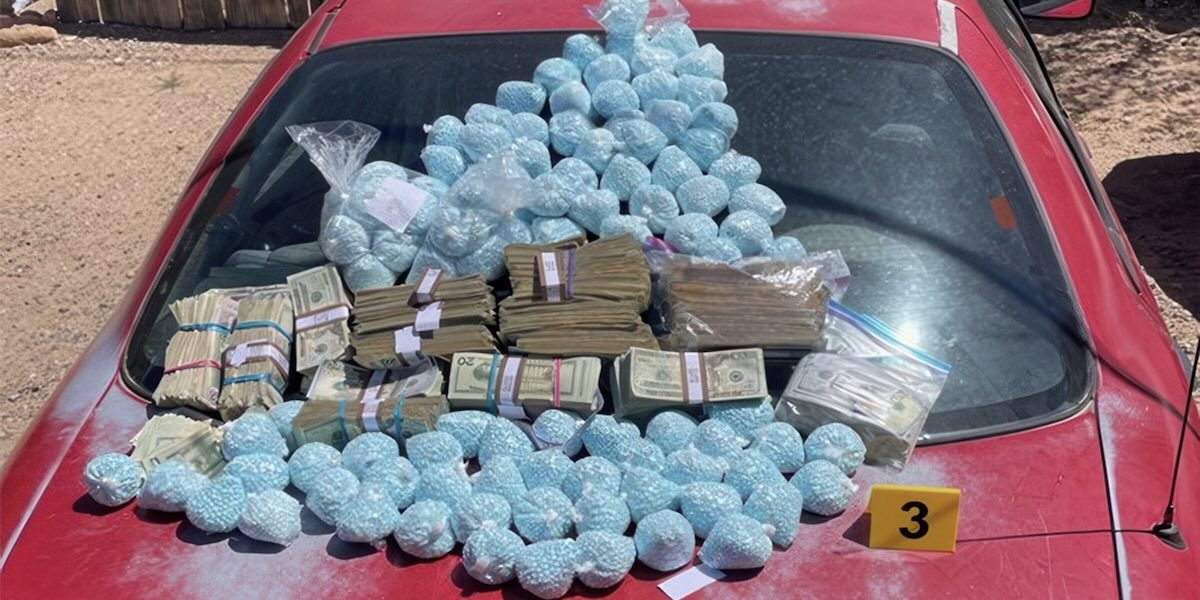
Cash and Drugs (fentanyl) seized in Santa Fe, New Mexico [DEA]
China’s relationship with Latin America is expanding beyond traditional trade and infrastructure investment. A significant, yet less visible, dimension has emerged: China’s indirect and directinvolvement in drug production and trade with Mexico. Chinese actors have supplied chemicals to produce fentanyl —responsible for thousands of deaths by overdose in the United States—, and the Chinse underground banking is supporting the fentanyl flow. Alleged efforts by Beijing to curb chemical trafficking have so far proved insufficient.
China has been portrayed as the spotlight of new technologies and investments, but it is also the origin of not-so-bright merchandise. Chinese actors have been involved indirectly and directly in the production of drugs and drug trade in Latin America, especially Mexico. They have contributed to the boom in the production of drugs by supplying deadly chemicals for the production of fentanyl, and have been involved in facilitating financial flows. Fentanyl is the illicit opioid that has lately been at the centre of attention.
In 2025, of the 73,690 deaths from overdose in the United States (January to November), 48,442 were caused by opioids. Since last autumn, 9,200 lb of fentanyl have been seized in the USA, and almost 96% of this was intercepted from the border with Mexico. The Sinaloa cartel plays a key role in the production of the drug, and the chemicals used to make it, and the pill press machines are sourced from China by traffickers and then turned into Fentanyl in Mexican laboratories before being smuggled into the US.
Adaptability of Chinese suppliers
In 2019, China classified fentanyl as a controlled narcotic and added some of the chemicals used to make it to China’s Supplementary List of Controlled Narcotic Drugs and Psychotropic Substances. Therefore, Chinese authorities started to put stricter controls over the fentanyl production, but even after this involvement at least 188 companies still produced precursors and pre-precursor chemicals used to make fentanyl. Thesecompanies were able to shift to new precursors not on the list and keep acting in the regulatory grey zones.
This suspicious economy relies on the adaptability of Chinese suppliers and the ingenuity of Latin American drug makers. Chinese suppliers are considered highly adaptable because they are able to keep the supply ofchemicals by exploiting loopholes in the regulatory fields.
Firstly, they are able to switch to precursors that are not yet regulated; one clear example is 4-AP and benzyfentanyl, which, in 2025, lack full international and uniform control. They have been addressed by organisations such as the United Nations, but a global consensus remains incomplete. Secondly, in China,law enforcement is divided into multiple fragmented agencies; this divide imposes a threat on the efficiency of law enforcement and makes it difficult to coordinate all of the decisions.
This fragmentation allows Chinese producers to exploit the loophole and always find new ways to traffic theillicit substances. The whole concept of adaptability lies in the constant innovation and adjustability that Chinese traffickers have; they are using chemicals that can be adapted to the production of fentanyl, but thatare not yet regulated, by lists such as the China’s Supplementary List of Controlled Narcotic Drugs and Psychotropic Substances, mentioned before.
Furthermore, the traffic routes that Chinese traffickers are using to ship the chemicals used for the production of fentanyl are being modified; they in fact began to flow from the Pacific ports in Mexico, instead of using thesouth-north traditional heroin corridors, they switched to a less regulated new west-east route towards the Gulf. Moreover, the collaboration with the Mexican cartels made the traffic of substances significantly easier; in collaboration with Chinese suppliers, they are able to conceal the chemicals in cargos that are supposed to be legitimate. For instance, in May 2023, chemical precursors were found inside 720 metal drums and seized at the port of Manzanillo.
Traffickers are able to engage in a ‘cat and mouse’ game with the regulators. They would adapt to everyaspect of the production, from the product itself to the shipping route, in order to get the chemicals to their destination.
Financial facilitation
Looking more into the involvement of China in the Mexican production, China is also involved in financialfacilitation, supporting the fentanyl trade. Chinese underground banking has been used to cover the production of the drug itself. The mechanism consists of US dollars getting exchanged through informal value transfer into Chinese yuan, an American broker in the US moves the cartel’s cash and provides the equivalentinto Chinese yuan, the exchange is mostly done through crypto or off-records methods. Moreover, theadvantage of this is that both parties stay off the grid by leaving the US dollars in the US and the yuan in China. Instead, accounts are set through trade-based money laundering (TBML) where the Chinese parties can purchase their chemicals with yuans and export them back into Latin America.
This system of money laundering is an advantage for both parties, that is because the Mexican cartels areable to reposition the illicit earnings and the Chinese ones are off the strict capital controls.
An excellent proof of the financial facilitation that Chinese underground networks give to fentanyl trafficking isthe indictment part of the ‘Operation Fortune Runner.’ In June of 2024, the US Justice Department announced a federal indictment against a criminal alliance between the Sinaloa cartel and money launderers linked to China. They were charged with 50 million dollars in drug proceeds that acted through California to send money to Chinese money exchanges. The scheme used to do it is the exact same as the money mirroring described before: US dollars were converted into Chinese yuan to buy the goods and chemicals for manufacturing the illicit drugs. It involved TBML and the use of crypto. This investigation is an example of how strong the influence of the Chinese market is on Mexico’s fentanyl production. It is an ongoing combat against Chinese traffickers who are able to evade rules and also facilitate financial flows by making themuntraceable and direct.
China’s two-faced policies
On the other hand, it is interesting to see how China deals with anti-drug policies in its own territory. In fact, when it is the case of Chinese anti-drugs regulations, it is known to be very strict, and to apply a zero-tolerance approach. But when it comes to exporting deadly chemicals, the regulators are normally vague and disorganised, allowing the Chinese traffickers to adapt.
China is actually very harsh when it comes to drug policies inside its borders. In 2017, China sentenced aColombian citizen to death for drug trafficking. The man had smuggled 4 kilograms of cocaine and wasimmediately detained in prison until the lethal injection. One may wonder where this ethical and strong legal approach is when it comes to the international drug trade in Mexico.
This is a paradox that could stem from simple selfishness or prioritising one's country's interest, but some argue, as some US policymakers believe, that Beijing could be using fentanyl as a weapon against the United States.