
En la imagen
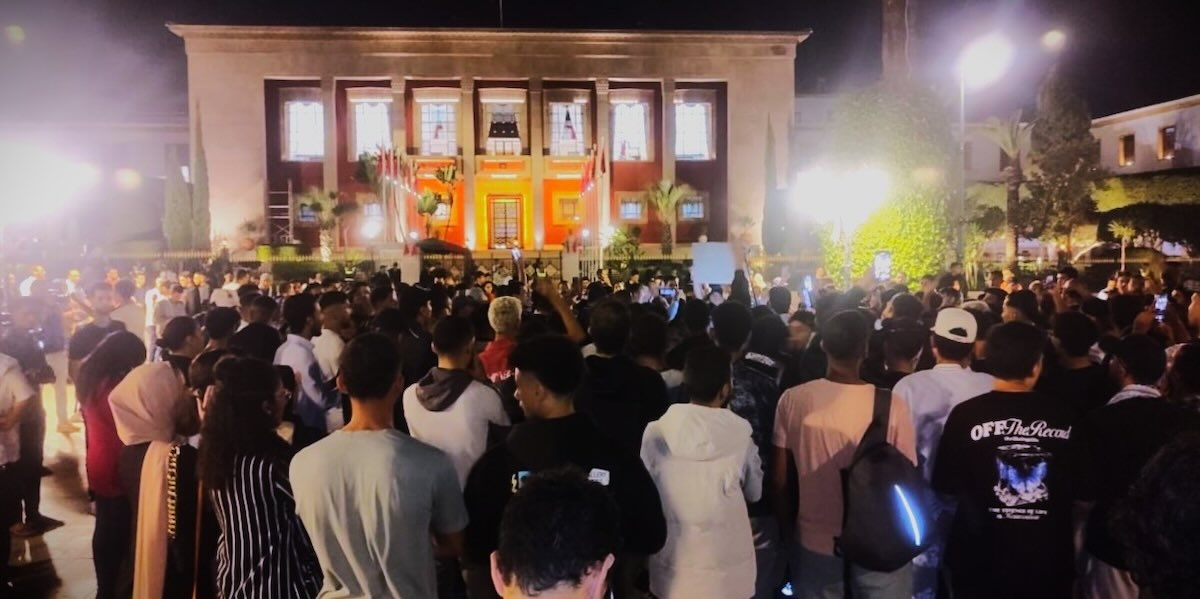
Protest in front of the Parliament in Rabat, in October 2025 [Mounir Neddi]
The figure of the king of Morocco has been historically respected by Moroccans, however recent protests risk damaging the king’s and the country’s reputation. Gen-Z 212 is a Moroccan grassroot movement founded by youngsters—in particular, university students and unemployed graduates of Generation Z—that was born in early September 2025 to protest against the Moroccan government. The movement, which took its name from Morocco’s international country dialing code (+212), was born as part of a wave of similar groups mushrooming in other parts of the world in a movement which peaked in October 2025 and died out in December of the same year.
All these youth entities emerged in different countries, some of which have been more successful than others, hold some shared views. In the first place, their members mostly belong to the so-called Generation Z, which encompasses the cohorts born between 1997 and 2012; hence, they are digital natives. Most of them, too, are students that have received secondary (high school) or higher education (university). This fact is particularly relevant because it attests, more than ever before, to the impact of educational institutions in shaping Gen-Zers’ mentality both towards democratic liberal ideals as towards expectations of the government observing the key principles in these ideals. Likewise, like most other similar movements, Gen-Z 212 was created online, mainly by students that coordinated anonymously through platforms like ‘Discord’.
Remarkably, the protestors managed to organize in a very efficient way without any leader or external actor influencing them; in fact, Gen-Z 212 was created as a horizontal movement. The grievances that drove them to protest were caused by a spiral of frustrations related to the low quality of public services, the high youth unemployment rate in Morocco and the disappointment with the rampant corruption of the government, besides the levels of poverty and inequality, especially in rural areas.
The trigger cause of the protests was the outrageous death of eight women due to the lack of medical assistance and medical materials following cesarean sections in a public hospital in Agadir during mid-September 2025. This was the last straw in the accumulated frustration. The main charge leveled against the government was that of allocating wrong priorities to public funds; the demonstrators demanded more attention to public services rather than to ambitious infrastructure projects, in particular the construction of the five new stadiums for the FIFA World Cup 2030 worth $20 billion.
The protestors demanded that Prime Minister Aziz Akhannouch was made accountable to King Mohammed VI who, under article 47 of the constitution, has the power to remove the head of government. Surprisingly, Gen-Z 212 actually had faith in the king’s support to their cause, even if they were aware of the illiberal regime that rules over the country, and demanded his support, which begs the question of why the protestors considered that King Mohammed VI was on their side.
In a different way than Spain and England, where the monarch has mainly ceremonial powers, in those countries it is not useful to appeal to this figure to resolve internal political issues, while in Morocco, the Monarch has an extensive political power. It is not surprising that generation Z appeals to him. It shows that the protest was not against the regime or the constitutional monarchy—at least not openly in order to try to prosper—, but against the bad management of the political affairs of the country.
Morocco operates nominally as a constitutional monarchy, but it is, in reality, an executive one led by King Mohammed VI, who is the Head of State. Remarkably, his legitimacy has two natures: traditional and legal-rational. The traditional legitimacy stems from the king’s role as the religious leader of Morocco—Commander of the Faithful is one of his titles—since the Alaouite dynasty founded in the 17th century, tracing back its origins to the Prophet himself (571-632).
Following the Arab Spring in 2011, however, the king was under pressure to amend the Constitution to give up and yield some of his powers to the government, which was approved by referendum. With this strategic political move, he asserted his legal control over the country. At the same time, he maintained his traditional, religious and cultural power.
The Makhzen is the shadow government that runs the country with the king; essentially, it is a network of co-optation composed by members of the army, landowners, the administrative elite, tax collectors and the court. It is the lobby behind the king; the Makhzen controls the economic apparatus of the state and influences the king’s decisions. In fact, the Makhzen holds more power than the elected officials, and indirectly controls foreign aid and mega-projects, among other things.
The king and the Makhzen reciprocally benefit from their relation because they need each other to govern; hence, the king backs the interests of the Makhzen to maintain his power and the Makhzen uses the king by using the personal cult around the monarch and his double traditional and legal legitimacy as king to defend their interests. King Mohammed VI has always been more secretive than the previous king Hassan II; he knows how to gauge his power and when to make concessions through reforms to appease the population while defending the interest of the Makhzen to assert his power.
To this day, King Mohammed is still regarded positively by the population because he made major reforms for women and has been tolerant with ethnic minorities. Hence, the protestors expected that he was going to be open to grant more reforms.
The personality cult built around the monarch still plays a key factor and is the reason why the king is largely accepted by the people as the legitimate ruler. At the beginning, it seemed that King Mohammed VI was going to address the protestors in the royal speech on October 10th, 2025. The rioters seemed to have faith in the king and think that he would have listened to their requests. However, the speech was a major delusion to their expectations since it omitted the riots and offered no concrete proposals or solutions to the issues moved forward by Gen-Z 212. Furthermore, in the following days, the police cracked down on the protests and arrested over 2.400 people.
The repression of the movement did certainly hurt the reputation of both the king and the country, whose image and economy have been tarnished by the protests. Nonetheless, Gen-Z 212 has not found much echo in Europe, and the Moroccan government is trying to sweep the protest under the carpet while international actors close an eye on the illiberal regime and keep up fostering their businesses using the momentum of Morocco’s economic boom. The 2025 Africa Cup of Nations went ahead in Morocco despite the protests and the government reaction.