
En la imagen
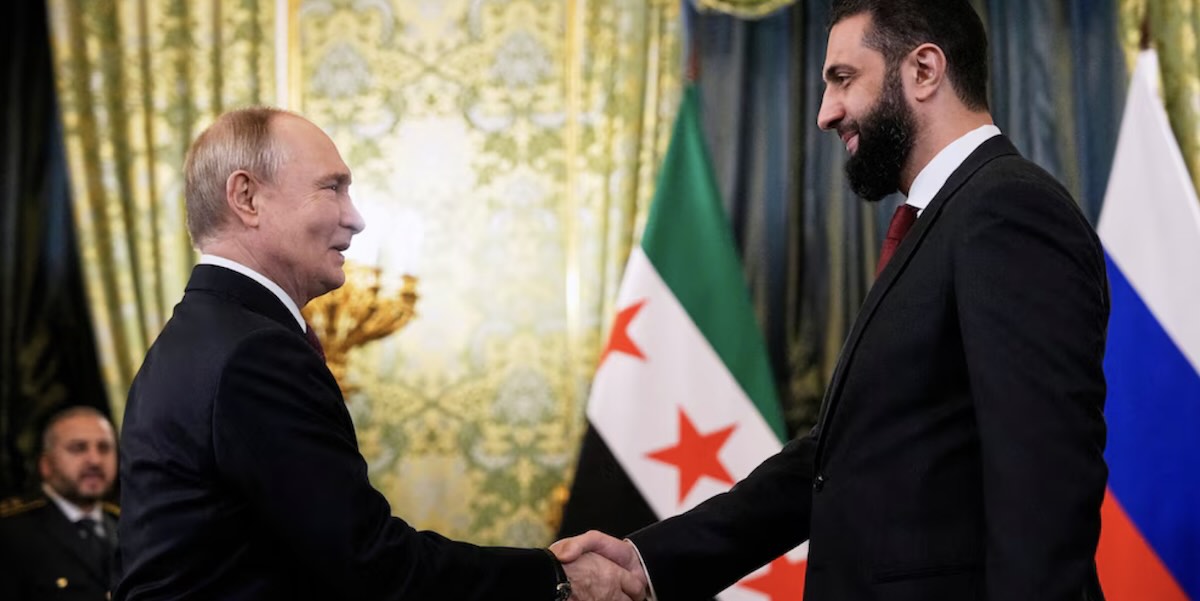
Putin meets Syrian President Sharaa in Moscow, October 15, 2025 [Kremlin]
For both experts and the public, perceptions of Russia are currently dominated by developments related to the war in Ukraine, which can be easily understood; however, this may narrow the analytical horizon leading to an attention asymmetry where other geopolitical shifts could receive far less consideration despite their significance. From a western perspective, Ahmed al-Sharaa's rise to power might appear less salient than the events in Ukraine, yet these developments are crucial for understanding regional goals particularly regarding Russia’s military bases in Syria.
Installations in Tartus and Hmeimim provide Moscow with a strategic foothold in the Eastern Mediterranean. Regime change in Damascus have turned unclear the prospects of those bases, whose significance remains unquestionable, as evidenced by the meeting in Moscow in early October, between President Vladimir Putin and Ahmed al-Sharaa. Russia’s influence, whether its fading or remaining unchanged, is likely to shape, not only the post-Assad Syria, but also the broader geopolitical dynamics of the region.
A key question concerns the geopolitical objectives that motivate Russia to maintain a military presence in a deeply divided and war-torn country like Syria. It can be argued that Moscow’s primary goal is to secure a position that allows it to exert influence in the region by maintaining proximity to the strategically vital Suez Canal. Another strategic interest lies in enabling the deployment and operation of military forces without the constraints of transiting the Bosphorus strait. It is equally important to notice that Russian geopolitical interest is likely not so much about achieving a far-reaching control over the eastern mediterranean region as about maintaining a foothold in the Middle East as well as possessing one key port in the warm waters of the region.
The continued existence of these military bases can also facilitate Russian operations in Africa which, because of the growing wave of anti-Western sentiment across several African states may provide Moscow with valuable new partners. By positioning itself as an alternative partner to the EU and supporting regimes that seek to distance themselves from Western powers, Russia can amplify its strategic presence. In this context, maintaining and expanding its military bases, and the execution of security operations become essential for advancing Moscow’s long-term geopolitical objectives on the continent.
Port of Tartus
After the second World War the Middle East became a key battleground between the Soviet Union and the United States. The interests of the former were multidimensional including economic military and ideological considerations. The Soviet Union sought to counterbalance US influence in the region by establishing military footholds. At the same time the colonial past and the anti-Western feelings offered the USSR a good opportunity to spread socialist ideology. Furthermore, as a competing nation with significant industrial capacities, the Soviet Union was in search of new partners providing energy resources to satisfy its growing energy demand.
This strategy, especially regarding the military, was pursued in Syra during the decades of the 1960s and 1970s, which led Moscow to increase the depth and intensity of its relationship with Hafez el-Assad’s Baathist regime in Damascus.
The port of Tartus is located on the Mediterranean Sea, roughly 25 kilometres north of the border between Lebanon and Syria and is classified as a full-service deep-water dual-use port servicing both commercial and military vessels. In 1971, an agreement was reached allowing soviet naval forces to use port facilities in Tartus. Some years after the opening of the base, in 1974, an agreement was reached allowing Soviet attack submarines and cargo ships to use the port facilities. In 1984, the base was updated to become the 720thmaterial-technical support point, in addition to station the 5th mediterranean squadron of the Soviet Naval Forces. After the collapse of the Soviet Union, Tartus remained a logistic hub for Russia’s various fleets and in 2017 a final agreement was reached providing for future use of the port; since then the presence of warships increased significantly and has been documented.
As to speak about the units deployed in the naval port of Tartus, it can be said that there are no continuously stationed units, though most of the time four or five warships including ‘Grigorovich’ and ‘Gorshkov’ class frigates as well as ‘Steregushchiy’ class corvettes, along with one or two ‘Kilo’ class submarines are docked in its piers.
The remarkable importance of Tartus can be approached from multiple perspectives. Examined from a geographic and historical point of view, the Montreux convention of 1936 must be mentioned to understand why the possession of the port in Tartus is so important for Moscow. This document in articles 20 and 21 enables Türkiye to close off its strait that connect the Mediterranean with the Black Sea in times of war or if there is an imminent danger of war. The possibility of having a well-functioning port outside the zone affected by the convention can help reduce the risk of the undesirable enclosure of the Russian Baltic Sea fleet to its shorelines. Should the undesirable situation arise, Moscow would lose its only warm-water port, which would severely undermine its ability to project power in the region and might result in significant loss of prestige, an outcome wholly unacceptable in times of war.
Moscow was quite close to this situation in the early days of December 2024, when Russia evacuated all the warships in the base in face of the behaviour of the new regime in Syria. This situation worsened in January2025 when the Tartus provincial government rescinded its contract with ‘Stroytransgaz’, the Kremlin directed Russian firm managing the naval facility’s development, a move that consolidated the lease’s termination. This was one of the key indicators prompting Vladimir Putin to convene a meeting with Syria’s new leadership, which has taken place recently after the government had relatively stabilized, and which will be addressed later.
Air base
Further extending its regional presence, Russia also operates, since 2015, the Hmeimim military air base, located approximately 25 kilometres southeast of the city of Latakia in western Syria. The base became a strategically influential location following Russia’s intervention in the then 4 year long civil war between Syrian anti-Assad revolutionary armed groups and the Syrian armed forces. Russian troops arrived in September that year with the official aim of combating international terrorism; however, from the outset, it became apparent that Moscow was primarily targeting anti-Assad rebel forces. Another commonly held view suggests that Russia’s military operations in Syria also served to divert the international attention from its annexation of Crimea in Ukraine.
The Hmeimim air base proved crucial for sustaining military operations, providing a viable alternative to maritime supply routes through Tartus for transporting equipment, weapons, and personnel. By the start of Russia’s engagement, its aviation group basing in Hmeimim included frontline bombers, ground attack aircraft, and intelligence planes, complemented by attack and transport helicopters. To ensure effective coordination with Syrian forces, a dedicated coordination centre was established within the base.
While Hmeimim remains the main hub for Russian air operations, various reports in Syria from the last summer pointed to the possibility that Moscow is looking for a third foothold at Qamishli airport, located 3-5 kilometres from the Turkish border in northern Syria. As of now, it is not clear whether this development points toward the depreciation of the Hmeimim base or to the diversification of its military capacity and the establishment of a new military facility to operate in parallel with the other two. This location has been known for Russia since 2016 as it was then used primarily for joint patrols with Türkiye. It is also worth mentioning that these Russian deployments were happening simultaneously with the significant US withdrawal from the eastern Euphrates region, handing over military bases (Mission Support Site ‘Green Village’, Mission Support Sites ‘Euphrates’ and ‘H2’) to Syrian defence forces which from a geopolitical point of view can hardly be called a coincidence.
Pragmatic rapprochement
The meeting that took place in Moscow on the 15th of October between the president of the Russian Federation Vladimir Putin and the freshly elected Syrian president Ahmed Al-Sharaa exemplifies the way political decision-making operates strictly in accordance with geopolitical calculations. Given Moscow’s prolonged efforts to sustain and shield the former regime from collapse, the meeting can be interpreted as significant first step and notable gain in the diplomatic sphere for Damascus.
Although the negotiations did not explicitly address the issue of the military bases, their strategic significance remains unequivocal. A diminution of Moscow's influence in the Middle East would not only entail a tangible loss of leverage but also a profound symbolic setback. Such an outcome in which, in a geopolitical environment like the Middle East, even the slightest manifestation invites contestation, could further embolden European and American policymakers to promote and support a Syria more autonomous and freer from Russian influence- thereby jeopardizing the long-term permanence of Russia’s military presence in the country.
From a Syrian point of view, probably the most essential goal is the diversification of its foreign relations. The country has a long-lasting history of being included in various UN sanction lists for different reasons. Moscow’s seat in the security council as a permanent member can be beneficial if a good working relation is maintained between the countries. Shaara has a good working relationship with the US and with Europe as well, but this can change. As Aron Lund put it, Shaara and Putin are “ruthless pragmatists” able to hide their differences well; they don’t trust each other but are able to shake hands and smile if it is needed. To summarize it, both countries can benefit from maintaining good diplomatic relations. Putin could preserve its foothold in Syria including its military bases while Shaara could count on Russia to accept its removal from UN terrorism sanction list, not to mention to receive oil and wheat to its ports.
Russia is probably in one of its most critical periods of its history; therefore, every decision it makes carries significantly more weight. This assumption can be applied to its future in the Eastern Mediterranean. Having footholds in Syria has always been and will most probably continue to be an important interest which will influence all of Russia’s operations and engagement in the region. Though the situation in the December of 2024 is likely to have given Putin some sleepless nights, the aspirations of the new regime appear broadly similar to those of Russia and point toward a calmer diplomatic dialogue which, though accompanied by somewhat less permissive arrangements, remains fundamentally consistent in substance.