
En la imagen
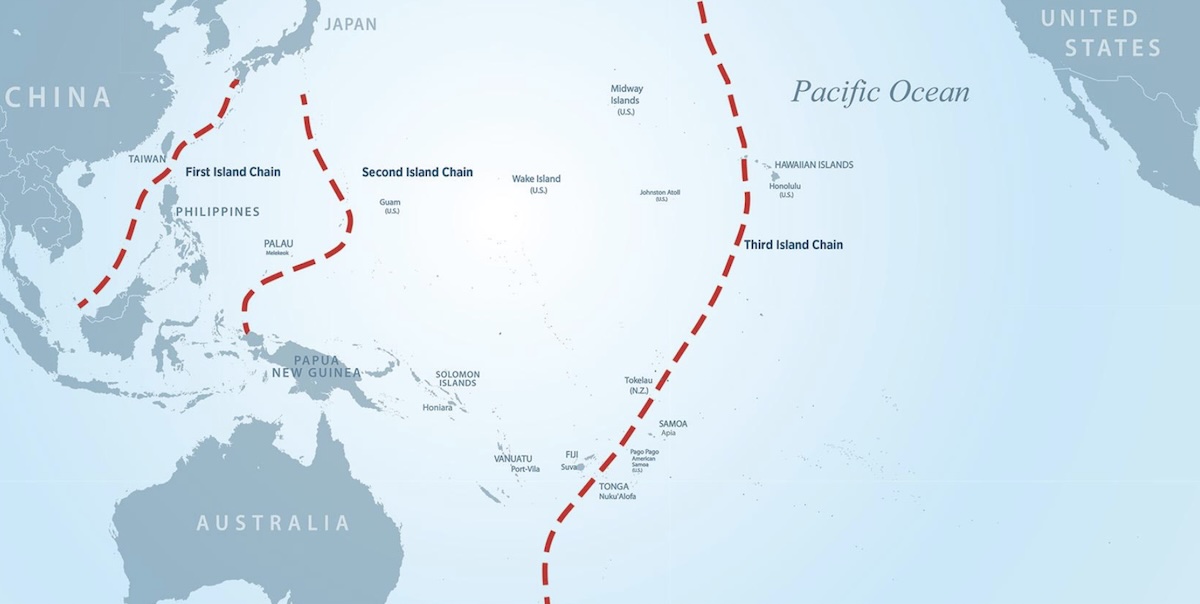
First, Second, and Third Island Chain [US Naval Institute]
China’s dual use of infrastructures in the Pacific provides the People’s Liberation Army Navy (PLAN) with a clear strategic advantage in the region, directly challenging the US and its allies, bringing it closer to the goal of becoming a regional hegemonic power. Even though projects such as the BRI can be apparently economically driven, strategic aims outweigh economic ones and serve as undercover infrastructures strengthening the PLAN’s power projection towards the Third Island Chain. As the People’s Republic of China (PRC) has stated in its 2025 white paper, the maritime realm is not anymore just a matter of national security and preservation of sovereignty but a matter of power projection driving economic growth and regional influence.
China has called for closer cooperation with Asia-Pacific countries in order to counteract the rise of unilateralism and protectionism which are undermining the functioning of the multilateral trade system. Beijing attributes the growing instability in the Asia-Pacific to US alliances and the increased mini-lateral security groupings such as the Quad and AUKUS. Through its growing presence in the region, China aspires to contest the existing maritime order and status quo that has maintained stability for several decades so that it can dominate through its dual use facilities. For the US and its allies, this is not merely about countering China but about defending the free, open and rules-based maritime order in the Asia-Pacific region.
This article explores China’s use of dual-use infrastructure in the maritime domain and the strategic implications such practice could have for the general balance in the Indo-Pacific region.
China’s maritime power projection beyond the South China Sea
It is important to bear in mind that the PRC is not building itself into a naval power, but into maritime power. As Xi Jinping stated, “Building a strong People’s Navy, entrusted with the long-standing aspirations of the Chinese nation to become a maritime power, is an important guarantee for the great rejuvenation of the Chinese nation.”
From the PRC's perspective, the First Island Chain is a constraint around the South and East China seas that restricts access to the Pacific and threatens the strategic ambitions that China aims to achieve, positioning maritime power as a top priority in its national agenda. As a consequence of controlling the seas beyond the chain, it claims that it can defend the country from foreign attack and intervention through those waters that have been historically used precisely to do that.
Over the past years, the PLAN has started carrying out operations expanding its influence over the Second Island Chain posing an undeniable threat to the pacific region which links Japan to Papua New Guinea and includes Guam and other US islands territories in the Marianas. In June 2025, the PLAN released photos of their two aircraft carriers Liaoning and Shandong navigating for the first time beyond the First Island Chain. Aircraft carriers are an important tool to help the PLAN by exercising power projection and expanding its regional influence beyond adjacent waters.
China’s era of isolation, when it was content with just defending its national security and preserving its sovereignty is clearly over; expanding its regional influence is core in its agenda. As stated back in 2004:
“In this new century, the ‘domain’ of China’s national interests in the maritime direction must continuously expand and extend from the waters of the near seas to the waters of the far seas… Inevitably, the substance of China’s naval strategy for the new century will gradually evolve from ‘Near Seas Defense’ to ‘Far Seas Protection.’”
Undoubtedly, the expansion of the PLAN constitutes a continuing threat to the post-Cold War order which aims to reshape the balance of power.
The nature of the dual use of infrastructures
China’s substantial presence across the Pacific islands through the development of dual-use infrastructures that besides serving as civilian assets, are able to provide military objectives and reinforce the PLAN’s power projection is threatening the status quo. The development projects such as the BRI are heavily influenced by Beijing’s hegemonic ambitions and strategic goals in the region. In other words, China is weaponizing these infrastructures aware of the increasing geopolitical significance of the region.
To justify and carry on with these kinds of development projects, portrayed in the 2025 white paper, the PRC aims among other factors, even without explicitly naming it, to accuse the US of the growing instability in the region. This instability has been accelerated through “the expansion of military alliances,” “the intervention of extraterritorial forces,” and the “proliferation of mini-lateral security groups” such as the Quad and AUKUS.
Nevertheless, China’s development projects are supported by state owned enterprises, which by law are required to collaborate with the PRC such as COSCO which controls ports all over the world. Above all else, China is driven by the expansion of its strategic and geopolitical influence beyond the First Island Chain, which is considered a constraint to its military purposes in the region. Dual-use facilities enhance the PLA’s overseas operational reach and move Chinese strategic interests closer. A clear example is the militarization of the Spratly and Paracel Islands, where it has deployed anti-ship and anti-aircraft missile systems and fighter jets among other things.
The control of ports, airports and information and telecommunications technologies over the Pacific empowers China’s ability to drive away traditional US allies from countering its regional expansion and shift in the balance of power. For instance, a well-known Chinese multinational technology company like Huawei has had a relevant role in Vanuatu for ICT projects.
Strategic implications in the region
Reshaping the balance of power that has prevailed in the region for decades and challenging US-led alliances has significant implications for the maintenance of the security in the international order. China’s strategic ambitions are centered on becoming a regional hegemonic power, expanding its influence beyond the First Island Chain toward the Second and Third Island Chain.
Through the establishment of dual-use infrastructures, China enhances its operational capabilities with a view towards a potential conflict for Taiwan and reduces the dominant position that the US and its regional partners have enjoyed for decades. This way, countries like Japan, South Korea, Australia and the Philippines might be forced to reconsider their partnerships with the US and opt to shift the regional balance of power in China’s favour.
Beijing’s hegemonic ambitions pose a continuing threat to the existing maritime order in which Taiwan may be the first injured party in Beijing’s quest to break the First Island Chain and increase its military presence beyond. Breaching the First and the Second Island chain is considered a key element in order to become a strong maritime power able to challenge the US' position. It is forging the ideal combination of hard power and dual-use infrastructures which grants the PLAN the capability to alter the balance of power and reshape the regional order.