
En la imagen
Concentration of people in Paulista Avenue, Sao Paulo [alexramos10]
For decades, Brazil’s geopolitical relevance rested upon a structural advantage few states in the Global South possessed: demographic scale. With more than 200 million inhabitants, vast territorial depth, and a relatively young population, Brazil emerged as a regional giant whose influence extended far beyond Latin America. Its demographic weight sustained economic expansion, reinforced its strategic autonomy, and fueled persistent ambitions of global leadership. However, the foundations of that exceptionalism are beginning to erode. The demographic advantage that once distinguished Brazil as South America’s dominant regional power is gradually disappearing, raising critical questions about the country’s long term economic dynamism, geopolitical influence, and strategic relevance within the emerging multipolar order.
Brazil is entering a demographic transition that could fundamentally reshape its geopolitical position during the 21st century. Fertility rates have fallen well below replacement level, population aging is accelerating, and projections indicate that Brazil will eventually begin to shrink demographically within the coming decades. With a population today of around 212 million people, Brazil will start losing population by 2041, according to Brazilian Institute of Geography and Statistics (IBGE) projections.
While declining birth rates characterize much of the developed world, the Brazilian case carries particular strategic significance because population growth was never merely a domestic phenomenon: it formed part of the country’s international projection of power. Besides, as a founding member of BRICS, Brazil’s population contributes to the alliance’s representation of more than half of the world’s population, strengthening its challenge to the geopolitical and economic dominance traditionally exercised by Global North powers.
Brazil’s demographic dividend is fading rapidly as fertility rates decline to approximately 1.5 to 1.6 children per woman and the population ages at an accelerated pace. Unlike advanced economies that experienced demographic aging gradually over several generations, Brazil is compressing this transition into a significantly shorter timeframe. Driven by rapid urbanization, changing family structures, and increased female participation in the labor force, the country’s age pyramid is shifting dramatically, with elderly Brazilians now representing an increasingly substantial proportion of the population.
Economic consequences
The consequences extend far beyond demographics alone. As fertility rates decline and the proportion of elderly citizens rises, Brazil’s working age population is expected to grow at a significantly slower pace in the coming decades relative to many other Global South countries. This transition will increase dependency ratios(that is, the proportion of economically non-working dependents to the working age population) and intensify pressure on labor markets and public finances. In economic terms, slower labor force growth may reduce Brazil’s long term growth potential at a moment when the country continues to face structural challenges related to productivity, inequality, and fiscal sustainability.
Brazil’s demographic trajectory increasingly resembles that of late stage industrialized societies. Having moved rapidly through the demographic transition that characterized much of Latin America during the late twentieth century, the country is now approaching a stage defined by low fertility, population aging, and a progressively narrower working age base. Unlike many advanced economies, however, Brazil is confronting this transition before achieving comparable levels of wealth, productivity, or institutional resilience.
This contrast is especially visible when compared to Sub Saharan Africa, where several states remain in earlier phases of demographic expansion characterized by high fertility rates and rapidly growing populations. While Brazil’s demographic momentum slows, countries such as Nigeria and the Democratic Republic of Congo are projected to continue expanding throughout the century, gradually shifting the demographic center of gravity of the Global South away from Latin America and toward Africa.
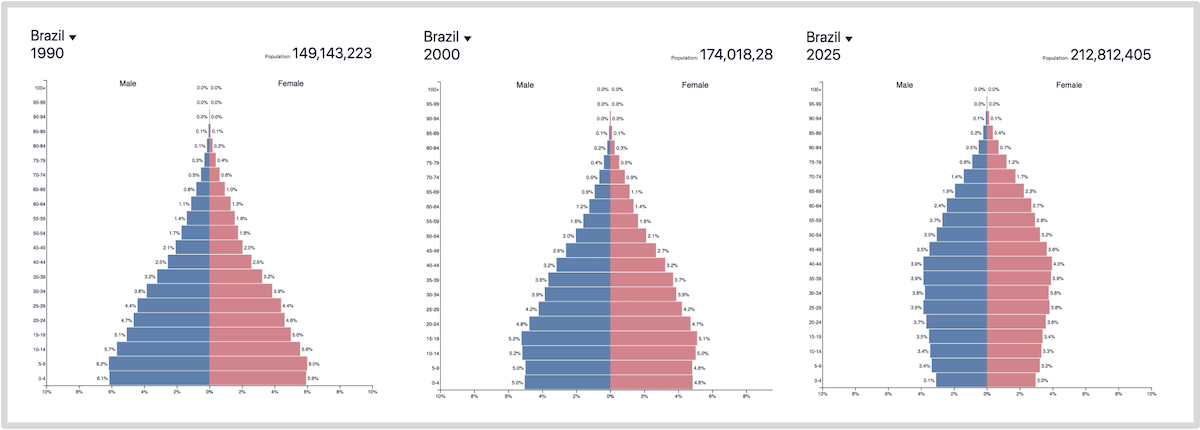
Brazil’s population pyramid no longer resembles that of a rapidly expanding emerging economy. Rather than displaying the broad base traditionally associated with high birth rates and demographic expansion, the country’s age structure is becoming increasingly constrictive. The narrowing younger cohorts reflect Brazil’s sharp decline in fertility rates, while the concentration of the population within middle-age groups reveals a society undergoing accelerated demographic aging. Although Brazil still benefits from a relatively large working age population, these cohorts will progressively move into retirement over the coming decades, increasing dependency ratios and intensifying pressure on healthcare and pension systems. At the same time, smaller younger generations indicate that future labor force growth will slow considerably, potentially constraining long term economic dynamism. In demographic terms, Brazil increasingly resembles late stage industrialized societies, despite lacking the productivity levels and institutional wealth traditionally associated with advanced aging economies.
To visually understand how the country’s population has inverted over time, population pyramids are the best way to understand this phenomenon. For this reason, population pyramids from 1980, 1990, 2000, 2010, and 2025 have been utilized to reflect upon Brazil’s population decline which translates into so many other implications which truly affects Brasilia’s global projection.
Losing a leading role in the Global South
This demographic transformation also complicates Brazil’s traditional identity as a rising emerging power. While the country continues to position itself as a leading voice of the Global South and a challenger to the economic dominance of advanced Western economies, its demographic trajectory increasingly resembles that of aging industrialized societies. Brazil may therefore face the paradox of confronting the structural burdens of developed nations before achieving comparable levels of wealth, productivity, or institutional capacity.
At the same time, Brazil faces mounting fiscal pressures associated with aging before fully developing. International Monetary Fund analyses warn that rising old age dependency ratios are likely to intensify pressure on public finances, particularly through increased healthcare and pension expenditures. Unlike wealthier industrialized nations that accumulated high levels of productivity and institutional wealth prior to demographic aging, Brazil confronts this transition while still struggling with structural inequalities, fiscal instability, and comparatively lower productivity growth. As a result, demographic aging may force increasingly difficult political and economic tradeoffs in the coming decades.
Weight within Latin America
The geopolitical implications may prove even more significant. Brazil’s regional influence has historically depended not only on territory and natural resources, but also on demographic asymmetry within Latin America. All the region is entering a ‘demographic winter’, but unlike Argentina or Chile, other influential regional actors with comparatively smaller populations and more limited internal markets, Brazil’s scale allowed it to project itself simultaneously as a continental power, an emerging economy, and a representative of the broader Global South. Yet as its labor force contracts and population growth slows, Brazil may increasingly struggle to preserve the structural advantages that once sustained its image as the unquestioned hegemonic power in South America. Maintaining relevance within an increasingly multipolar international order will likely require Brazil to compensate for demographic decline through productivity growth, educational reform, technological innovation, and deeper integration into high value global supply chains.
For much of the twentieth and early twenty-first centuries, Brazil’s demographic scale distinguished it from the rest of Latin America and reinforced the perception that it was destined to become a major global power. No neighboring country combined comparable territorial depth, population size, and economic potential. This demographic asymmetry allowed Brazil to project influence beyond its immediate region and cultivate the image of a ‘country of the future.’ Yet demographic decline threatens to erode precisely the factor that made Brazil strategically exceptional within the Global South. As younger and faster-growing societies emerge elsewhere particularly in Africa Brazil may increasingly find itself competing in a world where its population no longer guarantees geopolitical singularity.
This transformation matters because demography remains deeply connected to geopolitical influence. Population size affects labor availability, consumer markets, military recruitment potential, and long-term economic dynamism. As Africa rises demographically, Brazil may increasingly lose the uniqueness that once distinguished it among emerging powers.