
En la imagen
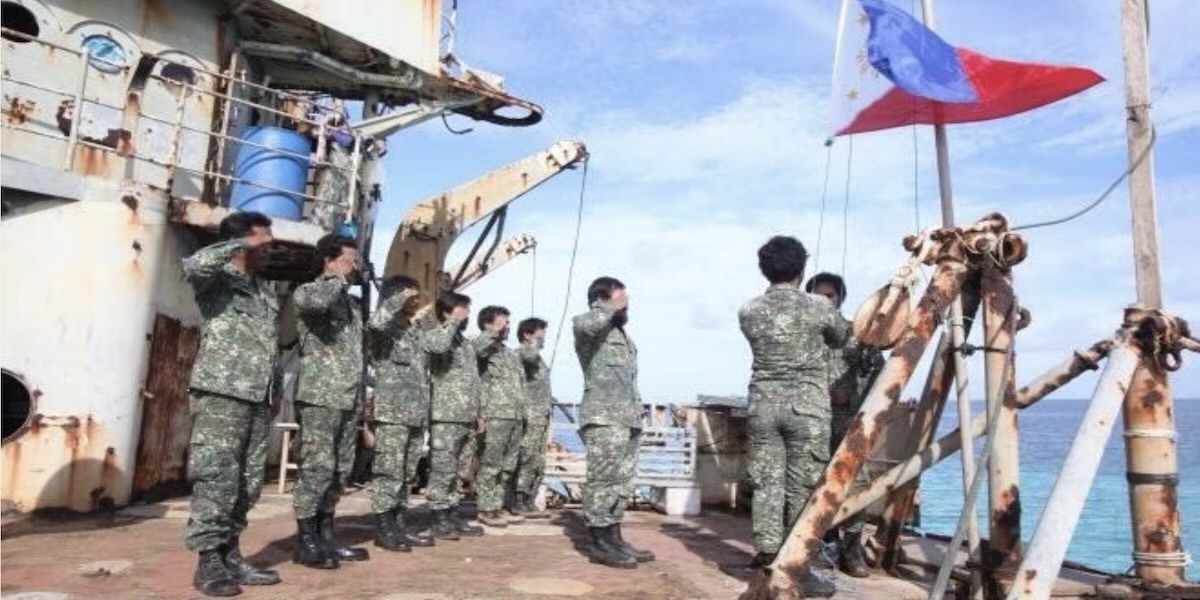
Troops on board of BRP Sierra Madre raising the Philippine flag [Armed Forces of the Philippines]
In July 2016, the Permanent Court of Arbitration in The Hague ruled against the People’s Republic of China claims of having historical rights—signalized by the so called ‘9-dashed line’—over waters disputed with The Philippines in the South China Sea. Beijing didn't accepted the international ruling and has kept its assertive presence in the controversial sea intensifying its harassment against Philippines’ troups and fishermen. Ten years after the ruling, what is the Manila’s stance and what support it gets from its allies?
On the 22nd of January 2013, the Republic of the Philippines instituted an arbitrational proceeding against the People’s Republic of China concerning its use of ‘historical rights’ as a source for maritime entitlement. Specifically, it challenged China’s 9-dashed line, the status of certain maritime features in the region, and the lawfulness of specific Chinese actions that allegedly violated the UN Convention on the Law of the Sea (UNCLOS). The proceeding persisted for three and half years, and records of the case contain a vast collection of legal memos, expert reports on environmental safety, and procedural orders, all culminating in the final award issued on the 12th of July, 2016.
The Permanent Court of Arbitration’s (PCA) monumental ruling formally dismissed China’s expansive claims to much of the South China Sea, and concluded that there was no evidence that China had historically exercised exclusive control over the waterway. In other words, the 9-Dashed Line was effectively delegitimated and overruled. Now, ten years later, how has this all played out? How did the political international system react to this ruling, and in what ways has this issue evolved since?
What is at stake
A key element, and a good place to start, is to look at what is at stake in this issue. Control of this waterway entails key access to the Strait of Malacca, a chokepoint through which nearly 40% of global trade and 80% of China’s oil imports pass through. The maritime region also contains an estimated 190 trillion cubic feet of natural gas and 11 billion barrels of oil—resources that could be key for Philippine energy security as the Malampaya gas field depletes. Furthermore, among Philippine fishermen and environmental conservation experts, Chinese ships are infamously known for exploiting the rich marine life and coral reefs that also inhabit the area.
The sea is roughly the size of India and has hundreds of islands and islets. It has some of the highest marine biodiversity on earth, with 571 known species of reef corals which are crucial to the fishing economies of adjacent countries. Chinese giant clam harvesting and construction of artificial islands are some of the ways in which the destruction and exploitation is carried out. All things considered, it is no surprise that both global and regional powers are eager to gain influence over the area, even if it means disregarding international law.
Reaction from Beijing and Manila
In light of this, a key factor in this dispute is the stance China held in the years in which the PCA proceeding was active. Throughout the three and a half years, China adopted a “position of non-acceptance and non-participation in the proceedings,” refusing to cooperate and recognize the authority of the Court. This was the first problem. The ‘Global Times,’ a Chinese daily tabloid under the state-run ‘People’s Daily,’ noted that the decision was “null and void,” publishing a series of articles claiming the tribunal’s incompetence, iterating that the ruling is illegal, and noting how the country even saw a rise of patriotism following it. The Communist Party of China (CPC), of course, aligned with this rhetoric, with President Xi Jinping stating that “China's territorial sovereignty and maritime interests in the South China Sea, under any circumstances will not be affected by the award.”
Further fueling this fire, former Philippine President Rodrigo Duterte—known for his ‘war on drugs’ and friendliness with China—was just beginning his term at the time, and expressed his reluctance to use the ruling, infamously dismissing it as “scrap paper.” The reasoning was based on the belief that good relations with China would bring in economic benefits and that confronting Beijing will lead to repercussions. Critics both at home and abroad have questioned this approach, pointing out how promised Chinese investments in the Philippines never materialised, and how the country, at the same time, saw an increase in governmental corruption under Duterte’s administration. It is as if Philippine maritime sovereignty was traded away for a private gain. Under current president Marcos Jr., corruption continues to burden the country, with hundreds of billions of Philippine pesos lost every year as a consequence of it.
Disputed area
Returning to the key issue, the aftermath of the 2016 PCA ruling saw an increase in Chinese presence in the disputed area. What was formerly labeled as ‘visits’ or ‘harassments’ from Chinese ships evolved into a permanent and integrated opposing force. Chinese vessels include a mix of People’s Liberation Army Navy (PLAN) warships, China Coast Guard (CCG) vessels, and maritime militia (armed fishing vessels) that are strategically spread throughout the key reefs, islands, and passage points throughout the maritime area. As of March 2026, over 60 Chinese PLAN and CCG warships are present in the West Philippine Sea, accompanied by some 241 maritime militia vessels labeled as the ‘Spratly Backbone Fishing Fleet.’
The geographical location of the key reefs and islands in dispute favour Manila. For instance, the Mischief Reef is 129 nautical miles (239 km) from the Philippine region of Palawan while about 600 nautical miles (1,111 km) from the closest Chinese shores in Hainan. Similarly, the Scarborough Shoal sits 124 nautical miles (230 km) from the Philippine province of Zambales and 472 nautical miles (874 km) from mainland China. Important to keep in mind when assessing such figures is Article 57 (20) of the UNCLOS, stating that a nation’s “exclusive economic zone [EEZ] shall not extend beyond 200 nautical miles” (~370 kilometers) from the baselines from which the breadth of the territorial sea is measured, in other words, its shores. According to international law then, these islands at stake are well within the Philippines’ EEZ, and in theory, would even extend it by the extra 200 nautical miles that Article 57 calls for. Figures like these are what establish the contestability of the 9-dashed line, and although it was ‘erased’ from legal paper, it continues to be solidified by ships at sea.
‘Grey zone’ tactics
To assert itself in the area, China uses ‘grey zone’ tactics: actions that are aggressive enough to seize territory, yet calculated to stay just below the threshold of actual wartime tactics. This includes the intentional ramming ships or the use of water cannons on Philippine fishing or navy vessels. The increasing presence of Chinese vessels poses the risk of the normalization of such skirmishes in the area—the possibility that the international community will quietly accept these dangerous encounters as standard tools of statecraft. This, of course, threatens the safety of fishermen and maritime workers, Philippine sovereignty, and the rules-based international system.
An epicenter of these ‘grey zone’ tactics is Second Thomas Shoal, known as ‘Ayungin Shoal’ by locals. It is located roughly 105 nautical miles (~190 km) west from the Philippine province of Palawan and is a key point of contention due to the BRP Sierra Madre. What was once a US battleship in both the Second World War and Vietnam War, was integrated into the Philippine navy after it transferred roughly 3,000 refugees from Vietnam to the Philippines in 1975. Today, though rusting away, the BRP Sierra Madre is permanently grounded in Second Thomas Shoal, stationed as a peculiar base from which the Philippines aims to protect its maritime sovereignty in the face of supply vessel harassments and interceptions, and intentional ship ramming.
Current Philippine administration
Contrary to former President Rodrigo Duterte’s rather docile approach to the issue, current President Ferdinand Marcos Jr. has adopted a more direct and assertive strategy known as the ‘Assertive Transparency Initiative.’ It is an information campaign that calls for the publication of videos and images to expose Chinese ‘grey zone’ tactics and false narratives, debunking disinformation to more clearly display the severity of the situation to the world. This assertive stance coincides with the Philippines’ 2026 ASEAN Chairmanship, where Manila has placed the finalization of a legally binding Code of Conduct (COC) at the top of the regional agenda, aiming to establish clear rules of maritime engagement in the area.
At sea, the Philippines has also engaged in Multilateral Maritime Cooperative Activities with US and Japanese forces. These joint patrols and exercises also involve Australia and most recently Canada, to serve as a concrete solidifier of the Philippines’ determination to maintain a presence in its own Exclusive Economic Zone. Conducting these operations with high-profile allies is a way to showcase that the 2016 PCA ruling is backed by key players in the international system, and although the Marcos administration is taking a step in the right direction, the persistent Chinese determination to dominate the region suggests that this is only the beginning of a long lasting struggle for actual maritime control.
It must also be considered that with both escalating tensions and the increasingly frequent use of grey zone tactics, the dangerous possibility of a future miscalculation continues to grow. For instance, if a future Chinese ship ramming or water cannon harassment is miscalculated and results in the death of a Filipino serviceman or Navy officer, the 1951 US-Philippine Mutual Defence Treaty could be triggered. Without a doubt, this would result in an immense escalation of the issue—possibly bringing the three countries to war, with enormous international consequences given their vast influence over world politics.
The next decade ahead
Ten years after the PCA ruling, the South China Sea dispute is evidently persistent as a focal point of international tensions and debate. While the Marcos administration’s ‘Assertive Transparency’ and strengthened alliances have continued to internationalize the issue, the burden of maintaining a presence in the disputed area to protect maritime sovereignty remains heavy.
Whether through a breakthrough in the ASEAN Code of Conduct or a continued stalemate at sea, the next decade will crucially determine if international law serves as a true shield for smaller nations or if military might continues to dominate as the primary mechanism for resolving territorial disputes. With Manila and its allies moving toward a more integrated defense position, the coming years will reveal if the 2016 ruling can be transformed from a legal declaration into a sustainable regional reality.