
En la imagen
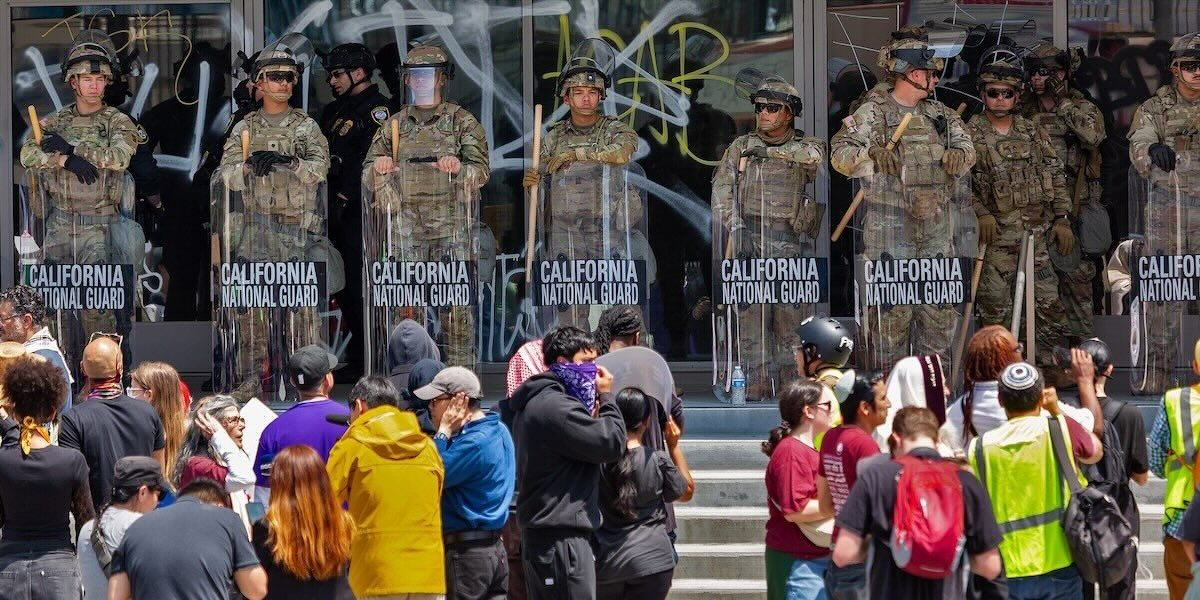
California National Guard with riot shields at June 2025 Los Angeles protests against ICE and mass deportation [U.S. Northern Command]
It is no controversy to state that migration has become a focal point of global politics. As stated in ‘Erga Migrantes Caritas Christi,’ contemporary migration can be considered a “sign of the times”. People move at greater pace, in greater numbers, and for a greater number of reasons—UNHCR data has shown that more than 108 million people were forcibly displaced in 2022, a number which has tripled since 2011. The recent public clash between US President Donald Trump and Pope Leo has only intensified the debate. By criticising the president’s treatment of migrants, the Pope brought renewed attention to the Church’s theology on migration.
Many assume the Church’s stance on the issue is clear and explicit. The US Conference of Catholic Bishops declared in 2001 that “a rich body of Church teaching, including papal encyclicals, bishops’ statements, and pastoral letters, have consistently reinforced our moral obligation to treat the stranger as we would treat Christ himself”. Pope Francis, long committed to the cause of migrants, went as far as to call Catholic theology “a theology of refugees” and clearly stated that repelling migrants is a “grave sin”.
In the light of these seemingly straightforward guidelines, many Catholics find themselves confused – does the church opt for a cosmopolitan, progressive open borders policy? Many remain uncertain as to whether such openness can be reconciled with respect for state sovereignty, the rule of law, and the right to self-determination. Does mercy have to substitute justice? Are national security and human dignity in conflict? This article aims to reexamine the Church’s doctrine on migration.
Pope Francis’ renowned support for migrants, as timely and powerful as it was, is but another addition to the Church’s teaching on the topic, for it has been developing for millenia. The Old Testament establishes the direct moral duty of hospitality: “Love the stranger for you were strangers in the land of Egypt” (Deut. 10:19). Moreover, as Pope Leo reminded us recently, Christ cautions us in the Gospel of Matthew that the treatment of the newcomer, “the stranger”, will serve as a fundamental criterion during the Last Judgment.
Nonetheless, regarding migrants and refugees, the Church does not neglect the challenges that come with welcoming strangers into local communities. Pope Benedict XVI in 2009 stated that although migration poses “dramatic challenges” for nations, migrants “cannot be considered as a commodity or a mere workforce. (...) Every migrant is a human person who possesses fundamental, inalienable rights.” The complexity of migration does not diminish the Catholic obligation to recognise inherent dignity in every person—a dignity that transcends national boundaries. The Church makes clear demands of host peoples and recipient nations, insisting that foreigners be treated justly, with charity, and ideally with hospitality.
Simultaneously, these expectations are not one-sided; the Church outlines clear duties for the migrants as well, which are often sidelined in contemporary debate. To protect the common good, welcomed migrants are called to obey the laws of their new country, actively participate in community life and “assist in carrying civic burdens”. Even with consideration to varying backgrounds and circumstances, migrants are still expected to respect with gratitude the spiritual and material heritage of the country that receives them (Cathechism of the Catholic Church 2241).
This considered, in order to navigate through this dichotomy of obligation, it must be acknowledged that the Scripture clearly recognises the term ‘ethnos’ as a foundational element of nationhood. While far from the ethno-nationalistic stance (which entirely rules out the possibility of assimilation, participation, and adoption), the Church notes that nationality is not merely a legal status detached from culture, history, and intergenerational solidarity. The scripture teaches that God “made from one man every nation of men… He determined their times” and crucially, “the boundaries of their lands” (Acts 17:26). Effectively, this legitimises both the essential sense of relation between countrymen and the established boundaries by which they live.
Nations, then, are not administrative zones or hostels, but “families of families”, as St. Pope John Paul II liked to refer to them. The Catechism affirms that “the love and service of one’s country follow from the duty of gratitude, and belong to the order of charity”. While universal dignity is an undeniable truth, so is the sense of belonging and the obligations nations have to the common good of their own citizens.
Recent papal teaching shows the balance clearly. Pope Leo XIV, despite calling for a “deep reflection” on the treatment of long-settled, peaceful immigrants, admitted that “every country has a right to determine who, how, and when people enter”, and clarified, “no one has said the United States should have open borders”. Similarly, Pope Benedict XVIth warned repeatedly that an absence of a just and orderly legal system harms immigrants most of all. A nation cannot uphold the dignity of anyone on its territory if it has abandoned the rule of law, under which its residents are protected.
This considered, so long as an immigrant doesn’t pose an immediate threat to a nation and abides to its national law, is that enough to become a part of it? Thomas Colsy argues that “civilisation is not sustained by the lack of evil alone”. Supportively, Ernest Renan wrote in 1882 that “to be part of a nation, for the human being… is the outcome of a personal voluntary choice. A nation's existence is a daily plebiscite.” He defined a nation as a “large scale solidarity”, built on shared sacrifice. Taking this into account, instead of focusing on whether the migrants will refrain from violence the debate should focus on migrants' desire for civic integration. As noted, the Catechism reinforces this view by stating that migrants must do more than simply obey the law—they are called to actively participate in the life of their new community and respect their host country. By doing so, they can become true patriots who enrich the broader community. The biblical figure of Ruth Moabite serves as the clearest example. She, a newcomer to Israel, declared: “your people shall be my people, and your God my God” (Ruth 1:16), and was welcomed with hospitality and honour. Families endure through active love of their members, through an active pursuit of common good—indifference is not enough.
Current Catholic commentators Thomas Colsy and Connor Tomlinson propose that the care and love for a nation act as a threshold for new arrivals. While catholics must stand against discrimination and plead for humane treatment of all, the protection of one’s community, home, and finite resources is a moral duty. The active de-obligation of newcomers to care for the common good has led to fragmentation, segregated cities, and has increased violent crimes. Colsy and Tomlinson’s approach, then, could be a viable outlook from which Catholics analyse this issue, for it aligns with the varying obligations it brings about. While the enforcement may initially be suboptimal, the lack of such understanding and care is what catalysed the wave of deportation proposals gaining momentum across the world—from Austria’s Herbert Kickl, to Britain’s Rubert Lowe or the US’ Donald Trump.
In an era of unprecedented human movement, Catholics must endure the challenge of navigating through persistent ethical dilemmas and competing moral obligations. From one issue to the next, it is no surprise that Catholics around the world may find themselves unsure what to advocate for. However, in regards to migration, it is no question that Catholics are called to protect the stability of their “family of families”, while always recognising the dignity of every person. Any Catholic stance or response must always be rooted in justice, charity, and always directed towards the pursuit of the common good.