
En la imagen
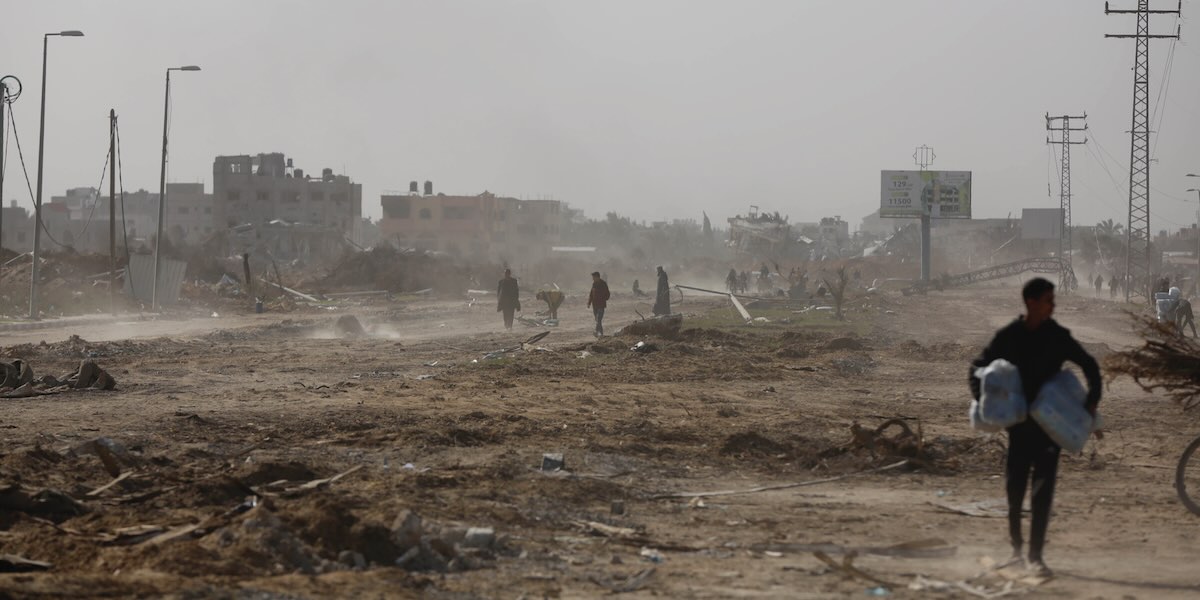
Palestinians walk amid the destruction in the Al Matahin and Al Qarara areas in northern Khan Younis, in January 2024 [UNRWA, Ashraf Amra]
How do prolonged conflicts, such as the Israel-Palestine armed struggle, create fertile ground for organized crime to evolve, adapt and exploit instability? For several decades, the Israel-Palestine conflict has not only shaped regional politics but has also disrupted social and economic structures, creating environments where institutions struggle to maintain order.
The ongoing dispute, rooted in competing national, territorial, and religious claims over the land historically known as Palestine has led to the evolution of organized crime in the region, with a range from continuous and heightened corruption levels to ceaseless smuggling and illicit markets in addition to cybercrime. The conditions subsequent to the blockade by Israel contributed to give rise to organized crime, defined as structured, profit-driven criminal activity carried out by groups operating across borders or within territories where effective state control lacks.
When viewing said pressing issue through the scope of structural realism, organized crime in Israel-Palestine is not just opportunistic but structurally inevitable in a system marked by anarchy, conflict and power asymmetry. Criminal networks function almost as state actors aiming to fill governance gaps as consequences of weak governance, thus providing security in insecure areas as they pursue relative gains, essentially mirroring the behavior of states.
This essay aims to explore how weakened institutionalism, fragile rule of law and insubstantial accountability have given the opportunity for organized crime to flourish under the context of an armed conflict with years of precedence.
Smuggling and illicit markets
As a consequence of the deep-rooted historical aspects of the conflict, smuggling networks through tunnels is no recent news. Throughout the blockade of Israel in the territory, Gaza-Egypt tunnels have constituted a key organised network, rising as a consequence of restricted trade, the borders’ population resilience and border authorities’ passive acceptance of tunnel-related activity. Said blockade has limited Palestinian movement and access to goods, for which smuggling became an alternative economy growing at such rates further leading to militarization of the zones. This militarization portrays convergence between organized crime and insurgency: criminal logistics enable military operations while armed groups provide protection and coercive enforcement for said illicit markets.
Decades ago, ancient smuggling highways from Lebanon and Syria to Egypt ran through territory of Israel’s control, dating back to the 50s; exposing the necessity for smuggling as a long lasting necessity During the interwar period, the conflict zone served as a transit and way-station for cannabis between neighboring states: smuggling markets are not only new, they are deeply ingrained in regional dynamics. Arms and drug trafficking have become ultimate alternatives mostly as a result of the region's protracted instability, poor governance, and difficult economic conditions.
Arms smuggling reflects a survival-driven, self-help logic related to structural realist principles by enabling militant groups and local factions to retain power, defend areas, and acquire leverage in a setting when legal access to weapons is restricted (10). Contrarily, drug smuggling allows for control over communities and provides income for armed operations, support networks, and livelihoods in areas with high unemployment and poverty. According to the Combating Terrorism Centre, 105 cases of identified disrupted weapons or drug smuggling attempts into Israel from Jordan and Egypt took place between 2021-2023.
Nevertheless, it is essential to note that not all trafficking and smuggling activities rely on weapon and drug distribution but also on consumer goods flows under the blockade, bringing into the picture illicit markets beyond just high-end crime. Smuggling, whether as a survival incentive or purely criminal incentive, raises an ethical debate as to the extent to which people in need under desperate and critical circumstances become part of organized criminal activity when reaching for their only alternative solution: disguised markets outside the law but with products for positive purposes. Where should we draw the line between criminal logistics and survival? Are these criminals as well?
Furthermore, conflict zones exacerbate the risk of human trafficking. In this case, in occupied Palestinian territory. Denegation to work, lack of access to healthcare and education, the intersection of economic marginalization and social exclusion, in addition to political limitations and institutional fragility, create a fertile ecosystem for exploitation of the weak. Many of the youth population fall under the trap of promising employment ‘opportunities’ abroad, plus the reported increase in forced marriages in the region to a greater extent involving trafficking for sexual exploitation. As a pressing issue, cultural shame inhibits and silences thousands of women victims of said ill treatment, being unable to seek justice without the fear of being judged.
Under the Israel-Palestine conflict, people are prone to join human trafficking networks or participate in trafficking as the result of economic desperation, social fragility and the instability brought among the nation. Victims are vulnerable to traffickers who promise jobs, education or safer living conditions due to high unemployment rates, poverty and limited possibilities, particularly in Gaza and parts of the West Bank. Because of the continuous dispute, there are gaps in administration and law enforcement that traffickers take advantage of with little chance of punishment.
Corruption and fragile institutionalism
In frameworks where legal systems are weak and political accountability minimal, corruption becomes an adaptive survival strategy for both officials and citizens. Embezzlement and nepotism as examples of corrupt practices are deeply built into the political system as a whole, inherited from the Palestine Liberation Organisation (PLO) and ceaseless since - at least - the Oslo peace process in 1990. Delving into the concept of patron-clientelism is key to understanding the prevalence and seriousness of the discussed misconduct. Patron-clientelism in this context depicts a hierarchical network of loyalty and protection. Gang leaders, criminal bosses or influential figures act as patrons who offer protection, access to resources or financial incentives to individuals (the “clients”) who ultimately provide services, information or enforcement in return. A business deal that goes beyond the legal frameworks.
This system allows corruption to embed itself in communities and political structures, hardening the task for formal institutions to step in. Weak governance and persevering instability in regions such as Gaza or the West Bank magnify these networks, enabling organized crime to thrive under the guise of reciprocal duties and personal obedience rather than official legal systems.
Along the dispute, Israel has indirectly gotten involved with Palestinian Authority (PA) corruption using it as a political tool. The occupation created conditions that enabled, protected and sometimes encouraged corrupt practices. Limited Palestinian sovereignty, PA dependence on external funding and weak institutions are some of those conditions that stemmed from the blockade. Moreover, the perceived and actual corruption ended up weakening leadership as war complexities exacerbated the risk for manipulation, misuse of aid and, ultimately, governance failure.
Cybercrime and digital propaganda
In an increasingly interconnected society, the internet’s role has risen to the extent to which it can be misused in the form of a weapon. Cyberattacks in the Israel-Palestine conflict constitute a more recent approach to the dispute, as access to databases and information online grow by the second. State actors have played a role among the recorded digital attacks, as well as non-state actors, some inspired by the IT Army of Ukraine (yet with less recognition and impact). Cyber operations in the conflict aim to disrupt infrastructure, gather intelligence and spread propaganda.
Types of cyberattacks vary on the purpose and methods; some of the types of cyberattacks starring throughout the recent years of the conflict have been as follows. Destructive attacks consist of phishing emails delivering “data wipers” to Israeli organizations. These erase the data or make it inaccessible. Service disruptions are DDoS attacks which target Israeli websites, especially those providing critical information to civilians. Ransomware and website defacements have taken place as well, where attackers encrypt systems or change website content to disrupt services and spread political messages. Hack-and-leak operations reflect on Iran’s decision to target Israeli and US entities to steal and leak sensitive data. Also, pro-Palestinian groups created apps mimicking official Israeli alert systems to mislead citizens and steal personal data. It is essential to point out that said cyber interactions have the purpose of spreading digital propaganda, espionage tactics and disruption rather than directly causing physical destruction.
Cyber operations in many cases are state-sponsored as seen in Iran's support to Hamas with cyberattacks and online propaganda, also engaging in hack-and-leak operations as previously mentioned. On the other hand, Israel, with strong cyber capabilities often defended targets and occasionally retaliated with attacks on Iranian infrastructure on media outlets like Gaza Now, cooperating as well with the US on cyber initiatives (4). Cyberattacks were predominantly one-sided, with Israel facing far more defacement attacks than Palestine highlighting the role of infrastructural differences. On the Palestinian side, internet infrastructure is limited. Following the conflict, internet connectivity in Gaza dropped to 15% of pre-war levels, partly due to Israeli telecom blackouts.
By spreading false information, interfering with vital services, and causing psychological distress among impacted communities, cybercrime exacerbates the conflict. Through the offering of financial incentives and cultivating networks of proficient hackers, politically motivated hacks have the potential to evolve into organized cybercrime. Attacks of this kind are most likely to take place in settings with internet access, asymmetrical cyber capabilities, significant political motivation, little chance of legal ramifications, and easy access to international hacking tools.
The need to rebuild the society
In the midst of a conflict of such scale, it is inevitable to scrutinize the juxtaposition between the portion of the population trying to adapt to the inhumane conditions they are being put through, and opportunistic criminals taking every chance they get to establish criminal networks and exploit the weak. Even if this contrast is evident to some, to many they are all delinquents. It is the need for adaptation and survival pressed against the fine line of criminal activity and illegality, further inviting us to reflect upon the essentiality not only of strong institutions and stable law enforcement, but of the need to rebuild society, seeking healthy and legal alternatives to prevent those who are unemployed, poor and lack access to education from having to take up arms, involve themselves in organized crime networks, corruption, or cybercrime.
This pressing issue is not to be underestimated, efforts to improve life quality and access to basic needs and opportunities shall address the issue from its roots instead of alleviating the symptoms alone; organized crime in enduring historical armed conflicts constitute if not the greatest and most pervasive symptom of social collapse. How can we as a society foster an environment where human ingenuity is directed toward reconstruction rather than destruction, in a world where conflict fuels both survival and opportunism?