
En la imagen
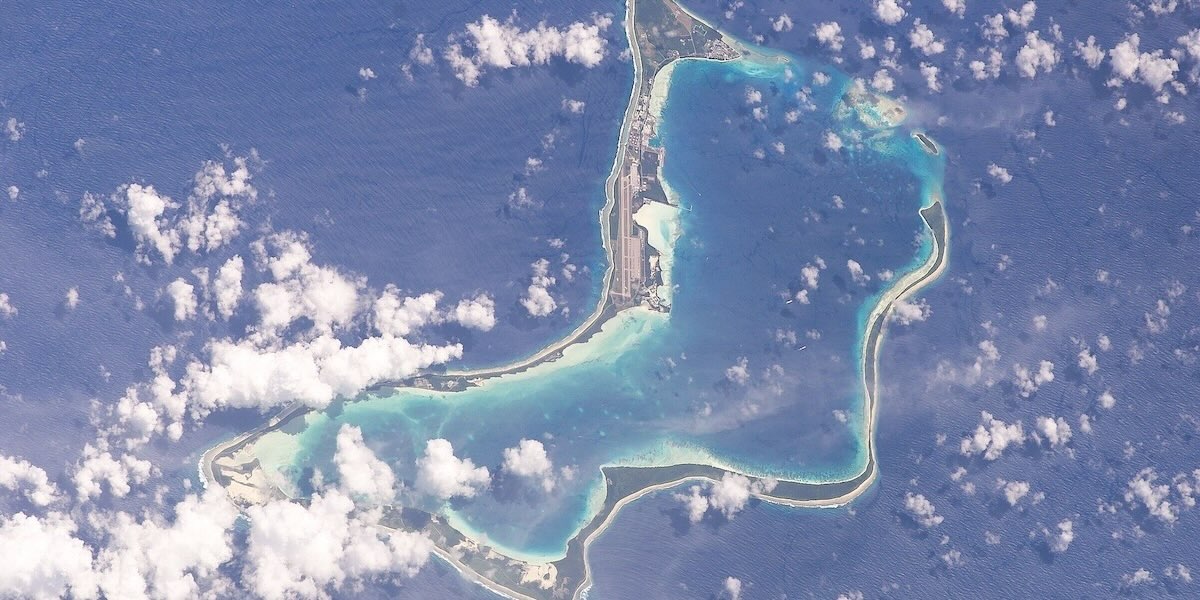
Diego Garcia militar base, in the Chagos Archipelago [NASA]
The historic deal to return sovereignty over the Chagos Archipelago from the United Kingdom back to Mauritius, surrendering its claim on the islands to Mauritian hands last year, may just mark the starting point for a new geopolitical avenue in maritime international affairs. While there are aims to resettle Chagossians back to their islands, the biggest island, Diego Garcia, will remain uninhabited and leased by Mauritius to the UK and the US for 99 years in order to continue their naval and military base operations in that region. The control over the Diego Garcia base and how it is used has always been an important point of contention, as the results from any decision can impactfully shape regional diplomacy in the Indian Ocean.
The deal reached in May 2025 affecting Diego Garcia, in the center of the Indian Ocean, comes with several, modern implications: naval power is increasingly a diplomatic actor; North–South collaboration in the Indian Ocean must continue to maintain global stability; Global South agency in the region can be a vulnerability, but also effective in easing inter-regional tensions; and these post-colonialism efforts call upon further policy change. With Western actors (UK, US) taking on a more cooperative stance, and Global South actors (Mauritius, even India) being able to exercise more agency, we are witnessing in real-time a shift in the balance of power of the Indian Ocean.
Naval power: A diplomatic actor
The US Navy and Air Force platform on Diego Garcia is one of the most strategically important and secretive US overseas facilities. The island hosts the largest US military base in the Indian Ocean, being an imperative location for Western interests in the region or connecting to even African, Middle Eastern, or Indo-Pacific matters. Countering China and Iran with this presence, this strategic location allows for a stable base in quick reinforcements for conflict-prone areas, as it may be difficult to access other nearby areas. Its heavy-duty runway, deep‑water port, GPS ground infrastructure, space-tracking systems and seismic monitoring equipment, on top of all of its other advanced capabilities, gives Diego Garcia an important role in global governance, specifically in monitoring space and nonproliferation. This base acts as a logistics hub and is vital in refueling and resupplying stations for naval and air operations. The technological importance of the base further enhances the major edge that the UK and the US possess in diplomatic affairs. In an ever-so globalizing world, naval power is increasingly a significant factor to leverage in the decision-making and negotiations between international actors.
North–South collaboration for global stability
As per the agreement, foreign military forces are not allowed to be present anywhere in the Chagos Archipelago and any nearby construction requires joint decision‑making with the UK. Despite the fact that there is indeed a 12-to-24-nautical-mile buffer zone around Diego Garcia in place (necessitating UK consent in any action or construction) to safeguard against undesired foreign actors settling too nearby, some UK political actors continue to be alarmed over the potential threat to Western security in the region. These concerns are founded on the basis of Mauritius’ close ties with China and even Russia. Mauritius is not part of China’s Belt and Road initiative, yet has been a long-time partner of the Chinese state, sharing a free trade agreement. This, in the Western perspective, may be perceived as a potential leakage point to Eastern forces, and could corrode stability in the region. With Mauritian presence near the Western base, securing naval and operational intelligence may be doubled down upon, as the trust between the US, the UK, and Mauritius is being put to the test. Hence, the maintenance of clear and consistent dialogue between these states is more favorable than ever. By ensuring transparency, communication, and good faith between these states, the provision for potential tensions arising can be prevented.
Global South agency to ease tensions
As aforementioned, the Global South’s newfound agency may lead to insecurity for the US and the UK in the Indian Ocean region, but it should be celebrated that the post-colonial tensions have been eased. This deal, as part of the reparations for the UK colonial rule, finally opens up for greater Mauritius-UK diplomacy, and subsequently more diplomacy with other actors in the region, as this major grievance is now being accounted for. This is considerably significant after the amount of years that have passed since several UN resolutions, namely the ones of 2017 and the ICJ ruling of 2019. We can observe that Mauritius’s archipelago is now left with a great responsibility: to serve as a bridge for North and South diplomacy. From what was once a point of contention and stress, the islands have turned into a shared stage of opportunity for peace and development.
India, a consistent supporter of Mauritian sovereignty over the Chagos, is another Global South country that now plays a greater role in the region from this agreement. Due to its geographical proximity and its alliance with Mauritius, India is a key security partner and will assist in surveillance of Mauritius’ waters. This reflects India’s growing geopolitical interest in being a security provider in the Indo-Pacific region. Overall, we can understand this shift in power to be a resolution to post-colonial disputes, reshaping pre-existing power structures by encouraging developing states to exercise more agency and carry more responsibility.
The need for greater post-colonialism efforts
With shifting powers in the Indian Ocean, and the spread-out Chagossian diaspora, regional actors are now acting with more agency in our post-colonial world. However, considering that there is still a Western dominion in the area, discourse over further decolonization may arise. The UK and the US are funding billions of pounds to maintain its Diego Garcia base (an average of £101 million pounds a year, £3.4 billion in total), with a possible 40 year extension, which goes to show how important it is for the Western powers to retain control over this strategic area. Furthermore, despite having total sovereignty, the deal states that “there would be no circumstances in which Mauritius would be able to prevent the UK or US having full control over operations from Diego Garcia”. It can be deduced that Western powers still maintain their stronghold over Diego Garcia, even though its sovereignty lies with Mauritius. This begs the question–how can we further enhance decolonization without infringing on Western securitization?
The current agreement demonstrates a deep understanding of this “balancing game” and reflects multilateralism as a diplomatic solution in our interconnected waters. It also helps in greater development of Mauritius, providing a means for economic improvement. The Exclusive Economic Zone (EEZ) totals to around a whopping 640,000 km2 of area. Yet, the human aspect still remains, and geopolitics are not independent from environmental nor societal impacts. Chagossians are already experiencing difficulties in returning to their home islands, and are even more troubled from not being able to go back to the largest island, Diego Garcia. Some feel excluded from the agreement altogether, arguing that the Chagossian people themselves were not consulted. Thus, by further measures to account for the displaced Chagossian population, the UK can further alleviate the wounds caused by its colonial past. Measures from all ends to preserve the rich marine biodiversity, like the Marine Protected Area detailed in the agreement, must be carried out successfully to avoid deepening grievances.
Turning point
In conclusion, the May 2025 deal marked a turning point for not just Indian Ocean power dynamics, but our understanding of maritime international relations as a whole. Diplomacy plays out through various mediums, including naval power, resulting in various international ramifications. The Chagos Archipelago is entangled in this balance between geopolitical security needs and decolonization measures; it is up to the proactive collaboration of states to find an equitable win-win path out of this. In understanding these historic changes, one thing is clear: what happens across oceans is just as impactful as what happens across lands.