
Robot experiments suggest that the real danger in an evacuation lies in pushing, not speed
This finding could contribute to the design of more efficient evacuation protocols or the creation of safer spaces
28 | 07 | 2026
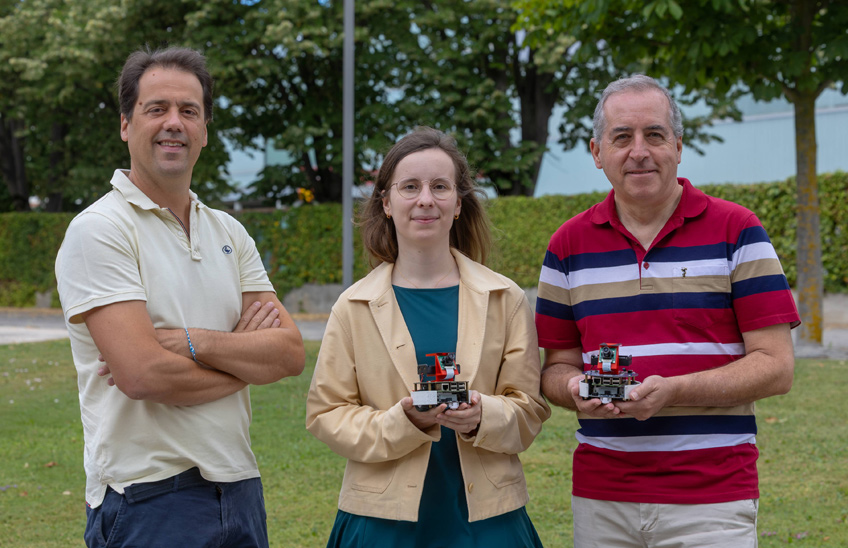
Marta Grasa, Laciel Alonso-Llanes, Angel Garcimartín, and Iker Zuriguel, from the Department of Physics and Applied Mathematics at the University of Navarra, have conducted a study demonstrating, through experiments with robots, that moving quickly while avoiding physical contact could be the key to achieving more efficient and safer evacuations. The research has been published in Physical Review Letters, a world-reference journal in physics.
Until now, safety manuals claimed that running toward an exit created bottlenecks, delayed evacuation, and multiplied injuries. This new research suggests that the real danger does not lie in speed, but rather in the pushing and physical pressure generated near doors.
The researchers programmed a swarm of robots to evacuate an enclosure through narrow exits. When the automatons avoided physical contact with each other, the increase in speed always reduced the escape time. As Marta Grasa, first author of the paper, explains, the results indicate that speed is not a drawback. "If the robots avoid contact with one another, the higher the speed, the better," she points out. Furthermore, she emphasizes that "what really affects [the outcome] are the collisions: if we let the robots push each other, the greater the force with which they do so, the worse the result."
Nevertheless, and despite these favorable indications, the researchers warn that these conclusions cannot be directly applied to real-world emergencies. “In a real evacuation, many other factors come into play, both physical (different sizes of people with different strengths, occurrences of falls...) and psychological (different motivations, reactions...). What the study does indicate to us is a possible direction to follow for future research: in highly competitive scenarios, it seems that the problem may lie more in physical contacts (pushing, elbowing, fighting to get out first) than in the speed the pedestrian may have until reaching a clogged exit,” suggests Ángel Garcimartín, Professor of Applied Physics and researcher of the study. In addition, he concludes that thanks to this research, “more efficient evacuation protocols or safer spaces could be designed.”