
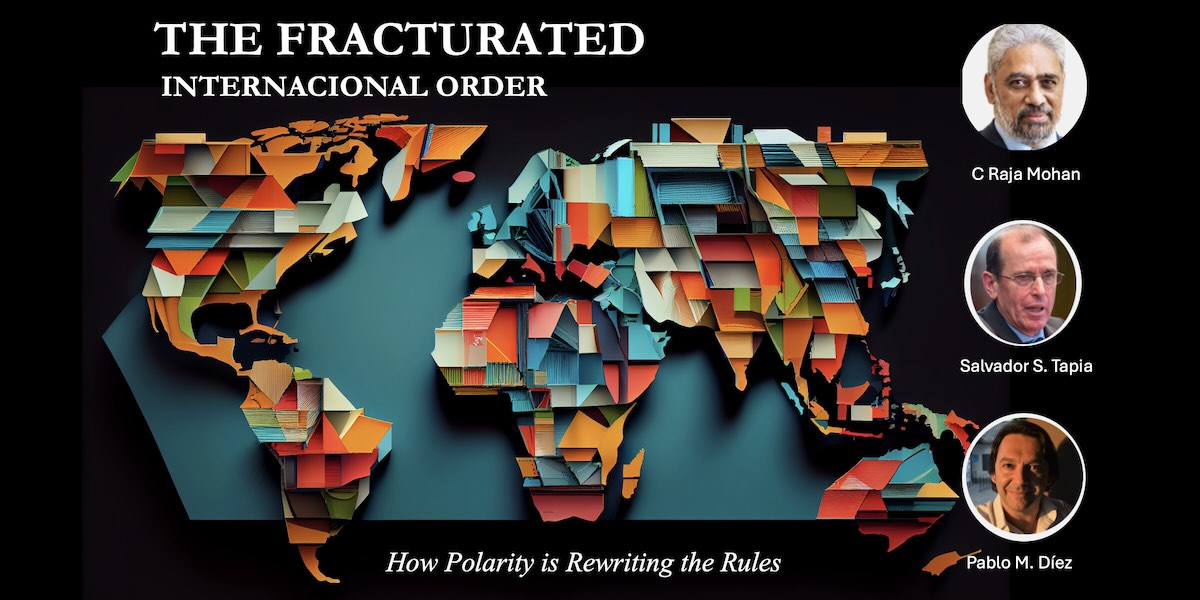
En la imagen
Poster of the event, with the three speakers
The first Winter Round Table Conference of the Center for Global Affairs and Strategic Studies brought together three speakers: Professor C. Raja Mohan, Professor Salvador Sánchez Tapia, and journalist Pablo Díaz, on 27 November 2025 at the University of Navarra, to discuss the evolving international system and the contested future of the liberal international order. Moderated by Prof. Shahana Thankachan, the discussion revolved around three core topics: the distribution of power in the international system, the structural pressures facing liberal democracies, and the capacity of the West, particularly Europe to defend the liberal order in an era of geopolitical fragmentation.
The debate revealed both analytical differences and shared concerns. While participants disagreed on whether the world is transitioning toward multipolarity or reaffirming bipolarity, they converged on the diagnosis that the liberal order faces profound structural and ideological challenges.
Professor Raja Mohan, who participated o opened the discussion by challenging what he described as a widespread but misguided assumption: that American power is in terminal decline and that the world has entered a genuinely multipolar era. In his view, the problem is not declining US power but rather how the United States chooses to exercise it. He pointed to two recent developments. First, the US approach toward the World Trade Organization, particularly during the Trump administration, that illustrated Washington’s willingness to undermine one of the central pillars of the postwar economic order. Yet, rather than witnessing a global rally in defense of multilateralism, most actors opted for bilateral negotiations with Washington, demonstrating the enduring leverage of American market power. Second, he cited a recent resolution in the United Nations Security Council regarding Gaza, which passed with overwhelming support despite its controversial framing. For Mohan, this episode further underscored that US influence remains structurally embedded in global governance mechanisms.
From this perspective, the emerging system resembles not multipolarity but a concentration of power primarily in two actors: the United States and China. The central challenge is therefore managing bipolarity and preventing the erosion of core principles such as territorial integrity and rules-based conflict resolution.
Professor Salvador Sánchez Tapia offered a complementary yet more pessimistic structural assessment. He agreed that the system is in transition and predicted that it will likely consolidate into bipolarity between the US and China. However, he argued that the change will not merely be adaptive but “radical in depth”. The liberal order’s foundational norms: rule of law, peaceful transfer of power, human rights, free trade, and respect for borders, are under sustained pressure from both internal weaknesses and external challengers.
Then Professor Sánchez Tapia identified three principal threats to the liberal system.
First, liberal democracies face declining credibility. The 2008 financial crisis, the COVID-19 pandemic, rising inequality, unsustainable welfare systems, demographic aging, and technological disruption have weakened public confidence. He cited polling data suggesting that a significant portion of younger generations view authoritarian systems as potentially more effective at delivering stability and prosperity. The attraction of illiberal solutions, in his view, stems less from ideological conviction than from perceived performance deficits.
Second, revisionist powers, particularly China and Russia are increasingly contesting liberal norms. Russia’s attempt to alter borders by force in Ukraine directly challenges the principle of territorial integrity. Meanwhile, initiatives such as the BRICS’ development institutions suggest parallel structures emerging outside Western-dominated frameworks.
Third, the United States itself has shown signs of partial retrenchment. Although not fully isolationist, recent administrations have prioritized the Indo-Pacific and reduced their appetite for serving as the ‘international policeman.’ This shift has profound implications for European security and global institutional stability.
Journalist Pablo Díaz enriched the debate with a longitudinal perspective drawn from two decades reporting in China. Recalling the optimism of the post-Cold War period, often associated with Francis Fukuyama’s “end of history” thesis, Díaz described China’s transformation from integrationist globalization to assertive strategic rivalry under Xi Jinping. The abolition of presidential term limits, the launch of “Made in China 2025,” the trade war with the United States, and the tightening of domestic controls marked a decisive shift.
The COVID-19 pandemic, he argued, exposed both the vulnerabilities of global supply chains and the risks of deep dependence on regimes with divergent political values. China’s stringent lockdown policies and opacity regarding the virus’s origins illustrated, in his account, the limits of authoritarian crisis management despite early containment successes.
Another recurrent theme was Europe’s strategic uncertainty. Sánchez Tapia outlined two possible trajectories if US security guarantees weaken: deeper European integration toward genuine strategic autonomy, or fragmentation as individual states seek separate security sponsors (potentially nuclear powers). The latter scenario risks a reversion to pre-1945 balance-of-power politics.
Raja Mohan added that deterrence has re-emerged as a central organizing principle in both Europe and Asia. Following Russia’s invasion of Ukraine and growing doubts about American commitments, European states are reconsidering defense spending and even nuclear arrangements. In Asia, similar debates are occurring in U.S. allied states. The post-1991 assumption that globalization would render great-power rivalry obsolete has, he argued, been fundamentally shattered.
Díaz emphasized that European societies must recognize the privilege they have long enjoyed under the American security umbrella. Future stability will likely require greater domestic responsibility: politically, economically, and militarily.
At the end, the question-and-answer session shifted the discussion from systemic diagnosis to normative and practical considerations.
One participant questioned how the West can credibly defend the liberal international order given its selective application of human rights and interventionist policies. Raja Mohan responded that the “liberal international order” is better understood as a heuristic framework than as a consistently practiced reality. Major powers have always prioritized core interests over values. What is novel today, he argued, is not selective application but the growing intra-Western ideological divide, particularly transatlantic tensions over liberal norms and the rise of populist movements.
Second, a question from another student addressed why populations facing insecurity and economic hardship might prefer authoritarian alternatives. Sánchez Tapia acknowledged democratic inefficiencies but framed them as safeguards rather than defects. Deliberation, pluralism, and procedural constraints slow decision-making but enhance legitimacy and long-term stability. Nevertheless, he conceded that liberal democracies must reform to remain functional and competitive, particularly in technological innovation.
The third question made by another student asked about what younger generations can do to restore the faith and utility of the international order, to which Díaz replied and emphasized education and media literacy. He warned against fragmented, algorithm-driven information ecosystems and argued that responsible citizenship requires exposure to diverse viewpoints and critical engagement beyond social media soundbites.
After that, responding to concerns about rearmament, Raja Mohan argued that deterrence has re- entered strategic thinking as a necessary condition for peace. In a world where territorial revisionism has reappeared, military capability underpins diplomatic credibility.
Finally, questions regarding domestic polarization in Europe prompted reflections on dialogue as a core liberal value. Sánchez Tapia reaffirmed that respectful deliberation enhances policy quality, even if it slows decisions. Díaz added that increased polarization partly reflects the democratization and deregulation of information channels, raising difficult questions about balancing free expression and accountability.
The roundtable highlighted three analytical tensions.
First, while there was disagreement about the extent of American decline, there was consensus that structural bipolarity between Washington and Beijing is consolidating. Multipolar rhetoric may obscure the continued centrality of U.S.-China rivalry.
Second, the principal vulnerabilities of the liberal order appear internally as much as externally. Democratic fatigue, demographic shifts, economic stagnation, and technological disruption are eroding confidence from within. The appeal of illiberal governance reflects performance anxieties rather than purely ideological rejection.
Third, the debate over deterrence signals a broader normative shift. The post-Cold War optimism that economic interdependence could replace hard power has given way to renewed emphasis on military capability. This does not necessarily imply abandonment of liberal principles but rather their defense under harsher geopolitical conditions.
In sum, the conference did not produce a unified blueprint for preserving the liberal international order. Instead, it offered a sobering diagnosis: the coming decades will likely be defined by intensified bipolar competition, institutional strain, ideological fragmentation, and renewed militarization. Whether liberal democracies adapt successfully will depend less on rhetorical commitment to universal values and more on their capacity to reform domestically, deter externally, and rebuild credibility through consistent practice. The discussion closed not with certainty but with a call to intellectual seriousness, an acknowledgment that the defense of liberalism in the twenty-first century will require both strategic realism and normative conviction.