
En la imagen
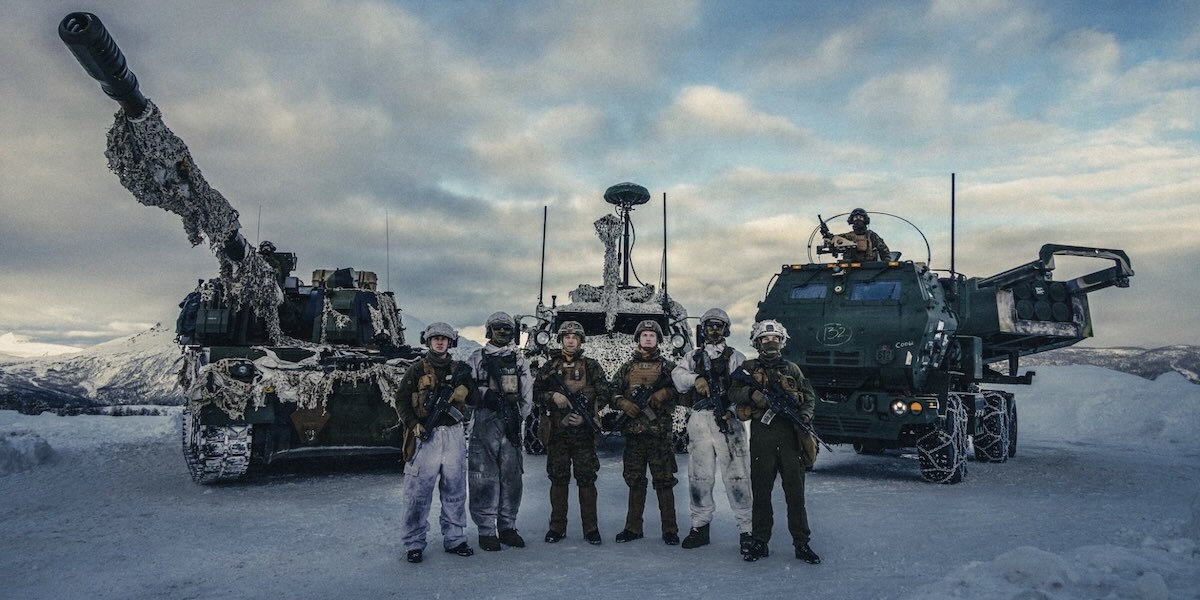
Display of capabilities by the US Marine Corps Forces Europe & Africa [US MARFOR]
On the 24th of August, the United States deployed US Marines to the island of Jan Mayen in Norway to conduct Operation Atlantic City, as part of NATO’s Exercise Nordic Response. The exercise, which has also seen British Royal Marines deployed to Norway alongside their American counterparts, is part of efforts to deter Russian military actions in Northern Europe. The US Marines forces involved in the Nordic Response operate under the command of the United States Marine Forces Europe and Africa (MARFOREUR/AF), one of the multiple command elements of the US forces in Europe.
Compared to other US Military branches forces in Europe, the Marine Corps is rarely associated to operations in Europe, with its most celebrated action in the continent being the 1918 Battle of Belleau Wood during WW1, which gained the Marines the nickname ‘Devil Dogs.’ On the present day, the Marine Corps is frequently overshadowed in Europe by other US military elements particularly the US Air Force, which operates several combat units such as the 48th Fighter Wing at RAF Lakenheath and the 31st Fighter Wing in Aviano.
The current article seeks to analyze the current strength of the US Marine Corps forces deployed in Europe, security challenges facing NATO in Europe and Africa, and what the Marine Corps might need to face emerging security challenges. The article will conclude with recommendations for NATO and US political and military leaders on the matter.
MARFOREUR/AF
The United States Marine Forces Europe and Africa (MARFOREUR/AF) is the command element that is responsible for all United States Marine Corps (USMC) units operating in European Command (EUCOM) and Africa Command (AFRICOM) areas of responsibility. Headquartered in the Panzer Kaserne-Barracks in Stuttgart, Germany, the current organization emerged in 1980 with the decision that US Navy and Marine units in Europe and Africa would share responsibilities for the two regions.
The current strength of the MARFOREUR/AF is around 1,500 active-duty troops in Germany, handling administrative and command duties, with US Marine combat units undertaking temporary deployments around Europe, rather than remaining permanently deployed in Europe like the US Army or Air Force, which maintain combat units deployed in Europe permanently such as the 173rd Airborne Brigade based in Italy.
US Marine units rotating in Europe and Africa undertake a variety of missions, from providing training and assistance to their counterparts in Africa to joint exercises with NATO and African partners such as the Exercise African Lion. Marines are also engaged in deterrence missions, particularly in Europe.
The Marine units rotated through the region fall under the command of one of the three Marine Expeditionary Units (MEUs) assigned to the US East Coast, which reports to the II Marine Expeditionary Force (MEF). These are the 22nd, 24th, and 26th Marine Expeditionary Units. The average strength of an MEU is a battalion of US Marine infantrymen, a helicopter unit consisting of attack and transport helicopter squadrons equipped with the Bell AH-1Z ‘Viper’ and the Bell-Boeing V-22 ‘Osprey’ respectively. If necessary, MEUs can also carry fixed wing aircraft from a Marine Fighter Squadron (VMFA), operating the F-35 ‘Lighting’ II.
Rather than a permanent combat unit, MEUs are composed of standing battalions of Marines that are rotated from their ‘parent’ Marine Regiments for a period of between six or nine months before returning to the parent unit when another MEU and as such, another Marine battalion takes their place. The total cycle between preparation, training, certification, and deployment can take months, as battalions undertake training for the duties they will carry out as part of an MEU.
The few Marines deployed permanently in Europe act as the headquarters element for the MARFOREU/AF, which includes the Marine Rotational Force-Europe (MRF-E), which oversees US Marine winter and mountainwarfare training with NATO allies. The MRF-E is forward deployed to oversee the duties mentioned above. The MRF-E is organized as a Special Purpose Marine Air-Ground Task Force (SP-MAGTF), which acts as the US’s emergency response force in times of crisis on short notice. The evacuation of non-combatants and reinforcing US Embassies are amongst its duties. MAGTF’s have infantry, armored vehicles, artillery, and an air component, as well as logistical and command elements. Like the MEUs the SP-MAGTF does not have any permanent units deployed to Europe, with MEUs deployed to Europe assigned to it operating under the same rotation system. The SP-MAGTF’s does have logistical personnel deployed in Europe, operating out of Moron Air Base in Spain, with additional facilities in Naval Air Station Sigonella in Italy.
If the necessity arises, such as in case of war, the MARFOREU/AR can call upon the aforementioned II Marine Expeditionary Force, located on the East Coast of the US. Among the units the II MEF has under its command are the 2nd Marine Division, located in Camp Lejeune in North Carolina, which acts as the main ground and amphibious combat element. Also, under the command of the II MEF is 2nd Marine Aircraft Wing (2nd MAW), which is the air combat element of the Corps. The MAW includes multiple Marine Aircraft Groups, which operate a variety of aircraft including V-22 ‘Osprey’, Bell AH-1Z ‘Viper’, CH-53E ‘Super Stallion’, Lockheed F-35 ‘Lightning’ II and Lockheed KC-130J ‘Super Hercules’.
Threats and challenges
The US forces deployed to Europe not only assist EUCOM operations and missions, but also those of CENTCOM and AFRICOM, and as such, we will analyze security challenges in Europe, Africa, and the Middle East accordingly. As of August of 2026, the United States and NATO face challenges on three areas that directly affect the US forces deployed in Europe.
The first challenge is Russia. Since the 2022 Russian Invasion of Ukraine, tensions between NATO and Moscow have increased, with fears among analysts and leaders in the West that Russian forces could launch an attack on the Baltics or Poland to test NATOs’ resolve. Hybrid Warfare threats by Russia and Belarus have increased, from cyberattacks to weaponizing migration and disinformation campaigns, Moscow has ramped up efforts to create cracks inside the Alliance.
The second challenge is Africa, which grapples with Islamist insurgencies in Burkina Faso, Mali, Niger, and Nigeria. In addition to this, there are also health emergencies such as the Ebola outbreak in the Democratic Republic of Congo. In addition, to these threats, there is also the issue of failed states in Africa such as Somalia. Furthermore, migratory flows from Africa have become a security challenge for Europe, as seen by the August 2026 migrant surge into the Spanish autonomous city of Ceuta. Adding to this, is the presence of Russia, which has deployed mercenaries from its Africa Corps (previously known as the Wagner Group) to Mali to assist its military regime in dealing with the insurgency after the French withdrawal in 2022.
The third challenge is the Middle East. The wave of violence that erupted in 2023 following the October 7 Attacks by Hamas against Israel rapidly escalated into conflict in Yemen with the Houthi Blockade of the Red Sea, which in turn led to US airstrikes in the region as part of the U.S. Navy’s Operation Poseidon Archer and Operation Prosperity Guardian. The conflict escalated further with Iranian missile strikes on Israel and Israeli airstrikes against Iran, culminating with the 2025 Operation Midnight Hammer strikes by the US against Iranian nuclear facilities in Natanz and Fardow. Conflict also escalated in Southern Lebanon between the Israeli Defense Forces (IDF) and Hezbollah. In February of 2026, the US went to war with Iran once more, leading to naval blockades in the Strait of Hormuz and economic crisis that have affected Europe, Asia, and Latin America. Furthermore, terrorist groups such as the Islamic State and others remain active in the Middle East.
Assessment
Based on the multiple threats faced by US forces in Africa, the Middle East, and Europe, the current US Marine force deployed in Europe is not suitable for a scenario where the US needs to respond to more than one crisis, at the same moment, on multiple theaters. While it may be alleged that the US could deploy the II Marine Expeditionary Force in case of necessity, the time to deploy such a large unit can take weeks if not months, as seen by the deployment of the 1st Marine Division to the Middle East for the 1991 Gulf War. Adding to this, is the logistical buildup required to sustain combat operations. Furthermore, US commanders fear the US Marines are spread thin to handle current threats as they prepare for future conflicts as the US pivots to the Indo-Pacific to counter China.
Another issue is the movement of such troops. The movement of US Marines into Europe will take the shape of a naval deployment in amphibious assault ships such as the ‘America’ and ‘Wasp’ class and the ‘San Antonio’ class amphibious transport dock. Such a move would also require US naval escort of aircraft carriers from the Atlantic Fleet, which includes as of September 2026, the USS ‘Gerald Ford’ (CVN-78), the most advanced carrier in the US Navy. ‘Arleigh Burke’ Class destroyers will also be deployed to escort the force, alongside US Navy supply ships. Such a considerable escort would likely to take place in case of a war with Russia.
Such a movement would likely to take place via the vitally strategic Greenland, Iceland, United Kingdom (GIUK) naval chokepoint in the Northern Atlantic through which NATO could blockade a Russian Naval push into the Atlantic. There would be a considerable risk US naval convoys heading to Europe could fall under air and naval attack by Russian forces if conflict breaks out, a scenario famed American author Tom Clancy envisioned in his 1986 novel ‘Red Storm Rising.’
In this context, an attack against US naval forces supporting such a deployment should be expected, as seen by the 1945 Battles for Iwo Jima and Okinawa. During those battles, US Navy ships supporting the invasion of the islands came under heavy air attack by Japanese Kamikazes, which caused loss of the last US carrier to be sunk to enemy action, the USS ‘Bismark Sea’. Naval forces would also likely come under attack by other ships and submarines, as seen by the brutal battles, mostly between US and Japanese cruisers and destroyers in the waters around Guadalcanal in 1942 to 1943 or the US destroyer ambush at Vella Gulf in August of 1943.
US forces heading for the Middle East would have to cross through the Mediterranean, which would offer the protection of Southern Europe to reach their destination, with the main obstacle being the Red Sea, which is mostly controlled by the Houthis in Yemen. Such a scenario is a possibility, especially after the September 2026 Houthi Offensive that captured several strategic islands in the Red Sea. While this obstacle could be bypassed by deploying forces via the Pacific, which would avoid the Red Sea but would consume more time.
Challenges to an increased US Marine presence in Europe
However, deployment of additional forces to Europe has considerable political challenges. For one-part, opposition by European countries to the US use of its bases in their territories for military operations are not unique to the 2026 Iran War. Italy and Spain refused to allow the US access to its air bases during Operation El Dorado Canyon, when USAF F-111 ‘Aardvarks’ had to fly over the Bay of Biscay to strike Libya in 1986.
The sentiment has also appeared when the US has conducted operations in Latin America as seen by the response of some Spanish politicians to the capture of Venezuelan dictator, Nicolas Maduro. Shortly after the successful mission, Spanish far left parties demanded Spain withdraw from NATO. As mentioned before, the US and Europe have faced tensions over the 2026 Iran War, and as such, the US may not be willing to deploy such a large force to Europe if they cannot be used.
Furthermore, the US public has gradually become more assertive on the issue of American defense expenditure in regard to Europe, and specifically NATO. One factor has been that the European opposition to US operations in the Middle East has generated in some Americans the image that Europe will not come to the aid of the US if it is attacked. The main issue has been the sharing of the burden of European defense. It is worth noting that Donald Trump was not the first American president to bring the issue to the table, but he has received much more attention from the media than other of his predecessors.
Another issue is geopolitics. Since the November 2011 US Pivot to Asia under President Barack Obama, Europe began to lose priority for the US as China became the main economic and geopolitical rival. Under the first Administration of Donald Trump, the US increased its focus on China, which triggered alarm in Europe about a possible US abandonment. However, during his second term, Trump has taken a renewed focus on the Middle East.
Recommendation
The recommended approach for the US, to effectively deter Moscow and respond to threats in Africa and the Middle East, would be to deploy a permanent force of Marines to Europe to allow a faster response. This force would be a brigade size force, which would be comparable to an understrength division, with two regiments rather than the three regiments’ US divisions normally have. The brigade would also have a Light Armored Reconnaissance Battalion equipped with LAV-25 vehicles or a Reconnaissance Battalion, with the possibility of an artillery regiment. This force would be around of 5,000 Marines.
The US should also consider the deployment of permanent air assets to Europe such as US Marine Corps F-35 squadrons and support units such as KC-130J and V-22 ‘Osprey’ to allow the fast movement of the Marines and to provide air support. Such a force would be roughly around 1,500 personnel.
It must be noted that the organization between divisions in the Marine Corps varies, as an example, the 1stMarine Division operates four Regiments, one of which is an artillery unit, while the 2nd Marine Division operates three regiments, one of which is an artillery unit.
Such a move would mean the reactivation of deactivated US Marines units, with the brigade likely being designated a division for the sake of maintaining the traditions of older units, such as the deactivated 5thMarine Division, which earned fame in Iwo Jima in 1945, where the division’s 28th Marines raised the American flag on Mount Suribachi. Deactivated Marine aircraft squadrons would likely be reactivated as well.
To counter American concerns over European countries free riding on aid, defense commitments must be secured from Europe, in which the deployment of these forces will be conditioned on European countries increasing their defense expenditure and expansion of existing capabilities. Furthermore, specific defense commitments may be secured from the countries where the Marines will be deployed, with Italy and Spain being the likely candidates as they already have existing US. bases. Such commitment should take the form of Spain establishing another unit similar to the Marine Corps Brigade-Tercio de Armada (BRIMAR-TEAR) or Italy establishing another unit similar to the San Marco Marine Brigade.
Conclusion
We can conclude that in order to effectively counter the increased number of security challenges, the US Marine Corps needs to increase its forces in Europe to counter existing threats in Europe, Africa, and the Middle East. Furthermore, political concerns from Europe over US military operations and US pressure on Europe to assume greater responsibilities in defense must be considered when discussing increasing US troops in Europe. Balancing these concerns will be the key to maintaining the transatlantic cooperation going.