
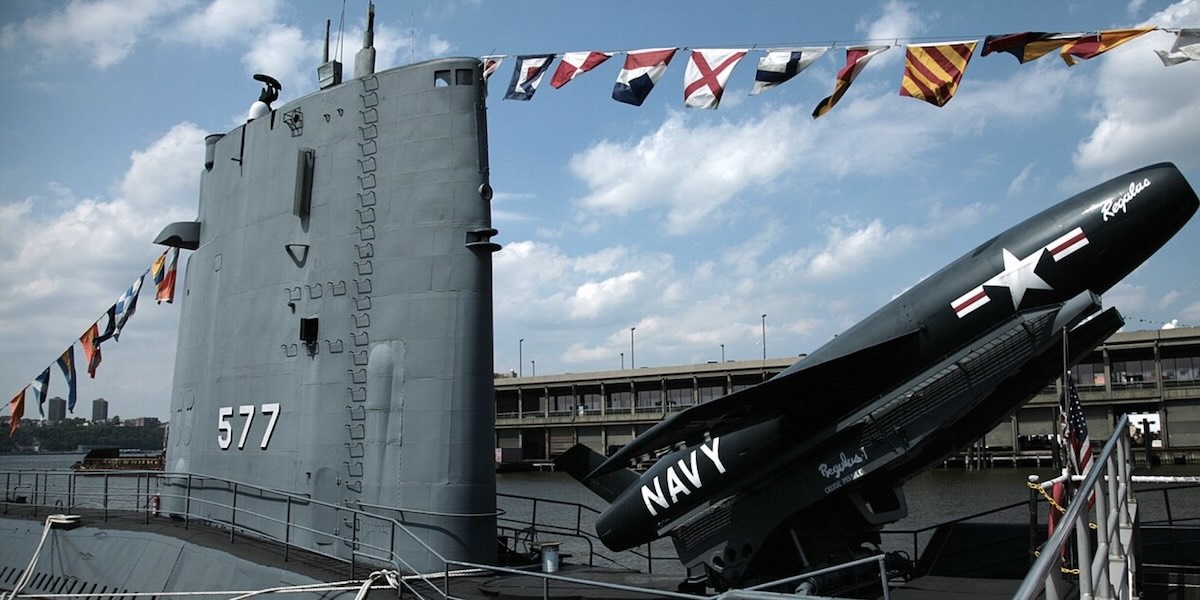
In the image
El USS Growler, uno de los submarinos diseñados para proveer capacidad de disuasión nuclear a EEUU, con un misil Regulus I [Max Smith]
Introduction
“The chief purpose of our military establishment has been to win wars. From now on its chief purpose must be to avert them.” Bernard Brodie’s statement at the dawn of the nuclear age captures the foundational logic of nuclear deterrence: under the later logic of Mutual Assured Destruction, this type of weaponry should not be designed to be used, but to avoid another large-scale war. However, in the current decade, the role of nuclear weapons is being reassessed in a profoundly transformed strategic environment, which is characterized by multipolarity, the erosion of arms control treaties and the birth of Emergent and Disruptive Technologies (EDTs).
The paper examines whether these advancements have affected the essential function of nuclear weapons in the present decade. It contends that nuclear weapons continue to function primarily as deterrents despite their increasing complexity and exacerbating risks. Even if their diplomatic assurance role has expanded, the military utility is limited.
To this end, the paper gets into de concept of nuclear deterrence, then analyzes current geopolitical and technological developments, in order to later asses the implications on the role of nuclear weapons in the global arena.
Nuclear deterrence
A classical definition of deterrence is “the manipulation of an adversary’s estimation of the cost/benefit calculation of taking a given action. By reducing prospective benefits or increasing prospective costs (or both), one can convince the adversary to avoid taking the action.”[1] James J. Wirtz argues that conventional and nuclear deterrence are strategically different, but that, in both cases, “Regardless of the weapons employed or the strategy adopted, capability and credibility are the key ingredients of deterrence success.”[2]
The difference between both kinds of deterrence lies in contestability. Conventional deterrence is contestable on the battlefield, whereas nuclear deterrence, with its catastrophic consequences, is largely uncontestable. This affects credibility: nuclear weapons suit retaliatory deterrence, while conventional forces are better for punishment and denial strategies.[3]
Faced with the new strategic environment, Keith B. Payne emphasizes the extreme value of prudence, which requires flexible and resilient nuclear and non-nuclear deterrence capabilities to dissuade threats from diverse and changing contexts.[4]
This is important because uncovering an adversary’s intentions must be understood as a psychological process. According to Michael J. Mazarr, this depends on how the adversary’s activity affects our perception of risks and feelings of uncertainty.[5]
We see the renowned statement of Colin Gray, who stated that “to deter, an ounce of will is worth more than a kilo of muscle.”[6] However, will is more unstable than capabilities, which explains why nuclear states maintain the deployment of force and declarative postures in line with their nuclear doctrine.
Impactful new developments in the 2020’s
Unlike during the Cold War, the current geopolitical landscape is multipolar, with diverse nuclear actors and EDTs complicating the nuclear order. Deterrence remains relevant, even though its credibility is challenged by new strategic calculations and regional dynamics.[7]
The war in Ukraine has become a game-changer, since it has exposed both strengths and limitations of nuclear deterrence. On the one hand, Russia has shown how nuclear capabilities can be used to influence conventional warfare dynamics in order to deter third party direct intervention.[8] On the other hand, it has failed to deter Ukraine’s resistance, even with the threat to use TNWs.[9] This has spurred an arms race and questions about extended deterrence in other regions, particularly Asia-Pacific and the Middle East.[10] Since, “one consequence of the war might be that advocates of nuclear weapons scale back their claims and ambitions.”[11]
Although the Ukrainian is a central case study, a broader geographical perspective shows that deterrence dynamics vary significantly across regions. In South Asia, the India–Pakistan rivalry represents a relatively stable yet inherently dangerous deterrence relationship, characterized by short warning times, risks of conventional escalation, and the persistent possibility of nuclear use. In the Middle East, the conflict between Israel and Iran reflects a particularly complex deterrence environment, where nuclear asymmetry and ambiguity interact with increasingly autonomous regional security arrangements. The emergence of the Makkah Joint Defence Agreement between Saudi Arabia, Türkiye and Pakistan adds a new layer to this dynamic by linking a major regional power to a collective-defence framework that includes a nuclear-armed state.
Across these cases, a common pattern emerges: increasing uncertainty and heightened escalation risks driven by regional tensions and evolving strategic calculations. This uncertainty is further reinforced by concerns about the reliability of extended deterrence, particularly in light of fluctuating US foreign policy commitments. As a result, debates about alternatives to the US nuclear umbrella have intensified, especially in Europe. In this context, France has gained renewed attention due to its independent nuclear arsenal and its potential role in strengthening European deterrence. While French nuclear doctrine remains strongly tied to national sovereignty, these discussions highlight its growing relevance within the European security architecture.
Overall, these developments demonstrate that nuclear deterrence in the 2020s is not uniform, but increasingly shaped by regional dynamics, strategic cultures, and threat perceptions.
Some authors consider that this new arms race and purpose of deterrence are changing the nuclear order, which entails the sets of practices and norms that rule the use of such capabilities with certain logics.[12]Despite that, this does not entail “slouching towards a nuclear Gomorrah,” since, according to Stephen Herzog, “foundation of international nuclear governance is more robust than often assumed.” Even though, mistrust among nuclear game-players is making several traditional multilateral arms control agreements fall under stress. The ABM Treaty of 1972 and the INF Treaty of 1987 where already dysfunctional before the war. At the same time New START, intended to bring transparency and limitation to strategic launchers and deployed warheads, collapsing after 2025.[13] Other treaties, like Comprehensive Test-Ban Treaty (CTBT) and the Outer Space Treaty are being questioned since the nuclear taboo is eroding.[14]
The challenge posed on non-proliferation is based on assurance. Terminologies tend to be mistakenly used as interchangeably with extended deterrence. Extended deterrence refer to “influencing adversaries to prevent attacks on allies,” whereas assurance is “directed at convincing allies.” As stated by Jennifer Bradley, “Just as deterrence is a cognitive function in the mind of the adversary, assurance is a cognitive function in the mind of the ally.”[15] This assurance is increasingly being questioned, specially regarding the US security umbrella. A significant case is the Republik of Korea, which signed the Washington Declaration and the establishment of the Nuclear Consultative Group (NCG) in April 2023. This came up after Sun Yeok approximation to the idea of ROK developing its own nuclear capabilities. Through the NCG assurance pretended to be granted through conventional-nuclear integration (CNI).[16] Japan and Australia, traditionally against the build-up of nuclear capabilities, are also discussing the possibility of nuclear-sharing agreements.[17] Russia has also made a shift on its nuclear-sharing position, by granting protection to Belarus through the deployment of tactical nuclear weapons on its territory.[18]
The newly established Makkah Joint Defence Agreement between Saudi Arabia, Türkiye and Pakistan provides a further illustration of this trend. Signed in August 2026, the agreement establishes a collective-defence framework under which an armed attack against one signatory is treated as an attack against all three. Although the agreement is formally defensive and does not explicitly identify an adversary, its significance lies in the combination of Saudi economic power, Turkish military capabilities and Pakistan’s nuclear deterrent. Rather than relying exclusively on the US security umbrella, Saudi Arabia is therefore participating in the construction of an alternative regional security architecture. This reinforces the importance of assurance as a component of deterrence: when the credibility of external guarantees is questioned, states may seek to diversify their security arrangements rather than immediately pursue independent nuclear capabilities. The agreement consequently illustrates how the role of nuclear weapons in the 2020s is becoming increasingly embedded in complex regional deterrence relationships.
The trend of EDTs, such as hypersonic weapons, cyber capabilities and AI, may impact the future of nuclear deterrence much more now than in previous debates.[19] Several authors have noted that EDTs generate vulnerability on nuclear capabilities, as they can make more credible an attack on an enemy’s nuclear forces and infrastructure like early-warning and command-and-control systems. This entails “negative effect on crisis stability, by neutralizing or at least minimizing the so-called stabilizing effect of nuclear weapons.”[20]
Keir A. Lieber and Daryl G. Press further explore this issue by analyzing the survivability of nuclear arsenals, traditionally grounded in hardening and concealment, which are increasingly eroded by significant advances in weapon accuracy and a revolution in remote sensing technologies. This development carries profound implications: the combination of enhanced precision and improved surveillance renders nuclear attrition strategies more viable, enabling a counterforce scenario in which a first, disarming strike (attrition, eliminating most of an adversary’s capabilities) becomes markedly more plausible, thereby weakening the retaliatory logic of nuclear deterrence. Nevertheless, vulnerabilities can also be reduced through EDTs: “The new era of counterforce will not be static; it will be characterized by vigorous efforts to develop countermeasures, as well as equally vigorous efforts to overcome them.”[21]
How the role of nuclear weapons has changed?
In 1983, Robert S. McNamara wrote an article titled “The Military Role of Nuclear Weapons: Perceptions and Misperceptions.” In it, he indicated that there are three incompatible views on the role of nuclear weapons: (1) TNWs can be used in a limited way for combat; (2) They have no military utility and their function is deterrence to prevent the enemy's first use; (3) What maintains the deterrence of a conventional attack is the threat of using them first. According to McNamara, a strategic first strike is not possible because it implies MAD. He also considers the use of TNWs militarily useless and politically suicidal, as they would facilitate a bloody escalation. McNamara’s statement on the role of nuclear weapons is clear: “Nuclear weapons serve no military purpose whatsoever. They are totally useless, except only to deter one's opponent from using them.”[22] Now it is necessary to consider whether new geopolitical dynamics and the development of EDTs have changed that exclusive role of deterrence.
Despite this, the debate over the utility of TNWs remains highly contested. Classical strategic thinkers, such as André Beaufre[23] and Michael Qinlan,[24] argue that TNWs contribute to the credibility of deterrence by filling the ‘gap’between conventional forces and strategic nuclear retaliation. From this perspective, limited nuclear options are necessary to make deterrence more flexible and therefore more believable in scenarios where full-scale retaliation would be disproportionate. Actually, this logic is reflected on NATO’s longstanding reliance on dual-capable aircraft and forward-deployed nuclear capabilities,[25] as well as on the ongoing modernization of systems like the US Navy’s Trident force, which includes changes to the W76 warhead.[26] These developments suggest that TNWs, rather than vanishing, are still integrated into operational planning as escalation control and signaling tools. As part of their deterrence strategy, even nations like France stress the importance of air-launched nuclear weapons as a ‘last warning’ capability. This implies that TNWs are still a part of the larger discussion about whether or not limited nuclear use improves or jeopardizes strategic stability.
According to Duchy and Bradley, TNWs play a primarily cohesive role within NATO, with a secondary military impact, since their direct military function has diminished due to US conventional superiority. However, they serve as a visible signal of US defense commitment to Europe. Just as TNWs decreased between 1980 and 2000 after the INF Treaty, the current trend reverses due to weakening treates and state’s need for assurance. Nevertheless, the role of TNWs differs depending on nuclear doctrine. For Russia, the use of TNWs is envisioned to force a de-escalation strike, that is, to impose red lines through compliance. This stance stems from its conventional inferiority compared to NATO and China’s numerical superiority.[27] One of the first instances of compellence through TNWs has been observed in Ukraine. During the Ukrainian offensive on Kherson, Russia reportedly signaled the possible use of TNWs to Western capitals, illustrating their limited but non-negligible coercive role. This supports Per Duchy and Bradley A.’s argument that the military role of TNWs is secondary, though not entirely absent, contrary to McNamara’s view.[28]
Regarding the possibility of a first-strike, Tom Sauer describes how an operation would be developed to disable the enemy's retaliation deterrence through the application of EDTs. First step would involve neutralization of Early Warning Systems. This can be done: Generating noise to interfere with the satellite, spoofing, electromagnetic interference, cyberattacks or with an accurate strike against radars. Second, use cyber and kinetic weapons to neutralize enemies nuclear forces. ICBMs are cyber-sensitive, and it is discussed if submarines (regarded as almost invulnerable nowadays) might be vulnerable to hacking. Actually, submarines may become already vulnerable by detection from sensors on autonomous underwater drones or swarm robotics. Finally, C2 will be the most detached element from the internet, but still cyberattacks are plausible, both disabling and enabling. Therefore states, “will be under immense pressure to safeguard their own nuclear forces and systems in crisis, and as a result use them, possibly even in a preemptive way.”[29]
However, multiple authors contradict this. Lieber and Press note that increased precision reduces hardening protection but does not show all systems can be neutralized. His own analysis depends on large assumptions about future technological capabilities, and does not prove that a fully effective first strike is achievable. Similarly, Andrew Futter does not deny that disruptive technologies pose challenges, but he criticizes the tendency to think that these technologies alone will make nuclear deterrence obsolete. Human decisions are more important than pure technology for nuclear stability, and technological simplifications can lead to not understanding the difference between theory and practice.[30]
So, despite new geopolitical dynamics and EDTs, McNamara was essentially right: nuclear weapons remain primarily an instrument of deterrence. The possible military use of the TNW is still very limited and only occurs in situations of vital interest and the EDTs are not yet capable of ending strategic stability. This does not mean, as James M. Acton indicates, that the risks have not increased, especially in relation to the entanglement derived from dual-use command, control, communication.[31] Likewise, it is important to observe whether the role of deterrence has changed, thus taking into account the traditional dual purpose of strategic deterrence: preventing aggression while promoting global nuclear stability.[32]
Regarding the preventive use of nuclear weapons, it is most clearly observed in recent conflicts where they have shaped the scope and limits of aggression without being used. In the case of Ukraine, Russian military doctrine emphasizes that nuclear deterrence applies when Russia’s territory or vital interests are in danger. This has allowed direct non-intervention by third parties, which illustrates how nuclear weapons can enable conventional aggression while simultaneously limiting its horizontal expansion. As in the Cold War, it avoids interstate escalation while the war takes place in a third state. Likewise, although the war has only occurred in Europe, in Asia-pacific there have been tensions.
Avner Cohen argues that Israel’s nuclear posture is designed not to deter low-level or asymmetric attacks, but to prevent large-scale aggression by regional adversaries or coalitions that might threaten its survival. [33] The escalation resulting from the Hammas attack on October 7, 2023 reinforces this distinction. As Tsili Lahav, head of Israel’s economic mission in Spain, indicated, Israel is “a two bombs state.” Hypersonic missiles are capable of overtaking Iron Dome. Therefore, the incorporation of nuclear capabilities to a few of these missiles could entail the destruction of an extremely small state. Hence Operation Night Hammer seeked to disable the Iranian nuclear program before it became functional at all costs. Therefore, nuclear deterrence plays a survival role, but proves insufficient to deter limited, asymmetric, or subconventional forms of aggression.[34]
Conclusion
This analysis shows that, despite significant geopolitical and technological changes, the fundamental role of nuclear weapons in the current decade remains that of nuclear deterrence.
The war in Ukraine and tensions in the Asia-Pacific demonstrate how nuclear deterrence serves to prevent regional conflicts from escalating into broader confrontations that could affect the vital interests of nuclear powers. Nuclear weapons therefore serve primarily as instruments of strategic deterrence and as a means of limiting the intervention of third states, rather than as instruments of direct combat. As for TNWs, although they currently have a very limited military effect as instruments of compellence, they play a diplomatic role in providing assurance. However, other measures, such as NCGs, have also had to be established.
EDTs pose unprecedented challenges to strategic stability by increasing the vulnerability of EWSs and nuclear arsenals while potentially hindering command and control (C2). Despite this, EDTs have not replaced the logic of deterrence, since the risks posed by these technologies ultimately remain mediated by human perception.
As a final assessment, in order to guarantee strategic stability in this decade, it must be acknowledged that nuclear weapons have not lost their relevance; rather, their role has become more complex. Above all, this requires prudence and constant strategic adaptation.
[1] Austin Long, “Department of Defense as Ministry of Fear: The Theory of Deterrence”, en Deterrence—From Cold War to Long War: Lessons from Six Decades of RAND Research, 1st ed. (RAND Corporation, 2008).
[2] James J. Wirtz, “How Does Nuclear Deterrence Differ from Conventional Deterrence?”, Strategic Studies Quarterly 12, no. 4 (2018): 58–75.
[3] Ibid.
[4] Keith B. Payne, «Nuclear deterrence in a new age», Comparative Strategy 37, n.o 1 (2018): 1-8, https://doi.org/10.1080/01495933.2018.1419708.
[5] Michael J. Mazarr, Understanding Deterrence (Santa Monica: RAND Corporation, 2018).
[6] Colin S. Gray, “Deterrence Resurrected: Revisiting Some Fundamentals”, Parameters 40, no. 4 (2010–2011): 97–109.
[7] Matthias Dembinski y Mikhail Polianskii, «Nuclear Threats, Nuclear Deterrence, and the Future of Nuclear Restraint Regimes after Russia’s War of Aggression», en PRIF Report (Peace Research Institute Frankfurt, 2024), https://doi.org/10.48809/PRIFREP2405.
[8] Ibid.
[9] Dimitri Minic : “ La guerre en Ukraine a entraîné une perte de crédibilité de la dissuasion nucléaire russe ” | Ifri», 6 de octubre de 2025, http://www.ifri.org/fr/presse-contenus-repris-sur-le-site/dimitri-minic-la-guerre-en-ukraine-entraine-une-perte-de. Accessed 1 September 2026.
[10] «The Future of Nuclear Proliferation after the War in Ukraine | Ifri», 16 de abril de 2024, http://www.ifri.org/en/studies/future-nuclear-proliferation-after-war-ukraine. Accessed 1 September 2026.
[11] Tom Sauer, «How Useful Are Nuclear Weapons in Practice? Case-Study: The War in Ukraine», Journal for Peace and Nuclear Disarmament7, n.o 1 (2024): 194-210, https://doi.org/10.1080/25751654.2024.2359818. Accessed 1 September 2026.
[12] Matthias Dembinski y Mikhail Polianskii, Nuclear Threats, Nuclear Deterrence, and the Future of Nuclear Restraint Regimes after Russia’s War of Aggression (2024), https://doi.org/10.48809/prifrep2405.
[13] Ibid.
[14] Doreen Horschig, A Fragile Consensus?: The Pressure on the Norm against Nuclear Testing (French Institute of International Relations, 2025).
[15] Jennifer Bradley, Preventing the Nuclear Jungle: Extended Deterrence, Assurance, and Nonproliferation, 2022.
[16] Bee Yun Jo, «Conventional-Nuclear Integration (CNI) as Alliance Practice for Extended Deterrence and Assurance», Journal of Peace and Unification, advance online publication, 1 de enero de 2024, https://doi.org/10.31780/JPU.2024.14.1.113.
[17] Bradley, Preventing the Nuclear Jungle: Extended Deterrence, Assurance, and Nonproliferation.
[18] Liviu Horovitz y Lydia Wachs, «Russian Nuclear Weapons in Belarus? Motivations and Consequences», The Washington Quarterly 47, n.o 3 (2024): 103-29, https://doi.org/10.1080/0163660X.2024.2398952. Accessed 1 September 2026.
[19] Tom Sauer, The Potentially Revolutionary Impact of Emerging and Disruptive Technologies and Strategic Conventional Weapons on the Nuclear Deterrence Debate, 2024.
[20] Ibid.
[21] Ibid.
[22] Robert S. McNamara, “The Military Role of Nuclear Weapons: Perceptions and Misperceptions”, Foreign Affairs 62, no. 1 (1983): 59–80, DOI.
[23] André Beaufre, Deterrence and Strategy (London: Faber & Faber, 1965).https://archive.org/details/deterrencestrate0000beau/page/n5/mode/2up Accessed 1 September 2026.
[24] Michael Quinlan, Thinking About Nuclear Weapons: Principles, Problems, Prospects (Oxford: Oxford University Press, 2009).
[25] NATO, Strategic Concept for the Defence and Security of the Members of the North Atlantic Treaty Organization. (2010) https://www.nato.int/content/dam/nato/legacy-wcm/media_pdf/pdf_publications/20120214_strategic-concept-2010-eng.pdf Accessed 1 September 2026.
[26] Office of the Secretary of Defence, Nuclear Posture Review (2018)
[27] Petr Suchy y Bradley A. Thayer, «Weapons as political symbolism: the role of US tactical nuclear weapons in Europe», European Security23, n.o 4 (2014): 509-28, https://doi.org/10.1080/09662839.2014.932772.
[28] «El ex jefe militar de la OTAN Rob Bauer: “España sueña si cree que los equipos de Huawei de la Guardia Civil no pasan información a China”», El Mundo, 10 de diciembre de 2025, https://www.elmundo.es/internacional/2025/12/10/69394006e85eced2068b4578.html.
[29] Sauer, The Potentially Revolutionary Impact of Emerging and Disruptive Technologies and Strategic Conventional Weapons on the Nuclear Deterrence Debate.
[30] Andrew Futter, Explaining the Nuclear Challenges Posed by Emerging and Disruptive Technology: A Primer for European Policymakers and Professionals, 2021.
[31] James M. Acton, «Escalation through Entanglement: How the Vulnerability of Command-and-Control Systems Raises the Risks of an Inadvertent Nuclear War», International Security 43, n.o 1 (2018): 56-99, https://doi.org/10.1162/isec_a_00320.
[32] Guy B. Roberts, «Shaping the Future of Nuclear Deterrence: Adapting to New Challenges and Opportunities», Peace Review 36, n.o 4 (2024): 674-91, https://doi.org/10.1080/10402659.2024.2414401.
[33] Avner Cohen, The Worst-Kept Secret: Israel’s Bargain with the Bomb (Columbia University Press, 2010).
[34] Curso Analista de Inteligencia, FESEI (June 2025)