
In the image
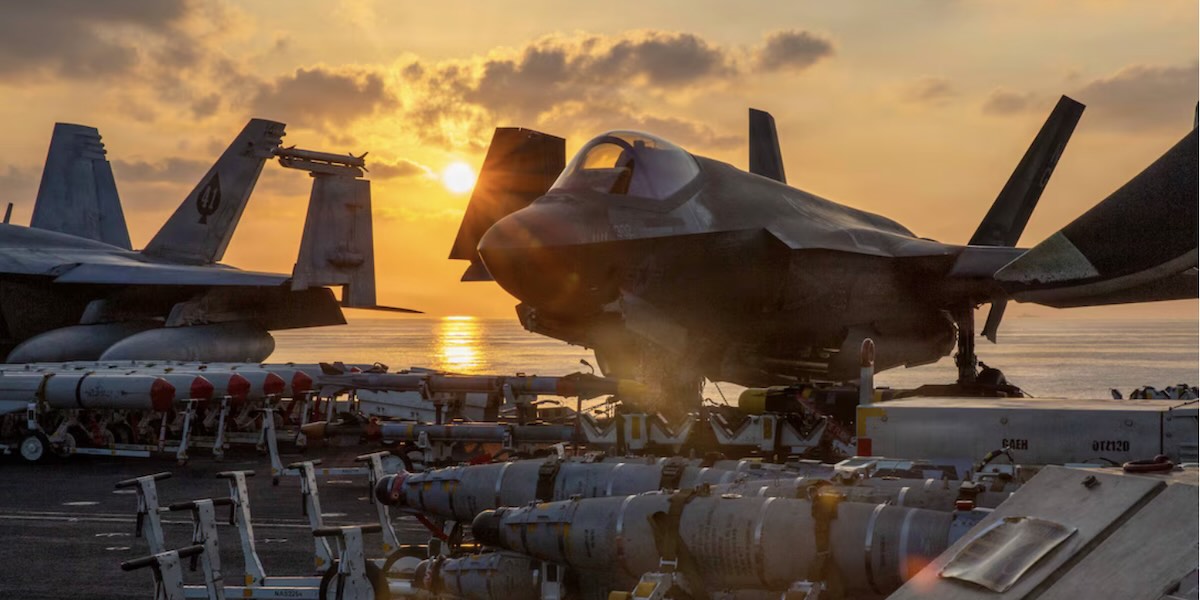
An F-35C Lightning II is staged for flight operations on the flight deck of the carrier USS Abraham Lincoln, in March 2026 [US Navy)
The National Defense Strategy published by the Trump administration in January 2026 represents a turning point in US military planning, signaling a recognition of the likelihood of attritional conflict in future warfare. With that kind of conflict in main, it stresses the necessity of a strong military production capacity and reliable supply chains. Rather than framing attrition as a contingency to be avoided, the document increasingly treats it as a condition against which Washington must be prepared.
On January 23, under the Trump administration, the United States Department of Defense —now referred to as the Department of War (DoW) following an executive order in 2025— released the unclassified 2026 National Defense Strategy (NDS), marking a shift towards a practical realism and the strengthening of US military readiness. As a follow-up document to the National Security Strategy (NSS), the NDS provides insight into the Department’s priorities. To this end, the document draws its strategic approach on four lines of effort: Defending the US Homeland; deterring China in the Indo-Pacific through strength, not confrontation; increasing burden sharing with US partners and allies; and the supercharge the US defense industrial base.This last point is of main interest for this analysis, whose main objective is to assess the question of whether the 2026 NDS marks a shift in US defense planning by assuming attrition as an unavoidable condition rather than a contingency to be deterred. Despite the contested nature of attritional warfare, it is important to acknowledge its necessity as part of a holistic defense strategy, even more so in light of China’s rise and the ongoing war between Russia and Ukraine.
Redefining attrition as an element of modern warfare
The International Encyclopedia of the First World War defines attrition as the “sustained process of wearing down an opponent so as to force their physical collapse through continuous losses in personnel, equipment and supplies, or to wear them down to such an extent that their will to fight collapses.” This definition suggests that attrition warfare entails high costs and high death tolls. It is because of its devastating nature that attrition warfare has traditionally been viewed as a last resort only.
Historically, wars of attrition have been associated with the large-scale industrial conflicts of the 20th century. Particularly, the First World War demonstrated how victory depended less on rapid maneuver than on the ability to sustain losses and exhaust the enemy’s manpower and resources over time. The post-Cold War era, however, saw an increased intention to avoid prolonged wars of attrition. In this context, US military strategic thinking emphasized rapid decisive operations enabled by technological superiority, precision strikes, and information dominance. It is not surprising, therefore, that the ‘shock and awe’ doctrine was the dominant strategic approach at the beginning of the 2000s. In this sense, post-9/11 armed conflicts such as the Iraq war demonstrated preference for bold rapid military response over interest in the systematic erosion of an enemy's military power.
Regardless of this, two major developments in the contemporary international arena point to the reversion to risk-averse oriented policies: the rise of China and the Ukraine-Russia War. These factors accelerate the change in perception about what attrition implies. The NDS, in this sense, describes China as being able to “afford to spend even more on its military,” and as being “able to do so effectively.” When addressing Russia, however, the DoW recognizes the Kremlin’s capacity to sustain war, and alerts of its “national resolve required to sustain a protracted war in its near abroad,” demonstrated in its confrontation with Ukraine. Current threats to US security challenge the classical conception of attrition as last resort, developing a more comprehensive understanding of the term as a possible factor of war that demands embedding it into defense strategies. The implication for the United States is that, in order to sustain a protracted effort, it must adapt the Joint Force to an attrition scenario.
Institutionalizing the attritional logic in US defense planning
To grasp the significance of this institutional shift, it is necessary to look back at its immediate predecessor. The 2022 NDS, released under the Biden administration, revolved around the idea of “integrated deterrence,” which, broadly defined, refers to the aim to work seamlessly across warfighting domains, theaters, the spectrum of conflict, and other instruments of US national power to prevent an escalation towards an open armed confrontation. This strategic approach did not emphasize attrition, where victory comes not from a deterrence or a single maneuver but from sustained war. In fact, the focus of that document was, precisely, on the prevention of attrition warfare, rather than on the need to be prepared to wage one. Not coincidentally, the document affirmed that “the Joint Force will be shaped to ensure the ability to respond to small-scale, short-duration crises.”
This is not to say that previous administrations have been entirely insensible to the risks of prolonged conflict. The 2026 NDS, however, marks an explicit departure from its predecessor that moves beyond deterrence language to formally assume sustained large-scale confrontation as a condition which the Joint Force must be prepared to endure. The document itself frames this shift towards attritional terms by stating that, “this effort will require nothing short of a national mobilization, a call to industrial arms on par with similar revivals of the last century that ultimately powered our nation to victory in the world wars.” On this line, Secretary Pete Hegseth stated: “Our objective is simple, if monumental: transform the entire acquisition system to rapidly accelerate the fielding of capabilities and focus on results.”
By accelerating acquisition cycles, the US military positions itself to adapt to changing battlefield conditions, ensuring that force regeneration keeps pace with evolving threats. In this sense, endurance is no longer understood as static stockpiling, but as dynamic adaptability, enabling the US to remain operationally effective while engaging in prolonged and unpredictable conflicts.
Reindustrializing the defense base as new strategy
If attrition is increasingly understood as a defining feature of future conflicts, then the capacity to industrially sustain prolonged warfare becomes an imperative rather than a logistical afterthought. In this regard, the NDS has emphasized the need to revitalize and expand the US defense industrial base.
More explicitly than previous administrations, the 2026 NDS emphasizes its intention to “supercharge the American defense industry so that it’s ready to meet the challenges of our era as effectively as it did those of last century.” The US Defense Industrial Base (DIB) comprises a wide range of companies that provide capabilities for military requirements, from large-scale production sites to research laboratories, including major defense contractors such as Lockheed Martin and Raytheon Technologies. In this matter, the ongoing rise of China, taken from a military standpoint, has led to growing concerns. When comparing US industrial capacity to that of Beijing just in 2023, shipbuilding capacity in the Chinese market was 232 times greater than that of the US. Similarly in 2024, the Chinese market was reportedly acquiring high-end weapons five to six times faster than its US counterpart. Under this context, US DIB’s productivity faces the risk of industrial decline.
Evidently, the intensified competition with China, after Russia’s 2022 invasion of Ukraine, has generated concern among policymakers about the health of the DIB. In light of this, under a prolonged war scenario, the question of revitalizing attritional warfare under a strong DIB constitutes a task of major national interest. The 2026 NDS is clear in its commitment to a long-term focus on military production capacity and supply chains. In doing so, it suggests that attrition should no longer be understood solely as battlefield losses, but as an industrial and economic contest of endurance in which the DIB becomes relevant.
Final considerations
The 2026 NDS represents a turning point in US military planning, signaling a recognition of the likelihood of attritional conflict in future warfare. Rather than framing attrition as a contingency to be avoided, the document increasingly treats it as a condition against which Washington must be prepared.
This shift is primarily recognized in the emphasis on revitalizing the DIB. The 2026 NDS suggests that the US views the revitalization of its DIB as a strategic necessity to compete with China and sustain prolonged conflicts. The comparison with China’s shipbuilding and weapons production capacity reveals growing concerns about the erosion of US industrial readiness and reinforces the idea that future military competition will depend not only on battlefield performance, but also on industrial endurance.
As a result, the 2026 NDS institutionalizes an attritional logic in which victory may depend less on short-term operational superiority than on the ability to continuously replace losses, adapt production cycles, and sustain national mobilization over time. While attrition has remained a contested feature of warfare since the two World Wars, current realities require a reconsideration of the necessity of a Joint Force where attrition and the expectation of prolonged war should be at the center of any military strategy. Ultimately, as retired Lieutenant Colonel Ralph Peters once concluded, there is no shame in calling reality by its proper name: “We are fighting, and will fight, wars of attrition.”