
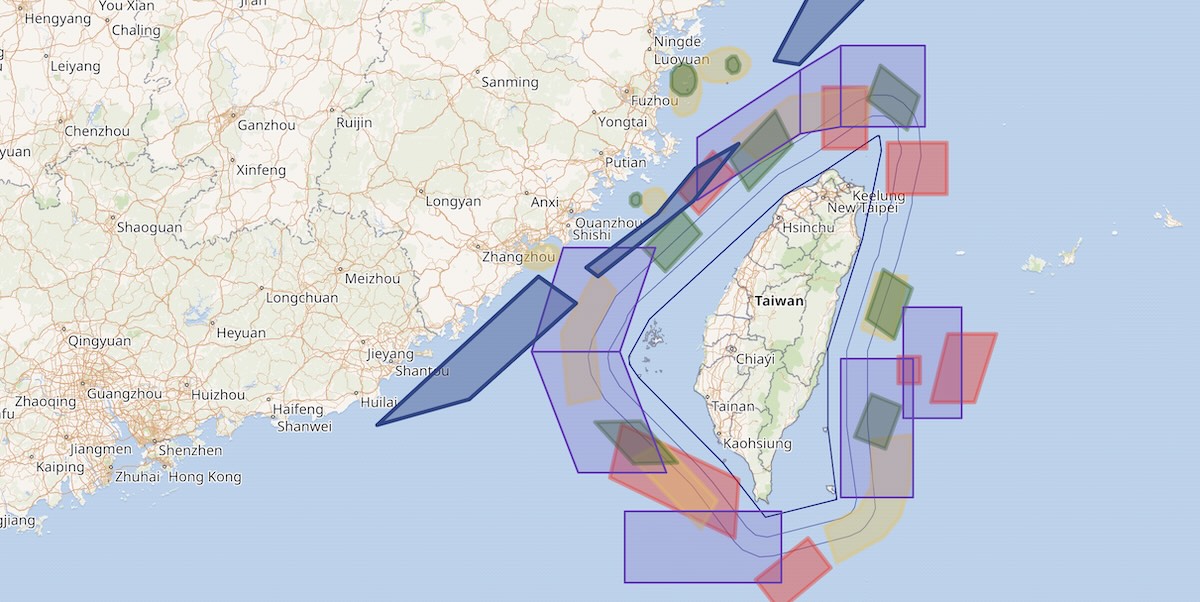
In the image
Locations of the combined operational zones utilized by the PLA for their military drills since 2022 [Wikipedia]
[Go to the interactive map to touch the areas and see the dates of the operations]
Imagine a merchant captain navigating the world’s most vital shipping artery. Ten years ago, the sight of a People’s Liberation Army (PLA) destroyer crossing the median line would have triggered international headlines and scrambled fighter jets. Today, that same captain wakes to a horizon cluttered with gray hulls, drone swarms, and ‘law enforcement’ patrols that never seem to leave. This isn't a sudden storm of war: it is a permanent fog.
In late December 2025, the People’s Republic of China (PRC) executed ‘Justice Mission-2025,’ a sophisticated two-day military exercise that effectively placed Taiwan under a quasi-blockade. The scene was defined by an unprecedented concentration of force, including over 200 aircraft sorties and a combined fleet of 14 PLA Navy warships and 15 Coast Guard vessels that tightened an encirclement across seven distinct zones. This strategic maneuver deliberately threatened to strangle Taiwan’s primary lifelines, forcing the cancellation or rerouting of approximately 941 civil aviation flights and obstructing critical LNG and maritime shipping routes.
The PRC has orchestrated a fundamental strategic shift toward Taiwan, transitioning from a reactive posture of deterrence to a proactive regime of normalization. While previous decades focused on preventing a formal declaration of independence through occasional ‘saber-rattling,’ the current doctrine prioritizes the institutionalization of functional control. By conducting frequent incursions across the median line and executing large-scale ‘rehearsal’ blockades, Beijing is effectively eroding the status quo through debilitation. The strategic objective is no longer merely to signal displeasure, but to transform provocative military maneuvers into a mundane, daily reality.
A turning point
In August of 2022, Nancy Pelosi, House speaker of the United States at that time, visited Taiwan. Many analysts have considered this as the geopolitical ‘Bing Bang’ that shattered the long-standing cross-strait status quo, specifically through the systematic nullification of the Median Line. Prior to this moment, the informal boundary was largely respected; for instance, between 2020 and 2022, only two recorded incursions crossed the line. However, the post-Pelosi ‘new normal’ saw an immediate and aggressive shift, with the PLA launching over 250 ‘military drills’ across the line in the first 23 days following the visit. These maneuvers, often associated with the ‘Joint Sword’ exercises, featured a heavy naval and aerial presence across six distinct zones surrounding Taiwan. By frequently crossing the Median Line the deployment effectively dismantled previous maritime taboos and signaled a shift toward a more permanent and assertive military posture in the region. This period transformed the Taiwan Strait into a theater of high-frequency, multi-zone incursions, where the PLA transitioned from isolated maneuvers in the southwestern ADIZ to complex, encircling operations.
The path to normalization
The military landscape of 2023 marked a definitive pivot from reactive signaling to a disciplined, ‘normalized’ state of high-alert readiness. Following high-profile diplomatic engagements like the Tsai-McCarthy meeting, the evolution of tactics shifted away from sporadic displays of anger toward sophisticated, repeatable operations centered on Joint Fire Strikes and precision encirclement.
This transition is most evident in two key areas. Firstly, the Philippine Sea Expansion. The PLA has pushed operational areas further into the Pacific to establish a persistent Anti-Access/Area Denial (A2/AD) buffer, intended to complicate or block intervention by Western allies. And second, the ‘law enforcement’ mask: by integrating the China Coast Guard (CCG) into military drills, Beijing is blurring the lines between a military act of war (blockade) and a domestic policing action (quarantine).
The normalization of these drills creates a cumulative exhaustion. For Taiwan, the cost is not just psychological; it is material. The constant scrambling of the Republic of China Air Force creates a ‘war of attrition’ on airframes and personnel. Meanwhile, the periodic rerouting of commercial shipping increases insurance premiums and threatens the ‘just-in-time’ supply chains of the global semiconductor industry.
Beijing’s strategic objective is now clear: to win without fighting by making the blockade so frequent that the world stops noticing until it is too late.
The architecture of lawfare: CCG Order No. 3
A critical, often overlooked dimension of this normalization is the transition from purely military maneuvers to ‘maritime law enforcement.’ In mid-2024, Beijing implemented Coast Guard Order No. 3, a decree that empowers the China Coast Guard (CCG) to detain foreign vessels and individuals suspected of “violating entry-exit management” in waters China claims as its own.
By deploying white-hulled Coast Guard ships alongside gray-hulled Navy destroyers, Beijing is attempting to reclassify the Taiwan Strait from an international waterway into internal waters. This ‘lawfare’ strategy creates a devastating dilemma for the international community: responding to a police action with military force risks being labeled as the aggressor, while failing to respond grants ‘de facto’ recognition of China’s administrative control.
Economic and energy vulnerability
The normalized blockade is not merely a tactical display; it is a calculated strike at Taiwan’s ‘Achilles’ heel’: Its extreme dependence on external resources. As of 2026, Taiwan remains a global energy island, importing roughly 97% of its energy. Taiwan’s Liquefied Natural Gas (LNG) reserves are notoriously thin, typically providing only 11 days of buffer. In a ‘normalized’ blockade scenario, China does not need to invade; it simply needs to delay a handful of tankers to trigger a cascading energy crisis that would paralyze the island's high-tech industry.
The stakes extend far beyond Taipei. With Taiwan controlling over 90% of the world's most advanced semiconductor manufacturing, even a ‘soft’ blockade, characterized by increased insurance premiums and shipping delays, acts as a massive tax on the global digital economy. Analysts estimate that a prolonged disruption in the Strait could cause a 5.8% contraction in global GDP, a shockwave larger than the 2008 financial crisis.
Psychological attrition: breaking the will to resist
Beyond the physical encirclement lies a deeper campaign of psychological attrition. The normalization of these incursions aims to induce a state of defense fatigue among the Taiwanese public and military.
Constant scrambles to intercept PLA aircraft place an enormous financial and operational strain on the Republic of China Air Force, forcing it to burn through maintenance budgets and pilot flight hours at an unsustainable rate. And by making ‘Justice Mission’ style drills an increasingly regular occurrence, Beijing seeks to dull the sense of urgency within the international community. The danger is that the world will eventually view a total blockade not as an act of war, but as a routine administrative adjustment, leading to a slow-motion surrender of the status quo.
Countering the ‘new normal’
The Strait of Taiwan has moved past the era of traditional deterrence. The normalization of the blockade represents a new, more sophisticated phase of conflict. One fought with ship counts, legal decrees, and the silent pressure of energy insecurity.
Preventing this ‘permanent fog’ from hardening into a final annexation requires a shift in international strategy. It demands not just military presence, but ‘economic deterrence’. Clear, pre-negotiated international sanctions that would trigger the moment a ‘quarantine’ begins. For Taiwan, the path forward lies in radical resilience: expanding LNG storage, diversifying energy sources, and ensuring that the ‘Silicon Shield’ remains too vital for the world to let it fall. The challenge for 2026 and beyond is to ensure that normalization does not become synonymous with inevitability.