
The awakening of the ‘Gen Z’ across Asia

The awakening of the ‘Gen Z’ across Asia: Common patterns and possible implications

ANALYSIS

04 | 12 | 2025

Text

The fact that young activists have been forced to resort to violence to bring about change in the system is deeply worrying and should not be ignored

In the image

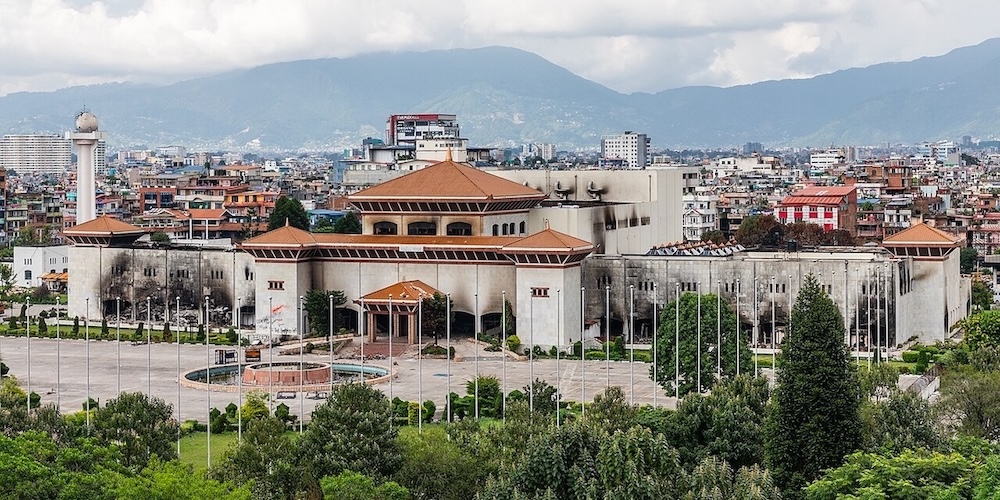
Damaged International Convention Centre in the capital of Nepal after Gen Z Protest, September 2025 [Bijay Chaurasia]

On September 9, 2025, the Nepalese Parliament was set on fire by young protesters, as part of the most violent unrest the country has faced in several years. During the protests, which began on September 8 and lasted 3 days, at least 72 people were killed by security forces, and official buildings, residences of political leaders and luxury hotels were targeted by arson, vandalism and looting. This ‘Gen Z Revolution’ was a direct consequence of the social media blockage by the Nepali Government, whose prime minister resigned after 48 hours of the violent revolt. However, Nepal is not the only country which has faced this political awakening. Other Asian countries such as Indonesia, Philippines and Bangladesh have also experienced these uprisings, which has aroused the idea that the ‘Gen Z’ has awakened.

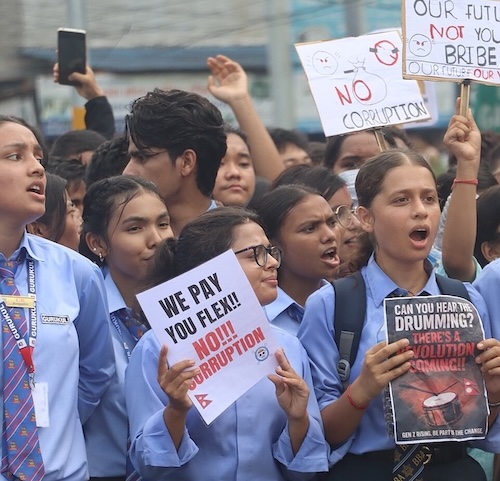
It is essential to analyze the key events that unfolded in early September in Nepal: the youth unrest had already begun by the day before the parliament was set ablaze, on September 8, after the announcement by the government of a social media ban of dozens of platforms. The reason given by the government for this ban was that these platforms did not comply with a series of registration requirements, which consisted of obtaining a license and appointing a representative in charge of addressing grievances. Among those platforms were several widely used social networks, including Facebook, YouTube, WhatsApp, Instagram and LinkedIn. Officials at the Ministry of Communication and Information Technology claimed it was their only option after several formal appeals, all followed by the refusal of those platforms to accept the new regulations. The ban was implemented on September 4, and led to many critics by the Nepali population, regarding the dubious intentions of the Prime Minister K.P. Sharma Oli to impose government control on speech after years of failure. The young protesters gathered in Kathmandu’s Maitighar Mandala and spread to other urban centers. The use of lethal force by the police to control the situation caused the death of 19 people, and others were injured.

On September 9, increased violence led to the collapse of the government, and Prime Minister K.P. Sharma Oli resigned. The parliament, Supreme Court, political party offices and leaders’ houses were set on fire. The Army took control of security in the capital: a curfew was established among all the country and warned of ‘mob justice’. The deaths rose to 25, as well as 600 injured.

Finally, on September 10, the country found itself in a situation of political vacuum: with no government and the army in charge of national security. The same evening, an online vote through a Discord channel (a communication space within Discord, an online platform used for online messaging and interaction), ‘Youths Against Corruption’, took place, with Sushila Karki, former Chief Justice, emerging as the winner and interim Prime Minister.

A deep-seated frustration

The events that occurred in Nepal during these days clearly reflect a deep-seated frustration and discontent among the young Nepali population, which had been building long before the social media blockade was issued. It was evident that the protesters wanted change. Frustration and anger against the government and its communist leader, K.P. Sharma Oli, coalesced around a range of issues.

First, and most important, the population had been suffering decades of systemic corruption. Indeed, one of the main demands of the activists, apart from lifting the social media ban, was the establishment of an independent anti-corruption body. Nepal ranks 107th out of 180 countries in Transparency International’s Corruption Perceptions Index 2024, and has also been placed in the ‘grey list’ of the Financial Action Task Force (FATF). Corruption in Nepal has permeated everyday life, reinforced by its political and economic context: highly regulated economies which create monopolies, restriction of civil liberties, manipulation of national laws and ineffective law enforcement institutions. This causes government officials to normalize corruption, as it provides them with great benefits in exchange for little or no consequences.

The issue of the ‘Nepo-Kids’ was another source of frustration that concerned the participants of the uprising. This name designates individuals who did not come of established business families, nor did they inherit substantial wealth, which raised questions among the population about the origins of their privileged situation, with a luxurious life and foreign education. Weeks before the protests, photographs showing the wealthy lifestyles of these ‘Nepo-Kids’ went viral across social media. They are young people who have benefited from their families’ privileged position; children of Nepal’s political elite, who evidence the corruption and inequality that is present in Nepal: while 20,3% of population live below the National Poverty Line (2022), this privileged elite enjoy a luxurious life, which generated resentment among the Nepali population.

Political instability has been another major issue that led to the violent revolts. Since the monarchy was abolished in 2008, Nepal has experienced 14 different governments, all of which failed to remain in power for a full five-year term. This, as well as the recycling of the same political figures over the years, has contributed to the spread of frustration and distrust among the Nepali population, as they have perceived that the political change is superficial, and the same political elites that dominate power do not really represent the Nepali’s interests, but serve their own desire of power, wealth and privilege. Moreover, the absence of a consistent parliamentary opposition has led to a weak system of checks and balances: politics in Nepal is guided by self-interest, which is evidenced by the apparent lack of dominance of any of the three main ideologies in the Parliament (the Nepali Congress, Unified Marxist–Leninist and the Communist Party of Nepal), as all of the three parties cooperate with each other with the purpose of dividing the benefits of political power.

Finally, the lack of job opportunities among the population has also been a significant source of frustration among the young Nepalis. With a youth unemployment rate of 20.8% (2024), many people have tried to find new opportunities abroad, which is why around one-third of Nepal’s gross domestic product is generated through remittance inflows. Nepal has failed to provide qualified jobs for the high number of young, educated people. There is a considerable imbalance between the educational system and the skills demanded by the market (80% of the employment in the country is in the informal sector). This has led to mass frustration and migration to find new opportunities, mostly to Gulf countries.

Nevertheless, Nepal is not the only country to have experienced a youth-led uprising. Several ‘Gen-Z’ movements have emerged across different countries in Asia, and it is interesting to analyze the common patterns among them.
In the image

Gen Z protest against government in Chitwan, Nepal, September 2025 [हिमाल सुवेदी]

Across different countries

In Indonesia, like Nepal, half of the population is under the age of 30. Indonesia also experienced youth demonstrations, but in this case, the uprisings were directly caused by the lavish privileges enjoyed by government officials: reports showed that, since September 2024, 580 members of the House of Representatives had been receiving a monthly housing allowance of 50 million rupiah (3,075 dollars). The protests, which began on August 25 and reached their peak on August 31, caused ten deaths, the destruction of hundreds of cars, and several government buildings burned. Citizens demanded the abolition of these perks enjoyed by the lawmakers, given the situation of economic hardship experienced by the majority of the population: the housing benefit amounts to nearly 20 times the minimum monthly wage earned in less-developed regions. Moreover, their demands were driven by almost the same issues as those of the Nepali youth: unemployment, corruption and economic inequality. As a result, President Prabowo Subianto revoked the government perks and removed five ministers from office.

On 21 September 2025, tens of thousands of Filipinos took place in a protest against government corruption, after billions of dollars in public funds collected from taxpayers were reportedly lost to fake flood relief projects. President Ferdinand Marcos Jr had uncovered this issue in July, and  established an independent commission to investigate anomalies in most of the flood-control projects, worth more than 9.5 billion dollars. Though the protests were largely peaceful, the following day violent confrontations between protesters and the police took place in Ayala Bridge and Mendiola, resulting in more than 200 arrested.

Bangladesh was also host to a student-led protest known as the Quota Reform Movement, which aimed to reform the quota system in government jobs in the country. This system was created to favor minorities, but in practice, students and youths perceived it as a form of discrimination, which created inequalities in government jobs. The system had been previously eliminated for first- and second-class jobs in 2018 by Prime Minister Seikh Hasina, but it was reestablished in 2024 after the High Court declared the invalidity of the order. Facebook as a platform played a crucial role in organizing the protest, as pages and groups were created by protesters to organize rallies and share activities. Videos and photos in which violent acts by government-supported groups and the police were documented and disseminated, which triggered public anger and transformed what initially began as a student protest into a mass revolution that toppled Sheikh Hasina’s regime.

Comparative analysis

A comparative analysis of the uprising in Nepal and these other movements across Asia reveals several common characteristics: each of these movements was led by young people and took place in nations with predominantly young populations; hence, they did not constitute a minority. These revolutions have helped channel the voices of millions of frustrated individuals who have finally awakened after decades of government-imposed limitations and abuses. Most of these have been commonly experienced by citizens of the four countries analyzed: corruption and mismanagement of resources, economic inequality, lack of jobs and labor discrimination. The key role of the social media in the revolt is another shared feature: the movements were mostly organized through social networks, which were employed by youngsters to gather the activists by creating groups, coordinate rallies, meetings or circulating photos and videos that helped ignite the spirit of the revolution.

It is evident that these social movements have drawn the attention of the international community, but questions remain about the extent of their impact. All of them are leaderless, which has undoubtedly broken precedent, demonstrating, in words of Piyush Adhikari, “that change could emerge from the collective rather than the charismatic.” However, this also raises doubt whether these movements will lead to real change or are just a product of an impulse of thousands of young people, reinforced by the use of social media. While it is not certain if major changes will be accomplished in years to come, some of them have actually been implemented: in Nepal, the government was overthrown, and Sushila Karki became the first-ever female prime minister in the country’s history; in Indonesia, Subianto followed the demands of the activists and removed the perks; and in Bangladesh, the protests ended up in the resignation of Hasina. This confirms that the thousands of frustrated young activists have not gone unnoticed.

Nonetheless, considering the consequences, the true value of these achievements is questionable: the fact that young activists have been forced to resort to violence in order to bring about change in the system—resulting in deaths, detentions, destruction, and overall chaos—is deeply worrying and should not be ignored. It has brought to light the lack of civil liberties that is present across Asia, as well as other deep issues that are overlooked by the international community. The problem runs deeper: these issues are structural, deeply embedded in the countries’ functioning and traditions, and a change of regime will not bring about a quick solution. Corruption in many Asian countries has become systemic, and the political and economic contexts of these countries complicate this issue: therefore, the solution relies on reforming the institutions and introducing transparency systems, in order to exert a stronger and more reliable control over the government and political elites. It is interesting to notice that in some of the analyzed countries, Nepal and Indonesia, the revolutionaries directed their efforts against symbols of state power, including official buildings; not just political leaders’ houses, but other institutions such as the parliament or the supreme court were also set on fire. This could be interpreted as a collective anger of far greater significance than a mere impulse, directed not only toward the current government, but also toward the entire institutional foundation of the country: against the three branches of power on which the State itself relies.

While violence and chaos can produce rapid change, the deeper structural problems are unlikely to be resolved in such a brief period. It is certain that these protests have not been passed over by the international community. However, as it has been stated, the grievances that caused these protests are not considered in the regional context as true anomalies. This reality means that the problems will remain internal, with the populations and political leaders of each country or region bearing the responsibility to lead the process of change. Until meaningful reform occurs, economic inequality, lack of job opportunities and, overall, systemic corruption, will continue to dominate internal affairs. Young populations, who are the most affected, may once again resort to violence if their claims are not adequately attended. All efforts should focus on creating an effective system that address grievances peacefully and prevent the recurrence of violent conflict.