In the image
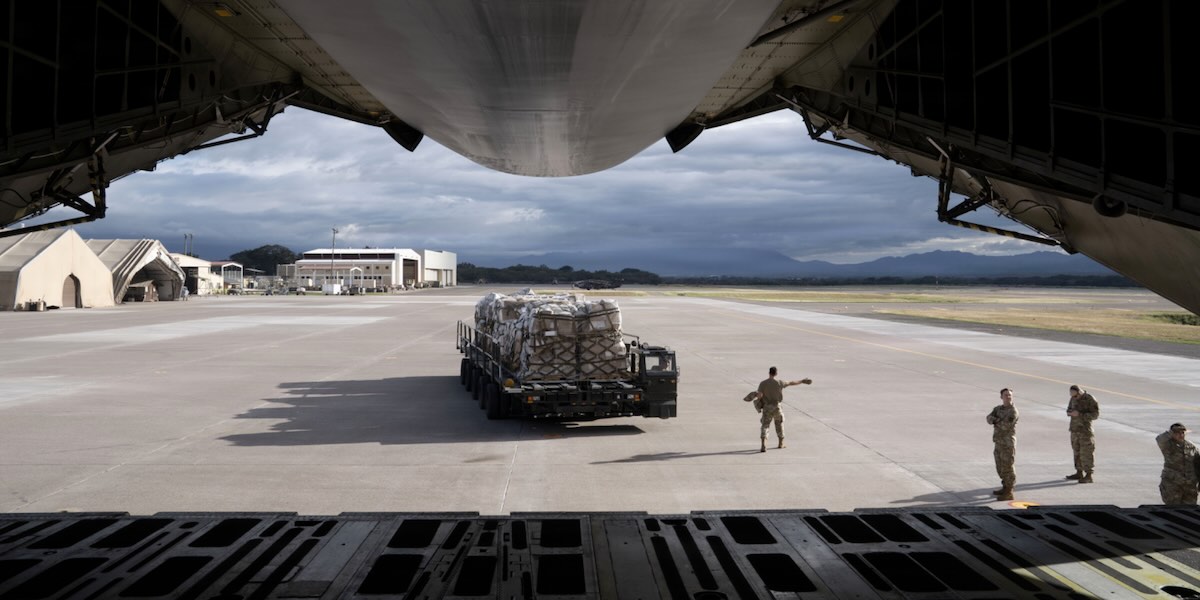
Humanitarian cargo during a Denton mission at Soto Cano Air Base, Honduras, Jan. 12, 2026. [Sgt. Alexander Merchak]
For decades, Honduras and Latin America in general have been at the back of US security policy. Compared to its counterparts in Europe, Middle East, and Indo-Pacific, the US Southern Command (SOUTHCOM) held only a miniscule force with which to engage the handful but formidable threats in theater. However, since the return of Donald Trump to the White House, the United States has increased its military presence in Latin America, primarily aimed at fighting the drug cartels and containing Chinese influence in the region. One key area in the War on Drugs, however, has seen no increase in American forces: Honduras and the vital Soto Cano Air Base.
The present article seeks to analyze the US military assets and missions currently in Honduras and the US approach to the security challenges the small but geographically vital Central American nation is facing, to conclude that the current level of US forces in Soto Cano base is insufficient. The article also offers recommendations for US and Honduran policymakers in this matter. Additionally, the article identifies challenges faced by the US in the region and possible contingencies.
Background
Following the end of the Cold War, the United States reduced its attention regarding security issues in Latin America. The end of proxy conflicts in Guatemala, El Salvador, and Nicaragua saw considerable reductions of US forces in the region after the 1989 invasion of Panama, (operation ‘Just Cause’) and the subsequent withdrawal of all US bases from the Canal Zone by 2000.
In the case of Honduras, Soto Cano Air Base in Comayagua Valley also saw troop reductions. The 1980s had seen the deployment of considerable numbers of US Army, Marine, and Air Force units to that facility to contain the ‘spread of Communism’ and provide assistance to Contra rebels engaged in attempting to overthrow Nicaragua’s revolutionary regime. The end of the Cold War saw the withdrawal of most of these forces, as focus shifted to the Balkans and disarmament.
This situation has persisted ever since. In 2025, however, the Western Hemisphere saw a considerable shift in US posturing, as Washington deployed a considerable amount of assets to the Caribbean as part of a campaign against drug trafficking launched by the Trump Administration. The campaign soon escalated into pressuring Venezuela’s regime to fall. These efforts were later consolidated into Operation ‘Southern Spear.’
American military efforts saw increased US military presence in the Caribbean and the reopening of decommissioned military bases in Puerto Rico. However, Soto Cano, America’s largest base in Central America was not involved in the buildup that culminated in the US’s first military operation in a Latin American country since Panama when US Special Forces, supported by aircraft and naval assets, captured Venezuelan dictator Nicolas Maduro on January 3rd, 2026 during operation ‘Absolute Resolve.’
Furthermore, American efforts to fight drug cartels, organized crime and human trafficking led to the establishment of the ‘Shield of the Americas’ initiative in Florida in a meeting between Trump and eleven Latin American leaders, with the declared objective of increasing coordination to fight the drug cartels and organized crime. The pact has faced severe criticism over the absence of key countries involved in drug trafficking such as Colombia, Mexico, and Venezuela.
As of 2026, despite US President Trump’s more aggressive push to fight drug cartels and reclaim American influence in the region, US military assets in Honduras have not varied in any significant way, even if the situation in Honduras has started to deteriorate in relation to the War on Drugs, with production of illegal drugs gradually increasing, and with the country shifting from the status of transit country to one of producer.
Furthermore, operations in Latin America have seen the transfer of resources to Europe and the Middle East with the start of the US-Israeli campaign against Iran (operation ‘Epic Fury’). Particularly significant was the departure of the aircraft carrier USS ‘Gerald Ford’, which was transferred to the Mediterranean to participate in the operation against Iran in February of 2026.
Major challenges in security
One of the major security challenges facing Honduras has been transnational crime in the form of traffickers tied to the drug trade in Mexico and Colombia. Honduras’ geographical location makes it a necessary steppingstone for cartels heading to the US. The influence of drug traffickers has been well documented, as seen in the major scandals that have affected presidents in the left and right or their families. While the true scope of the involvement of these figures varies based on available evidence, the damage government and political institutions have suffered has been palpable, as well as Honduras’ image in the international stage. This problem has been exacerbated by a weak judicial system.
Another challenge is that posed by natural disasters. Honduras, as the rest of the Central American region, is particularly vulnerable to hurricanes, such as Hurricanes Eta and Ioata in 2020, or like the infamous 1998 Hurricane Mitch. Another major risk is forest fires, particularly during the dry summer seasons. Water shortages have caused problems for firefight attempts trying to put down the flames in forest areas, which in turn leads to massive ecological damage. Furthermore, Honduras lacks helicopters with the capability to carry large water baskets to combat the fires, hampering efforts.
Organized crime and gangs are a common threat faced by the countries of the Northen Triangle, and one that has left its mark. While El Salvador under President Bukele’s controversial but effective war on gangs saw major success, Guatemala and Honduras have continued to suffer from high criminality rates. Alarmingly, members of gangs such as MS-13, which have been a thorn for law enforcement in the Northen Triangle for decades, have been arrested and deported in several Immigration and Customs Enforcement (ICE) operations in the US, showing the range of the gangs. Furthermore, in Central America, gangs have managed to control areas via extorsion as well as the freeing of fellow gang members from prison or deadly riots in prisons.
Poverty is the main concern of Central American countries, and one that has been linked to the other security problems affecting the region. Honduras has typically ranked amongst the worst-off countries in the region, surpassed only by Haiti. The lack of opportunities and inequality has led to considerable numbers of people leaving the country in the caravans. Complicating matters, a considerable amount of labor is informal in Honduras. This, alongside the dependency of many low-income families who wither live exclusively or partly on remittances sent by relatives in the US, some of which entered illegally into the country, causes considerable problems for Honduras’ stagnant economy, dependent on willingness of US officials on whether or not to enforce immigration laws.
Without any doubt, however, drug trafficking is the most important security challenge for Honduras, one whose effects spill over the country’s borders to involve the whole Central American region, and the US beyond it.
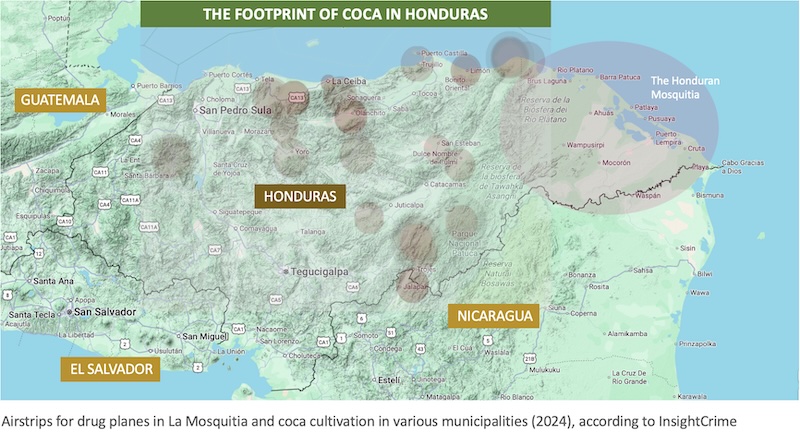
The Area of Operations (AO) where the War on Drugs takes place in Honduras is La Mosquitia, a massive jungle area covering the eastern part of Honduras and the border with Nicaragua, with considerable biodiversity and isolated population centers made up of native Misquito populations. The area is also known as the Biosphere of the Platano River. Dense jungle and rivers dominate the area, making ground access difficult, meaning operations will have to be conducted via helicopter or using small patrol boats to patrol rivers, like the US approached in Vietnam’s Mekong Delta. Drug traffickers have built small ‘narcopistas’: small, clandestine airstrips where Cessna and smaller aircraft land to unload drugs. Operations to neutralize them involve using explosives to crater the airstrips.
However, recent operations by the Honduran Army in the 2020s have discovered cocaine farms, where coca leaf plantation has started. This has expanded the AO from La Mosquitia to several major departments of Honduras, consisting of the Caribbean Coast areas and the Nicaraguan border areas. These areas are mountainous, and covered with either forest or jungle, making ground operations difficult in the perilous dirt roads that crisscross the mountains and valleys.
Trafficking also takes place in the Caribbean and Pacific, with small boats, known as ‘narcolanchas,’ moving considerable amounts of drugs towards the US. With all these things considered, Honduras faces at least three fronts of the War on Drugs: the Caribbean, the Pacific, and Eastern Honduras. Located geographically at the center of the continent and Central America, Honduras is the door for the drug cartels to reach the United States, and for Washington, the choke point where to slow the cartels.
Countering these problems is of immediate importance, not only for Honduras, but also for the United States, especially as Trump’s focus on security has emphasized countering illegal migration and drug trafficking.