
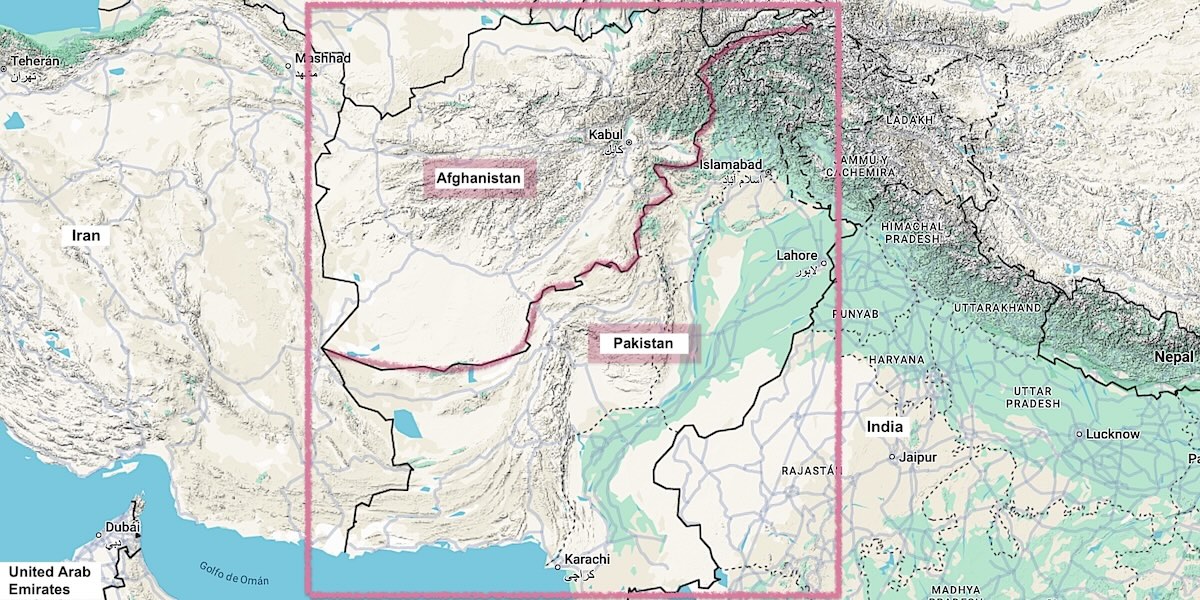
In the image
The Durand Line, the border between Afghanistan and Pakistan
In late February 2026, Pakistan went to war with Afghanistan by bombing positions of the Pakistani Taliban and the Islamic State-Khorasan Province near its border, in response to previous cross-border attacks by these militias. Pakistan accuses the Afghan Taliban government of supporting them. The war, now in a low-intensity conflict, shows the paradox of a state fighting its former proxy.
For decades, Pakistan’s relationship with Afghanistan has been shaped by changing strategic priorities, ideological alignments, and the enduring legacy of colonial borders. What began as a confrontational relationship has evolved, first into support and now into all-out war. Despite Pakistan’s commitment to continue fighting in Afghanistan, it has been quick to forget its past as one of the Afghan Taliban’s main supporters, a policy which has produced unintended consequences. The same Taliban movement once cultivated as a strategic asset has become a source of instability, empowering militant networks that now threaten Pakistan itself. With the fighting seemingly nowhere near stopping, the current conflict reveals not only the fragility of Afghan-Pakistani relations but also the long-term risks of proxy warfare and geopolitical opportunism.
Background on Pakistan-Afghanistan relations
Pakistani-Afghan relations have been continuously marked by cycles of tension. One of the main points of contention between these states until today has been the existence of the Durand Line, an artificial colonial border drawn up by the British in 1893. This border separates the Pashtun ethnic group between the two states, leading to almost a century of serious military hostilities, socio-economic issues and geo-political clashes between Afghanistan and Pakistan. Until the Soviet invasion of Afghanistan in 1979, the relation of this country with Pakistan remained contentious.
It was not until the Soviet invasion that Islamabad’s attitude toward its neighbor began to change, recognizing that the geopolitical landscape of the region had fundamentally changed. The Pakistani government then started to provide material as well as political support to Afghan resistance forces within Afghanistan and took up the issue on various international forums, as well as became the frontline state in the United States’ covert policy there. However, there were many resistance forces (mujahideen) fighting against the Soviet occupation, and Pakistan was faced with a difficult choice: Which group should it favor among them all? Ultimately, Pakistan made a choice that has defined its foreign policy until today: its Inter-Services Intelligence directorate began to provide support to a new Islamist organization called the Taliban, even going so far as to train its founder, Mullah Omar, in one of its anti-Soviet training camps.
By 2001, Pakistan was providing the Taliban regime in Kabul with hundreds of advisers and experts to run its tanks, aircraft and artillery, and thousands of Pakistani Pashtuns to man its infantry. Pakistan provided the oil needed to run the Taliban’s war machine. After the terrorist attacks in the US on September 11 of that year, as Pakistan positioned itself as one of Washington’s main allies in the Islamic world, it continued to support the Taliban, even welcoming its exiled leaders once the US invaded Afghanistan. From there, Pakistan increased its control and influence over the Taliban, giving the organization critical help and assistance used to resume the war inside Afghanistan in 2004.
However, there were some limits to Pakistani control of the Afghan Taliban. Even when Mullah Omar was in power in Afghanistan in the late 1990s, he refused to recognize the legitimacy of the Durand Line. Furthermore, the Afghan Taliban provides assistance to the Pakistani Taliban, created after Islamabad’s offensive against al-Qaeda in its homeland, which is engaged in an insurgency against the Pakistani army and is responsible for dozens of terrorist attacks inside Pakistan.
Overview of current conflict
Although Pakistan and Afghanistan have seen an improvement in their relations over the last few decades, relations have deteriorated since the beginning of this year. The current conflict began in February when Pakistan launched airstrikes in important Afghan locations (Kabul and Kandahar), claiming retaliation for the Taliban government’s harboring of the Pakistani Taliban (as well as separatists from the Pakistani region of Balochistan), which had carried out terrorist attacks in Pakistan in the weeks prior. This “open war,” as Islamabad calls it, is an ironic twist of fate. Pakistan had long provided support and a safe haven for the Afghan Taliban, using it to protect its interests in the region, only for the Afghan Taliban to break away and begin sponsoring the Pakistani Taliban, one of Islamabad’s main enemies.
Nonetheless, attacking its more powerful neighbor could prove to be a faux pas for Afghanistan, as it is a landlocked country almost completely dependent on Pakistan’s coastline for transit trade. Pakistan has cut off trade with Afghanistan since October 2025, which has greatly affected businesses in Afghanistan and negatively affected its already-suffering economy. Although the war has entered a phase of low-intensity conflict and gone through two brief ceasefires, Afghanistan faces more devastating consequences if the situation endures.
Afghanistan conducts significant trade with India (valued at around USD 1 billion) via the Iranian Port Chahbahar, one of the terminals of which has been financed and managed by India, which could provide an alternative to the affected trade routes through Pakistan. However, Iran is currently embroiled in a war of its own with Israel and the US, which has led to the closure of the Strait of Hormuz. It is unlikely that India will be able to trade with Afghanistan through Port Chahbahar, leaving Afghanistan in a precarious situation.
International implications
The current war between Pakistan and Afghanistan could easily have regional spillover, especially where Pakistan’s other neighbor India is concerned. This conflict could lead to the potential escalation of the longstanding India-Pakistan conflict that monopolizes Pakistan’s foreign policy. India has had closer ties with Afghanistan as of late, and New Delhi could seek to strengthen these relations in order to oppose Pakistan on the matter; this could in turn lead to India’s direct involvement in the war, leading to a nuclear standoff that could have catastrophic consequences.
Pakistan also accuses Afghanistan of hosting and supporting Baloch separatists in Pakistan, another point that could bring India into the conflict. There is also some evidence to support India’s years-long interests in Balochistan. In a national Independence Day speech at Delhi’s Red Fort in August, Indian Prime Minister Modi sent his greetings to the “people of Balochistan, Gilgit and Pakistan-occupied Kashmir.” This speech understandably caused outrage in Islamabad, where they were viewed as an infringement on Pakistani sovereignty and seemed to confirm their long-standing claims that India had been supporting insurgencies in Balochistan and elsewhere in Pakistan. This speech also came after the Indian National Security Advisor, Ajit Doval, made threats to Islamabad over an escalation of violence, saying “you do one more Mumbai [attack], you lose Balochistan.”
If not seeking to become directly involved with insurgencies in Pakistan, India could seek to counterbalance Pakistan in the region as well as disrupt the ongoing China-Pakistan Economic Corridor which, although it has the potential to stabilize Pakistan by developing its economy, could also bring China closer to the region and exert its influence over Pakistan’s domestic and international affairs.
Furthermore, a point of contention between Pakistan and Afghanistan is Afghanistan’s aforementioned refusal to accept the Durand Line, which separates Pashtuns between two sovereign states. Pashtun separatist groups could be incited by the confusion and chaos of the current conflict to commit violence and insurgencies in order to advance their project of creating a Pashtun nation-state. Therefore, full-scale war between Pakistan and Afghanistan could also lead to the resurgence of separatist movements in both countries (for there are also Pashtun separatists in Afghanistan), but especially within Pakistan.
Over the past few years, Pakistan has been strengthening its ties with the United States, its ally since the Cold War, where Islamabad was one of Washington’s main supporters in the fight against communism. Along these lines, Pakistan has also been trying to change its image from a harborer of terrorists to a neutral mediator, exemplified by its recent eagerness to broker peace talks between Iran and the US. Pakistan’s recent stronger ties with the US could further deteriorate the situation in Afghanistan; the latter has been opposed to the United States since the Taliban first took power in 1996. These relations position Pakistan on a fundamentally different ideological plane than its neighbor, placing it on the side of liberal democracy in an attempt to erase its past ties to Afghanistan’s current regime. However,
Pakistan’s new image also poses a threat to itself. By engaging in open war with Afghanistan, Pakistan contradicts its desired status of friend and mediator to the West.
The paradox
The ongoing conflict between Pakistan and Afghanistan underscores the paradox at the heart of Islamabad’s regional strategy. In seeking advantages against its rivals, Pakistan has inadvertently empowered forces that have gradually slipped beyond its control, turning from allies into adversaries. Today’s tensions are not an isolated phenomenon, but the culmination of decades of policy choices rooted in short-term security calculations. As the risk of regional escalation grows, drawing in actors like India, Iran, and even global hegemons, the stakes extend far beyond bilateral disputes. However, Pakistan’s foreign policy has almost always been focused on India, and this enduring preoccupation may ultimately limit its ability to navigate the complex and dangerous situation ever evolving on its western border.