
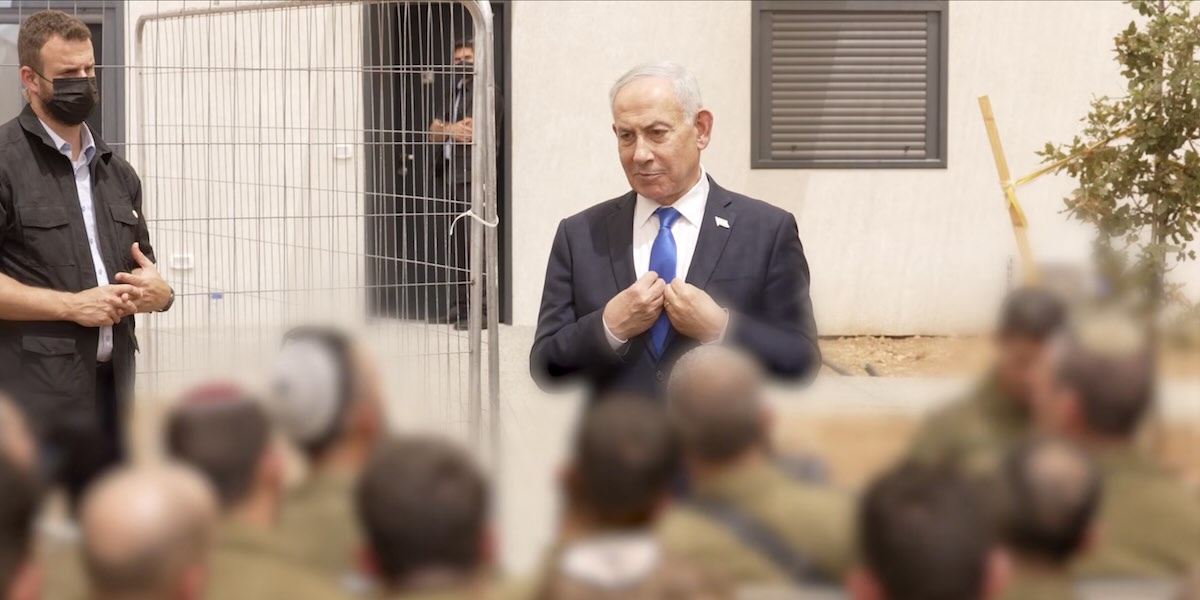
In the image
Israel’s Prime Minister Netanyahu meets with a Reserve Combat Officers’ Course in Gush Etzion, in June 2026 [GPO]
To properly understand the recent history of Israeli politics, it is important to also analyze the individual character and leadership style of its current prime minister Benjamin Netanyahu, who has held office for a long time. Political choices are often explained by ideologies, security situations, or institutional factors, but the psychology of political leaders can also have an impact on the types of policies that their countries adopt. As such, analyzing Netanyahu's psychological profile can provide a helpful perspective for understanding the relationship between national security policy, political survival, and individual styles of leadership in shaping modern Israeli politics.
Benjamin Netanyahu is widely regarded as one of the most prominent and longstanding figures in modern Israeli political life. He is the longest-serving prime minister in Israel’s history. He first assumed office in 1996, serving a three-year term before being succeeded by Ehud Barak. He returned to power in 2009 and has since held office for 16 of the past 17 years.
Netanyahu was born in 1949 in Jaffa (Tel Aviv) into a family strongly marked by intellectual and ideological influences. His father, a historian and advocate of strong Zionist nationalism, significantly influenced his understanding of history, identity, and the constant threat faced by Israel. Netanyahu later studied in the United States and served in the elite Israeli military unit ‘Sayeret Matkal,’ experiences that further shaped his strategic orientation and strong focus on security.
Over a political career at the apex of Israeli politics spanning nearly three decades, these attributes have often worked to his advantage. However, one event had a particularly deep and lasting impact on his personal and political development: the death of his older brother, Yonatan Netanyahu, in operation ‘Thunderbolt’ in Entebbe (Uganda) on July 4th, 1967. ‘Thunderbold’ is one of the most well-known hostage-rescue military operations ever executed by the Israeli Defense Forces. In that operation, Yonatan, commander of the elite Israeli unit ‘Sayeret Matkal,’ got killed when leading his unit to rescue more than one hundred hostages taken by members of Palestinian and German terrorist groups operating together. This incident was both a major tragic event for Benjamin Netanyahu and a turning point that strengthened his worldview.
For Benjamin, this event had deep personal significance, as Yonatan was more than a brother: he was a role model of intellectual ability, military bravery, and moral seriousness. His death, therefore, represented not only a family loss, but a traumatic event that strongly influenced Netanyahu’s perception of political reality and security threats.
The loss of his brother may have further reinforced Netanyahu’s perception of Palestinian actors and regional threats as existential dangers to Israel. Such a traumatic event likely shaped his psychological structure, giving him a strong emotional motivation to preserve security, decisiveness in leadership and strategic planning, as well as an urge to continue his brother’s legacy. Analysts suggest that this tragedy contributed to his strong perception of a “constant threat” looming over Israel and shaped his hard political stance on issues of terrorism and security.
Through his political and public engagement, Netanyahu has often reflected this combination of personal experience and professional responsibility which can be interpreted as a form of accepted mission to continue what his brother symbolized. A number of factors, including personal experiences, familial relationships, and traumatic experiences have played a significant role in shaping his personal and professional identity.
The relationship with his father is another essential element to appreciate how family dynamics contribute to the development of Netanyahu’s character and to understand his personality. Benzion Netanyahu, historian and intellectual, was also a very demanding and emotionally absent figure who instilled in his son a deep sense of the high value of discipline, knowledge, and of awareness of the importance of history. This intense relationship with his father not only shaped Netanyahu’s critical perfectionism, strong desire for recognition, ability to set high standards and to demonstrate emotional vulnerability but also created in him a deep sense of determination and self-confidence through the strictness and stresses of his family norms and an immense level of intellectual accountability.
Saul Kimhi, a professor of political psychology at Tel Aviv University, has spent years studying the psychological profile of Israeli Prime Minister Netanyahu. In his commentary for Al Jazeera, Kimhi notes that his analysis of Netanyahu as early as 1999 revealed a concerning pattern of behavior. Among his conclusions was that Netanyahu exhibited traits of narcissism, a strong conviction in his own correctness, paranoia, and a tendency to respond poorly under stress.
Kimhi revisited his analysis of Netanyahu in 2017 and found that little had changed. He argued that, as individuals age, their behavioral tendencies often become more pronounced. In Netanyahu’s case, his paranoia and narcissism appear to have intensified. According to Kimhi’s research, he places limited trust in others, perhaps only in his immediate family, and prioritizes his ‘personal future’ above all else.
Netanyahu’s political career demonstrates how a resilient personality can successfully navigate politics in a highly polarized system such as that of Israel. He combines strategic foresight, his abilities to shape perceptions, build loyal political coalitions, and convert crises into political gains to sustain his leadership. The personal attributes that he exhibits, such as strong discipline, confidence, and pragmatic focus on survival, are also accompanied by his defensive, calculated style of operating in his interactions with his adversaries.
Netanyahu’s first experience in leading the country came in 1996 when he ran on a platform, ‘Netanyahu – Creating Secure Peace,’ which focused on the need for Israel to strengthen its security in response to multiple suicide bombings. His initial action, from 1996 until 1999, included a number of highly publicized and controversial decisions such as that of opening a historical tunnel close to the Al-Aqsa Mosque, which incited multiple acts of violence and resulted in the withdrawal of Israeli forces from parts of Hebron. After a brief withdrawal from politics, he returned in 2003 as Minister of Finance, implementing economic reforms that further reaffirmed his political positions. Returning to the leadership of Likud in 2005, and then to the position of prime minister in 2009, he emphasized the dangers posed by Iran and its nuclear program and strongly opposed the 2015 agreement.
Undermining the Palestinian state
Benjamin Netanyahu advocates a security doctrine based on the perception of a constant existential threat, on the adoption of preventive measures, and on decisive responses to attacks, including military operations and diplomatic initiatives aimed at preserving Israel’s strategic advantage. Despite publicly expressing openness to a two-state solution, Netanyahu has been widely criticized for consistently undermining the process. This includes his insistence that any prospective Palestinian state should not possess full military or security control over its own territory.
During his tenure, the expansion of illegal settlements accelerated significantly, while the political repression of Palestinians became increasingly widespread. Netanyahu has also sought to bypass the Palestinian issue by pursuing regional normalization agreements with Arab states through the Abraham Accords. These agreements consist of a series of joint declarations and bilateral accords aimed at normalizing relations between Israel and several Arab countries, brokered by the United States Government under the administration of Donald Trump in 2020. While these accords represented a significant diplomatic breakthrough in the region, they were met with strong criticism from Palestinian leaders and communities, many of whom viewed them as a strategic betrayal, arguing that regional normalization was being actively pursued prior to a just resolution of the core Israeli–Palestinian conflict.
Staying in power at any cost
On several occasions, Netanyahu’s political career appeared to be nearing its end. In 2015, facing significant electoral pressure, he employed fear-based rhetoric, warning that “Arab voters are heading to the polls in large numbers,” a strategy that contributed to his reelection.
After losing the premiership for one year, he returned to power in 2022, this time by forming what has been described as the most far-right government in Israel’s history.
Among key members of his cabinet is National Security Minister Itamar Ben-Gvir, who was convicted in his youth for incitement to racism, property damage, and affiliation with a designated terrorist organization. Finance Minister Bezalel Smotrich leads the hardline Religious Zionist Party, which rejects Palestinian statehood, denies the existence of a Palestinian people, and has condemned LGBTQ activists. Interior and Health Minister Aryeh Deri, an ultra-Orthodox rabbi, has previously served a prison sentence for bribery.
By assembling such a cabinet, critics have accused Netanyahu of prioritizing his own political survival over the broader interests of the state. The Israeli newspaper ‘Haaretz’ has published comments describing some members of his government in highly critical terms, including as ‘neo-Nazis’ and ‘neo-fascists.’ Nevertheless, such criticisms appear to have little bearing on Netanyahu’s political calculus. According to Kimhi and other analysts who have studied him, his primary objective remains the preservation of power, regardless of the cost.
Benjamin Netanyahu’s career, however, has also been marked by controversy. Since 2019, he has faced charges of fraud, breach of trust, and corruption, while some observers and international critics today accuse him of responsibility in the context of the conflict with Palestinians, including military actions that have caused large civilian casualties. Such events further shape his reputation in the public and the international community, while at the same time confirming a personality that has extended from adolescence and continues to the present in a highly challenging political environment.
The greatest domestic obstacle facing Netanyahu's government, the 2023 judicial reform initiative, directly reflects his identified psychological traits of paranoia and an absolute prioritization of his personal survival. The proposed changes, which seek to grant the Executive Branch overriding influence over judicial selections and limit the Supreme Court's authority, align closely with his defensive, calculated style of operation and a structural distrust of state institutions outside his immediate control. Critics argue that this aggressive push to weaken judicial independence highlights his narcissistic conviction in his own correctness, viewing institutional checks and balances as personal threats to his political longevity.
Even when faced with unprecedented mass protests from trade unions, academics, and military leadership warning of state destabilization, Netanyahu’s response highlighted his tendency to operate poorly under stress, digging into a polarizing stance before being forced into pragmatic retreats. The subsequent suspension and postponement of various reform components demonstrate how his hyper-focused drive for political preservation can create deep domestic gridlock, illustrating a direct link between his defensive psychological profile and the destabilization of Israel's internal political balance.
A personality outlined
In conclusion, the current political trajectory of Israel cannot be detached from Benjamin Netanyahu’s unique psychological profile, where personal trauma, an entrenched security doctrine, and an absolute instinct for political survival converge. As Professor Saul Kimhi and other analysts suggest, his deep-seated paranoia, narcissism, and lifelong perception of existential threats, forged by family heritage and the tragic loss of his brother, directly dictate his strategic decisions. Whether systematically undermining a Palestinian state, pursuing the polarizing 2023 judicial reforms, or maintaining a hardline stance amid the massive domestic and international fallout of the post-October 7 landscape, his actions consistently reflect a leadership style that prioritizes his personal political future above all else.
Ultimately, Netanyahu’s ongoing legal battles, the International Criminal Court arrest warrants, and the tactical postponement of his corruption hearings highlight a defensive calculus where geopolitical conflict and personal preservation become inextricably linked. By viewing external regional adversaries and internal institutional checks through the same lens of existential threat, his personality does not merely influence his choices, it serves as the primary engine driving Israel's domestic gridlock and protracted wartime strategy. His political survival at any cost has transformed from a personal psychological necessity into the defining feature of modern Israeli statecraft.