
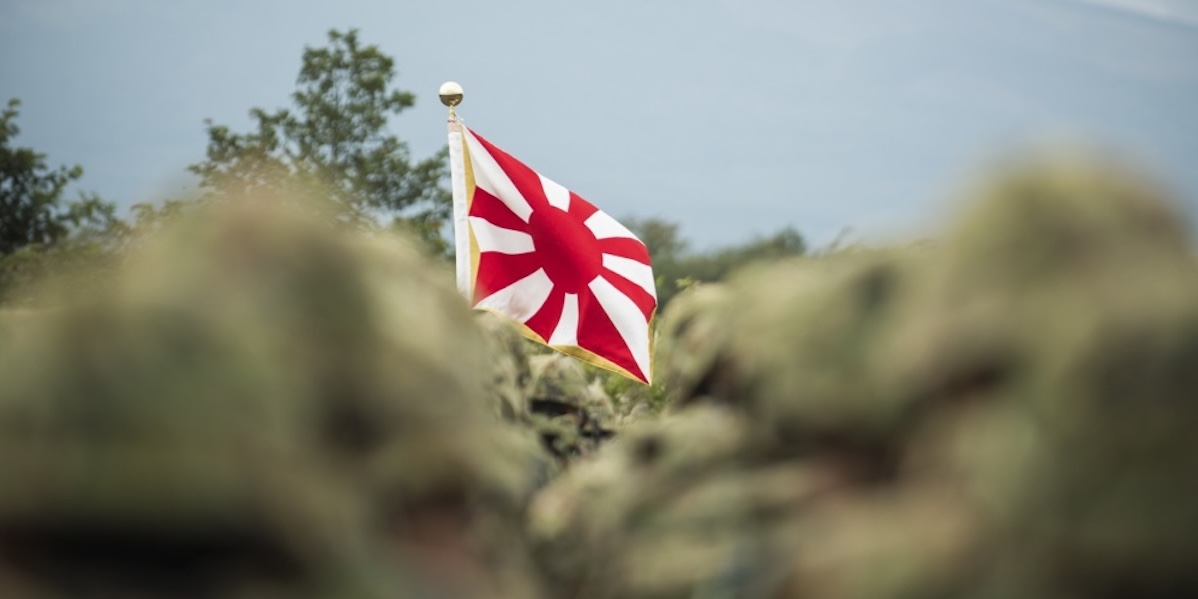
In the image
Flag of the Japan Self-Defense Force (JSDF), flying during Orient Shield 17 military drills [Markus Castaneda]
The lasting coalition partnership between the leading Japanese party LDP and the smaller Komeito came to an end in October 2025, after almost three decades of collaboration. Without Komeito functioning as a pacifist brake on the LDP, there is a high chance that Japan will obtain “normal military powers,” and self-inhibition will disappear.
On October 10, 2025, Japan’s leading coalition of 26 years between the Liberal Democratic Party (LDP) and Komeito came to an end. Komeito, “the party of welfare and peace,” has its roots in a Nichiren Buddhist movement called Sokka Gakkai. From its founding in 1964, the moderate conservative party has repeatedly sought to support the interests of a segment of unrepresented Japanese citizens. On the opposite end is the dominant, big-tent conservative LDP, which, under Sanae Takaichi, is rooting for anticommunism and assertive right-wing politics. Marking a major political shift of the collapse of the most stable coalition in modern Japanese politics, the question arises: What will Japanese foreign policy look like after Komeito is no longer present in the Diet? This article examines the key role of Komeito before the coalition split, functioning as a pacifist brake on the LDP. It further narrows its focus to a specific dimension of the LDP’s policy agenda, namely its support for the reinterpretation of Japan’s constitution to allow an expanded military role.
Japan’s pacifism and culture of anti-militarism
Japan’s postwar pacifist stance is enshrined in Article 9 of the Japanese Constitution (1947): “Aspiring sincerely to an international peace based on justice and order, the Japanese people forever renounce war as a sovereign right of the nation and the threat or use of force as means of settling international disputes.” After the Second World War, the Constitution was forced upon the Japanese people by the American occupying forces; article 9 represents MacArthur’s vision of an unarmed Japan. Its ruinous defeat in 1945 resulted in many ordinary Japanese citizens developing repugnance towards militarization and war in general.
Japan’s reluctance to assume a more assertive military role is not primarily the outcome of material constraints but rather a deeply embedded “culture of anti-militarism” that emerged in the aftermath of the Second World War. It is rooted in the collective memory of the Japanese that the military is a dangerous entity that must be constantly restrained so it does not undermine the Japanese post-war democratic order. Though collective guilt is present in postwar Japan, victimization is ultimately the stronger narrative. Many citizens viewed themselves as doubly victimized by the West through economic coercion and wartime destruction, as well as by their own military leadership, which had heedlessly plunged the nation into catastrophe. This perception of “double victimization” further bred deep institutional distrust of the armed forces.
From a constructivist perspective, this combination of institutional constraints and societal norms has produced a national identity that characterizes Japan as a “peace state,” in which the use of military force is seen as both politically and morally problematic. As Martha Finnemore and Kathryn Sikkink argue, norms and identities are socially constructed and shape how states define their interests and behavior.
Today, Komeito serves as a vital defender of this ethos in Japanese politics. However, its core values have gradually eroded under pressure to accommodate and mitigate the LDP’s more aggressive proposals since the two parties became coalition partners in 1999. After the coalition break-up, the worry lingering among the Japanese, now with Takaichi and the LDP in power, is whether militarization could return as a norm over time in Japan.
26-year-long party coalition
The LDP-Komeito coalition was characterized by strategic pragmatism rather than ideology. The partnership would never have survived for 26 years without reciprocity. The biggest pull factor for LDP was Komeito’s ability to mobilize 7-8 million Soka Gakkai voters, consequently delivering 20,000–30,000 extra votes per single-seat constituency, potentially preventing the loss of nearly 100 lower house seats without this support. In return, Komeito ensured 8-10 seats in single-member districts, 20–25 via proportional representation, plus cabinet positions and a seat at the policymaking table, outcomes unattainable independently in the winner-take-all system.
Komeito, lacking the power to fully block LDP initiatives, yet retaining sufficient leverage to shape and moderate them, is precisely how it served as a pacifist brake. This common functioning of coalition politics, when the junior partners must constantly balance influence against principle, perfectly mirrors the LDP-Komeito dynamic.
During Keizo Obuchi’s administration between 1998 and 2000, Komeito contributed to the passage of legislation establishing the hinomaru as the national flag and “Kimigayo” as the national anthem (even though the party had previously opposed it as the song and the anthem had military affiliations). Hardest pills to swallow for the Komeito party were the SDF deployments to Iraq under Koizumi post-9/11 and the compromise for the passage of the unpopular Act on the Protection of Specially Designated Secrets (SDS), implemented in late 2014. The Komeito of the 1960s and 1970s, anchored in a commitment to democracy, peace, and human rights, would never have stomached supporting policies that so blatantly augmented the power of the state. Despite Komeito’s constant push back by the LDP, the collaboration did result in the LDP passing fewer aggressive military initiatives.
Komeito could not stop normalization, but it slowed and constrained it. One example is Komeito’s importance in diplomatic negotiations within the coalition, instead of resorting to confrontation. In 1972, Komeito Secretary General Yoshikatsu Takeiri travelled to China and met Premier Zhou Enlai to discuss the normalization of Sino‑Japanese relations. When he returned to Tokyo, he conveyed Zhou’s views to Prime Minister Kakuei Tanaka of the LDP and reportedly helped persuade him that Beijing was serious about establishing diplomatic ties.
Constant opposition to the revision of Article 9 is of the utmost importance in the work of Komeito. Komeito party leader Natsuo Yamaguchi warned of unilateral reinterpretation lacking legitimacy. While it ultimately accommodated reforms during the prime ministership of Shinzo Abe, it ensured that measures like collective self-defense were tightly circumscribed and legally bounded. In this sense, Komeito served as an internal brake on the LDP, often curbing its bolder revisionist initiatives, effectively “saving the LDP from itself.”
Without Komeito’s brake
The end of the coalition between the LDP and Komeito marks the removal of the main representative of pacifist moderation within the Japanese government. For 26 years, Komeito has served as an internal brake on the LDP, not always successfully, and not without compromises, but meaningfully and consistently. Without the brake, the conditions for accelerated military normalization in Japan are more favourable than they have been since 1945. The LDP under Takaichi is leaning towards constitutional revision, increased defense spending, and more aggressive foreign policy. The coalition constraints that previously forced moderation are now gone.