
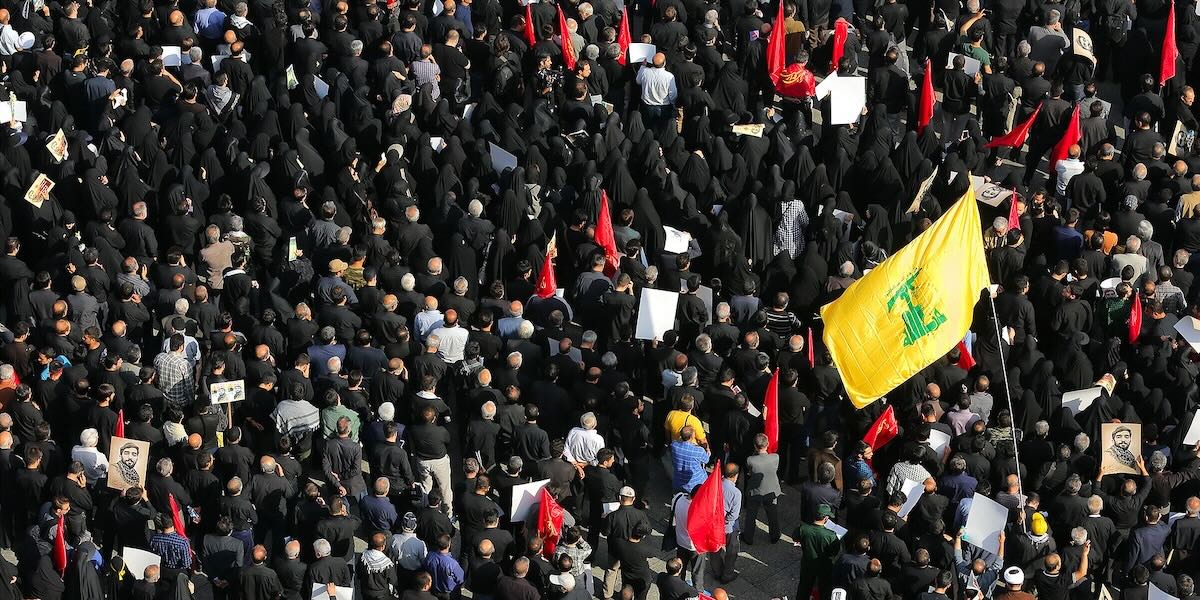
In the image
A Hezbollah’s flag during a mourning in Tehran in 2017 [Wilipedia]
There has been growing evidence that Hezbollah has employed cryptocurrency wallets to finance its terrorist activities. In 2023 Israel authorities stated that Hezbollah and the IRGC had begun to use cryptocurrency to fund their daily activities; in 2024, a police operation in Argentina uncovered a crypto wallet attached to an operative linked to Hezbollah. Despite the fact that cryptocurrency fluctuates widely, it is an attractive choice for terrorist groups because it allows for anonymity, decentralisation, and global access.
Hezbollah is a Shiite Muslim political party and militant group based in Lebanon which was created during the Lebanese Civil War (1975-1990). Since the Iranian Revolution (1978-1979), Hezbollah has been actively supported by the Iranian Revolutionary Guard Corps (IRGC). Alongside Hamas in Gaza, the Houthis in Yemen and some splinter groups within Iraq, Hezbollah is part of the so-called “axis of resistance”. In 1987, it was listed as a foreign terrorist organisation by the United States, while the European Union designated its military wing a terror group in 2013. In recent years, Hezbollah has adapted its financing mechanisms, which include the use of hawala networks and illicit trade, to include cryptocurrency due to its greater anonymity.
What is terrorist financing?
The International Monetary Fund (IMF) defines terrorism financing (TF) as “the financial support, in any form, of terrorism or those who encourage, plan, or engage in it”. The mechanisms through which TF is conducted and the complexity of the operations depend on the terrorist organisation in question. The Financial Action Task Force (FATF), which attempts to combat terrorism and proliferation financing worldwide, has stated that TF exists both to fund specific terror actions and to offer material support which can further the organisation’s aims. TF does not necessarily have to focus on illicit activities, as it can also be carried out through funds raised by legitimate businesses or charities.
Hezbollah’s traditional financing
TF also occurs through illicit means; in Hezbollah’s case, mostly through drug trafficking. Hezbollah operatives are suspected of involvement in the trafficking of fenethylline, commonly known as captagon, which produces effects similar to amphetamines. Though originally created in Germany in the 1960s, captagon is now popular in the Middle East as a recreational drug. The trafficking of this drug is incredibly profitable, as an individual pill costs approximately 1 USD to produce and can be sold for up to 20 USD. Governments including the United States and the United Kingdom have sanctioned individuals associated with Hezbollah for trafficking with captagon, accusing them of attempting to destabilise the Middle East and generate an addiction crisis. In 2025, Hezbollah was alleged to have focused on narcotics trafficking and narcotics laundering in Latin American Free Trade Zones (FTZs).
Hezbollah has also been linked to the sale of oil and natural gas, mostly supplying the former Syrian Government headed by Bashar al-Assad. The US Treasury Department alleges that a senior finance member of Hezbollah and several Lebanese businessmen run networks involving smuggled oil and liquified natural gas(LNG). It is believed that these smuggling operations generate millions of dollars in revenue for Hezbollah, and according to the US Treasury are employed to enhance Hezbollah’s terrorist activities. While the group has its strongest links in the Middle East, it carries out activity in other parts of the world, including Latin America, where it has been linked to drug trafficking and arms smuggling, or Africa, where the profits of trade in diamonds and other precious stones are channeled to finance the group.
Why is cryptocurrency an attractive option for terrorist groups?
Cryptocurrency is defined as a “medium of exchange, created and stored electronically on the blockchain, using cryptographic techniques to verify the transfer of funds and an algorithm to control the creation of monetary units”. This medium of exchange is especially attractive for terror groups because of its anonymity. According to the FATF, Bitcoin specifically shows an increased risk of TF because it allows for the anonymous movement of funds internationally; while the first purchase of cryptocurrency may be traced, all following movements are difficult to detect.
Cryptocurrency has been gradually implemented by terrorist groups, although it is associated mostly with Islamic State and Hezbollah. Despite the fact that cryptocurrency fluctuates widely, which means that the value held within digital wallets may abruptly fall in value, it remains an attractive choice for terrorist groups because it is anonymous. Indeed, it is thought that terrorist groups are primarily attracted to cryptocurrency because it allows for anonymity, decentralisation, and global access.
Hezbollah’s use of cryptocurrency
In recent years, there has been growing evidence that Hezbollah has employed cryptocurrency wallets to finance its terrorist activities. In 2023, Israeli media reported the seizure of crypto accounts linked to Iran and Hezbollah. According to the Defence Minister at the time, Hezbollah the IRGC and other Syrian groups had begun to use cryptocurrency to fund their daily activities. The following year, four people were arrested in Argentina in connection with a crypto wallet attached to a Syrian man who was linked to Hezbollah.
The increase in counterterrorism successes since 2023 suggests an increasing regulatory oversight, mostly carried out by the United States. In 2024, the US Treasury’s Office of Foreign Asset Control (OFAC) sanctioned a Syrian operator for managing digital wallets which were used by Hezbollah operatives. The Israeli government has also been active in the crackdown against digital wallets, seizing 40 wallets since 2021. Even though this is likely a result of Hezbollah’s closeness to Hamas and Iran, it reflects a growing awareness of the role that digital wallets play in the international financial system.
The path ahead: Cryptocurrency and growing regulatory oversight
In conclusion, cryptocurrency will remain of vital importance in the fight against TF because it is difficult to trace and allows for the rapid movement of capital coming from both licit and illicit means. However, national governments and international organisations such as FATF have increasingly recognised the threat that cryptocurrency, which operates in a decentralised exchange, presents. As a result, there is growing evidence of regulatory oversight. Since 2021, US and Israeli authorities have detected dozens of Hezbollah-linked crypto wallets and sanctioned individuals allegedly administering them on behalf of the terrorist group. Such operations are likely to continue in the future.