In the image
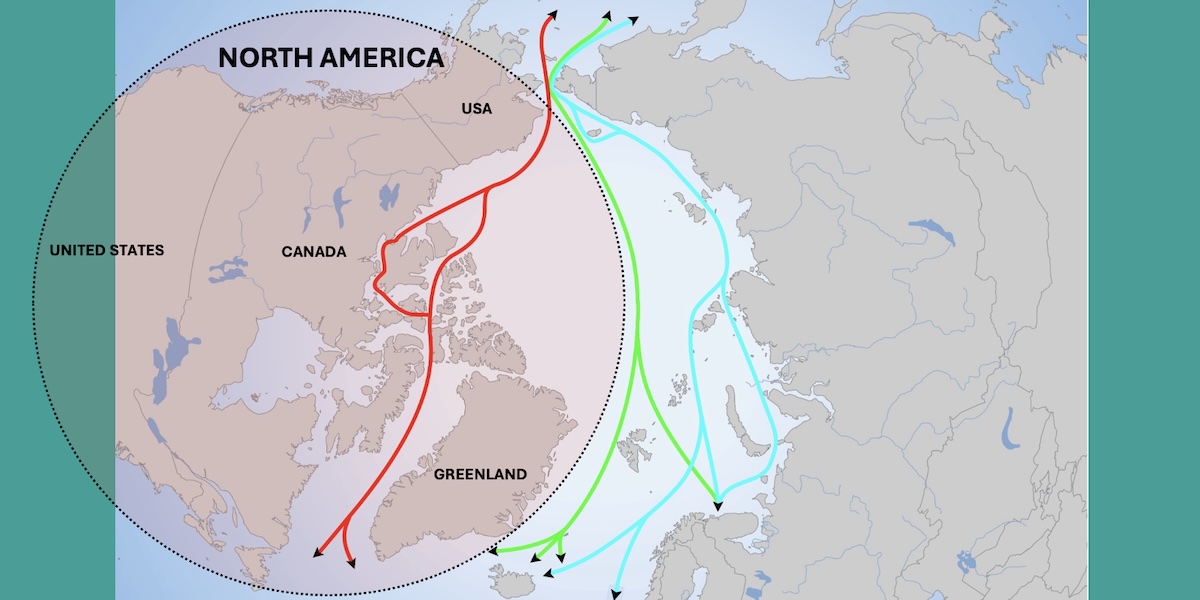
Arctic routes. Red: Northwest Passage; blue: North Sea Route; green: Transpolar Sea Route. [Map from The Arctic Institute, with added references to North America]
√ Since his return to the White House in January 2025, Trump has publicly insisted on his desire to take Greenland, even by sending troops.
√ In recent months, the US president has toned down his rhetoric and ruled out an invasion, but the debate has damaged NATO cohesion.
√ Danish authorities and pressure from Washington have blocked several Chinese projects on the island, but Beijing—like Moscow—maintains its Arctic ambitions.
Greenland has gained a central stance in the geopolitical arena, that has gone from a strategic periphery to a central role in global geopolitics. The accelerating climate change has unlocked access to critical natural resources and opens new maritime routes, which enhances the big island’s military significance. As a result, Greenland has become a major area of interest that is intensifying competition among major powers.
From his return to the White House in January 2025, Trump has insisted in a public and confrontational bid to absorb Greenland; this has fractured the quiet Western consensus that had managed great-power competition in the High North with relative stability. By treating Greenland as a transactional asset rather than an allied territory, the United States risks accelerating the very dynamics it seeks to contain: Chinese economic penetration, Russian military assertiveness, and a drift toward Greenlandic autonomy that would strip the West of its most strategically positioned Arctic outpost. The most pressing risk is not direct confrontation over Greenland, but a gradual erosion of NATO in the High North that Beijing and Moscow will want to exploit.
There is an array of actors that are competing for dominance in the region. On one hand the United States seeks to consolidate its strategic presence on the island to preserve Arctic dominance and secure critical supply chains, specifically rare earth elements. China, meanwhile, has pursued a strategy of economic penetration through infrastructure investment, resource acquisition, and its broader Polar Silk Road Initiative. At the same time, Russia continues to expand its military footprint across the Arctic, reinforcing its strategic deterrence capabilities and challenging Western influence in the region.
These overlapping ambitions reshape the geopolitical landscape of the Arctic. Greenland’s geographic position, resource potential, and evolving political status place it at the crossroads of security, economic, and environmental dynamics. The result is a more competitive and potentially unstable Arctic region, where cooperation is increasingly strained.
Greenland’s strategic importance
Greenland occupies a uniquely strategic position between North America, Europe, and the Arctic, making it critical for military surveillance, missile defense, and maritime control. Its proximity to emerging Arctic sea lanes, including routes connected to the Northern Sea Route, enhances its geopolitical relevance as polar navigation becomes more viable.
The Arctic’s transformation from a frozen periphery to an active geopolitical arena is driven by an irreversible variable: accelerating climate change. As ice sheets recede, Greenland's strategic significance compounds along three axes simultaneously.
First, previously inaccessible deposits of rare earth elements, uranium, and critical minerals are now ideally being targeted for exploitation. While doubts about their financial viability remain, their consideration offers an opportunity to counter Western structural dependence on China for rare earth supply chains essential to defense manufacturing and advanced technology sectors. Second, the retreat of Arctic ice is extending the navigability of High North maritime corridors, with the potential to reshape global trade patterns and elevate Greenland's position within emerging routes between Europe, Asia, and North America. Third, Greenland's geographic position between the North Atlantic and the Arctic Ocean makes it indispensable for missile early-warning systems, space surveillance, and naval freedom of operation, functions currently anchored at the Pituffik Space Base (formerly Thule Air Force Base), whose bilateral legal basis rests on a 1951 agreement between the United States and Denmark.
None of these dynamics is entirely new. What is structurally new is the happening of its simultaneity: resource accessibility, maritime viability, and military salience are intensifying at the same time that the institutional mechanisms designed to manage Arctic rivalry, such as the Arctic Council, have been effectively paralyzed since the Russian invasion of Ukraine in 2022. The result is a brewing intensifying competition without a functioning diplomatic framework to constrain it.
Three power competition
Prior to Trump’s renewed campaign on Greenland, great-power competition in the Arctic had been intensifying. The United States maintained strategic primacy through Pituffik and actively blocked Chinese infrastructure investments in the island on national security grounds, including opposition to Chinese-financed airport expansion projects and interference in mining ventures.
China had declared itself a ‘near-Arctic state’ and pursued a strategy of patient economic penetration through its Polar Silk Road initiative, an Arctic extension of the Belt and Road, and seeks to finance airport expansions and acquire stakes in rare earth projects such as Kvanefjeld, as well as expanding icebreaker fleet expeditions. These efforts are closely tied to China’s broader objective of securing access to critical minerals and reducing vulnerabilities in its supply chains. However, many of these initiatives have been blocked or limited by Danish authorities and US influence, reflecting growing concerns over strategic dependence and security risks.
China’s approach can be characterized as one of strategic patience, combining economic engagement with long-term geopolitical ambitions. Russia, on the other hand, has expanded its Arctic military presence with help of the modernisation of its Northern Fleet, the deployment of advanced missile systems, and the expansion of Arctic bases in its territory, which reinforces nuclear deterrence and strategic deterrence capabilities without crossing into direct confrontation.
The US: security, deterrence, and control
For the United States, Greenland is a cornerstone of Arctic security strategy. Its primary objective is to maintain strategic dominance in the High North, ensuring early-warning capabilities, missile defense coverage, and freedom of operation in the region. The modernization of the Pituffik Space Base reflects this priority. The base plays a vital role in ballistic missile detection and space monitoring, making it indispensable to US and NATO defense systems.
Washington has also taken steps to limit the influence of external actors, particularly China. US authorities have actively opposed Chinese investments in Greenlandic infrastructure, including airport construction and mining projects, citing national security concerns. The 2019 proposal by Donald Trump to purchase Greenland, while widely criticized, highlighted the strategic value Washington places on the island. More broadly, Greenland functions as a buffer within NATO’s northern flank, which reinforces transatlantic security and deterring potential adversaries.
Trump’s discourse activated again in 2025 targets an allied territory through coercive rhetoric. Although he has later ruled out an invasion, his disregard for the Greenlanders could backfire as a diplomatic windfall. China can now credibly position itself as a respectful partner of Greenlandic self-determination, in contrast to an overbearing United States, while Russia can cite intra-Alliance disorder as evidence that NATO’s cohesion is structurally fragile. More concretely, US pressure has inflamed Greenlandic and Danish public opinion in ways that may raise the political cost of security cooperation.