
En la imagen
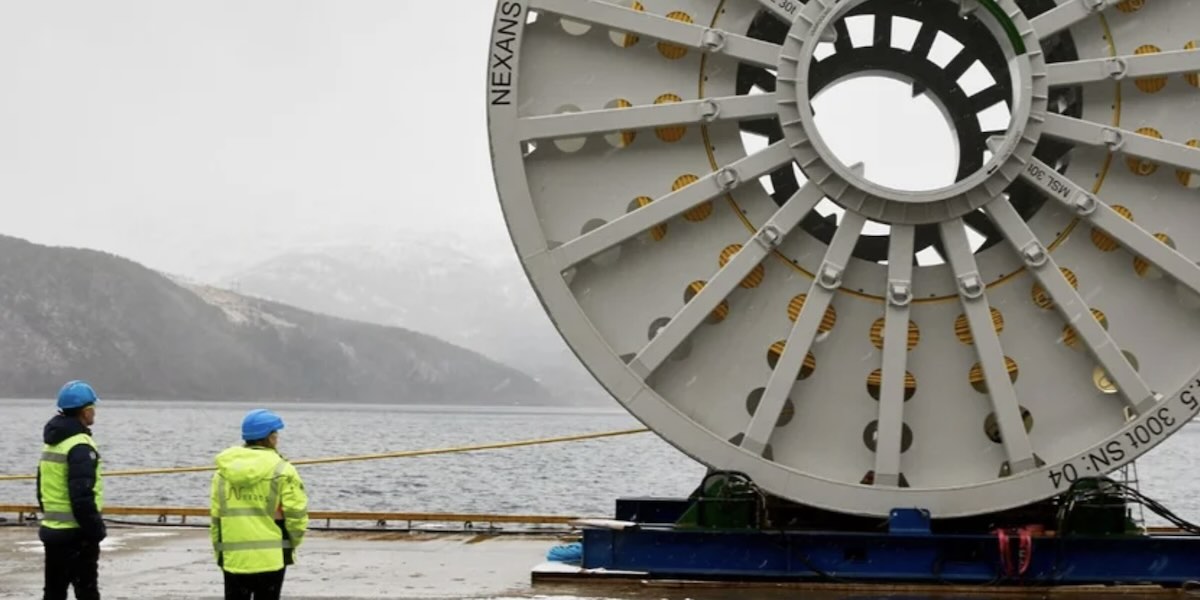
Undersea telecommunications cable laying [Nexans]
There are approximately 600 subsea cables around the world transmitting data and connecting international markets. According to the Open Geospatial Consortium, they carry almost 99% of intercontinental internet traffic and $10 trillion in daily financial transactions. Even though they have been placed under our seas since the 19th century, in recent years they have become so important that they are usually described as the Achilles heel of modern states’ connectivity. They are increasingly under threat, suffering multiple sabotages, particularly from Russia in the Baltic Sea and China in Southeast Asia, showing the vulnerability of these networks.
The submarine cable infrastructure is now recognized as a priority in states’ defense strategies. Addressing Russian President Vladimir Putin, the UK Defense minister said, "We see you. We see your activity over our cables and our pipelines, and you should know that any attempt to damage them will not be tolerated and will have serious consequences.” Therefore, the official explanations and the pretext of these actions of damage and disruption being accidental is no longer considered credible. Rather, they are deliberately planned and executed by these hostile states as a means of hybrid warfare.
This article explores the strategic relevance of critical undersea infrastructure, focusing on submarine cables as critical enablers of global connectivity, and explores the acts of sabotage subsea infrastructure is suffering from Russia and China.
Implications of damaging undersea cables
The reason for protecting these cables from malicious acts is that carrying electricity and data, they cross Earth’s oceans and seas for a total length exceeding 1.3 million km, more than 32 times Earth’s circumference at the equator. According to the Joint Research Centre of the European Commission, installing a submarine power cable costs on average between €1-2 million per km, while the costs for subsea telecommunication cables range from around €25,000 to €45,000 per km. Typically, the cost of repair of a subsea power cable per incident is $10 million-100$ million depending on several factors and for subsea optic fiber cable $500,000-$1 million.
High seas are not anymore just a way to generate wealth and project power; the undersea realm has become a geopolitical hotspot which itself will only grow in importance throughout the 21st century. On average, 150-200 subsea cable damages occur every year with most of them being accidental and unintentional caused by human activity such as fishing vessels. Others are provoked by natural hazards like submarine earthquakes, landslides and tsunamis. Nevertheless, over the last years several suspicious incidents have raised concerns about the malice of these acts by foreign belligerent actors.
Cutting underwater cables can instantly disrupt global communications and economic activity, undoubtedly an attractive hybrid warfare strategy for state and non-state actors which seek to impose economic costs and popular unrest. In an early stage of a conflict, damaging these cables would be one of Russia’s main tactics.State-sponsored actors have opted for the weaponization of oil and fishing vessels, intentionally damaging subsea infrastructure using anchors and fishing or trawler gear.
Tracing responsibility
Russia has put huge emphasis on this kind of hybrid warfare as a means of punishing and deterring Western countries from continuing sending military aid to Ukraine. The Baltic Sea has suffered several incidents in recent years, becoming Russia’s favorite theater for cutting cables. GUGI units as part of Russia’s navy and directed by the Defense minister and the president, are key for conducting underwater cable sabotages and covert surveillance. The acronym stands for the Russian words for Main Directorate for Deep Sea Research (Glavnoye upravlenie glubokovodnikh issledovanii).
China, which has been internationally accused of damaging cables in recent years, does not fall short and it is leveraging Europe’s vulnerable seabed infrastructure and Taiwan’s lack of maritime intelligence and information. China recently developed a new deep-sea cable cutting submersible with no purpose other than to disrupt submarine infrastructure. It has been argued that for China understanding how undersea cable cuts can impact Taiwan “provides useful insights” that can be leveraged in both traditional and hybrid warfare. Taiwan is under a deliberate and sustained campaign of underwater cable sabotage by China as part of a broader plan to undermine Taiwan’s sovereignty and territorial integrity. Taipei has classified these attacks as a ‘grey zone’ strategy to pressure the island, which China claims as its territory. To no one’s surprise, China has denied its participation, implying they were common maritime accidents caused by geological events such as volcano eruptions or earthquakes. In addition, it has opted for shaping the narrative against Taiwanese authorities, blaming them for reacting exaggeratedly to change how the rest of the nation see these issues.
The need for protection
These events make it clear that physical protection including burial techniques and rock placement can help prevent damage to underwater cables. However, they may not be sufficient to protect them from vigorously designed acts of sabotage by hostile actors. NATO claims that there is an urgent need to increase surveillance activities on the waters to try to prevent malevolent acts from happening under the surface. Today, when one of these sabotages occurs in international waters, there is a lack of an effective regime to hold the perpetrator of the physical attack accountable under international law. That is why intergovernmental organizations must take underwater cable security and protection seriously.
Western leaders have already realized that these tactics of hybrid warfare are more alive than ever in Putin’s and Xi Jinping’s strategic plans as a means to alter world maritime security. This is evidenced by EU’s Action Plan on Cable Security, published in February 2025, which launched a set of measures to bolster the resilience of this critical infrastructure, addressing prevention, detection, response, recovery, and deterrence. Another meaningful example is NATO’s formation of a Critical Undersea Infrastructure Network and Maritime Centre for the Security of Critical Undersea Infrastructure.
If we want to keep our information and connectivity safe, it is essential that intergovernmental organizations such as the International Telecommunication Union (ITU) provide a protection plan that gives jurisdiction to the cable owner’s state. This way, the cable owner’s state can take the perpetrator’s state to court and take due legal action. This plan could serve as a deterrent tool and avoid legal vacuums when holding the perpetrator accountable.
For the moment, neither sovereign states independently nor the international community has established a powerful mechanism that ensures the protection of all the intercontinental internet traffic and economic activity that traverses our oceans. Therefore, they are incessantly under threat by China and Russia, and non-state actors who leverage the vulnerability of the underwater infrastructure to destabilize the international maritime order.