
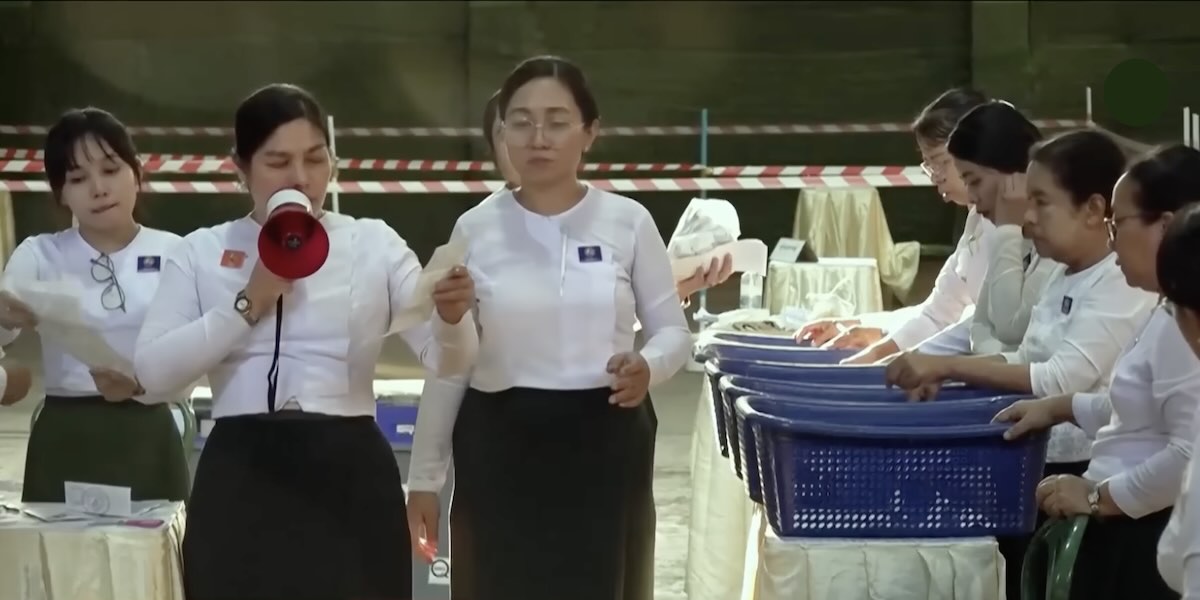
En la imagen
Counting the votes cast during the 2025-2026 general elections [Myanmar TV]
1. Introduction
On 15 October 2025, Myanmar’s junta leader conceded that the military-backed government would be unable to hold the planned general election across the entire country, as the civil war unleashed by the 2021 coup continues to escalate. Earlier, on July 31, 2025, the junta ended the state of emergency and began preparations for the December 2025–January 2026 election.[1] Yet many observers, including Western governments and opposition groups, have condemned the election as an attempt to legitimize military rule through proxy parties,[2] noting that numerous anti-junta organizations were banned or chose to boycott the process.[3]
Since the 2021 coup, Myanmar has descended into protracted conflict. The overthrow of the elected civilian government in 2021 sparked a nationwide rebellion that has stripped the military of control over much of the country. By 2024, the junta governed only 21 percent of Myanmar’s territory, while resistance forces and ethnic armed groups held around 42 percent.[4] The United Nations estimates that more than 3.5 million people have been displaced and nearly 20 million now require humanitarian assistance.[5]
These developments reveal that Myanmar’s authoritarianism did not end with its brief experiment in democracy; it has merely evolved. The military continues to consolidate power by manipulating the very institutions of democratization, illustrating what Levitsky and Way describe as competitive authoritarianism: a regime that maintains elections and formal democratic structures while systematically violating the principles that make them meaningful.[6]
2. Hybrid regimes and the façade of reform
To understand why Myanmar’s post-coup “return to democracy” is a façade rather than a genuine transition, this section draws on two key frameworks: Levitsky and Way’s concept of competitive authoritarianism (2010) and Stokke and Aung’s analysis of Myanmar’s hybrid regime (2019). Both help explain how the military uses democratic institutions to legitimize continued domination.
Levitsky and Way define competitive authoritarianism as a regime type in which formal democratic institutions serve as the principal channels for obtaining and exercising political authority, yet incumbents routinely subvert these institutions to maintain power. Although opposition parties can contest elections and engage in political competition, state resources, legal frameworks, and coercive instruments are systematically manipulated to favor those in power. In such contexts, competition remains genuine but fundamentally unequal, rendering the regime neither fully authoritarian nor meaningfully democratic.[7]
3. Historical roots of military dominance
In Myanmar, the military has long employed these tactics to maintain political dominance. Since gaining independence from Britain in 1948, the country has experienced almost uninterrupted military control, interrupted only briefly between 1958 and 1960 and again after 2011. The generals suppressed early democratic movements, most notably by annulling the 1990 election results after the opposition National League for Democracy (NLD), led by Aung San Suu Kyi, won a landslide victory. Suu Kyi was subsequently placed under house arrest, and the junta refused to transfer power, reinforcing the military’s resolve to govern without genuine electoral accountability.[8]
Realizing its limited popular legitimacy, the junta sought to institutionalize its rule under the guise of “disciplined democracy.” This strategy culminated in the 2008 Constitution, which entrenched military dominance by reserving 25 percent of parliamentary seats for the Tatmadaw, granting it control over key ministries, and allowing it to administer its own affairs independently. The commander-in-chief also holds the authority to assume control of the state legislature, executive, and judiciary during an emergency. By embedding veto powers and structural safeguards, the military engineered a system that permitted limited reform and the appearance of democratization while ensuring its continued supremacy.[9]
Levitsky and Way argue that in countries with limited ties to the West, the survival of authoritarian regimes often depends less on external pressure and more on the strength of the ruling organization itself and its ability to command loyalty, enforce discipline, and control state institutions.[10] In Myanmar, the military has long embodied this kind of organizational power, dominating the state directly or indirectly for most of the postcolonial era. Through its rigid hierarchy and the 2008 Constitution, which formalized its central role in politics, the Tatmadaw functions as a unified and durable institution. This cohesion has allowed it to suppress opposition, manage internal rivalries, and preserve authoritarian rule even in the face of widespread resistance.[11]
4. Electoral manipulation and controlled political openings
Ahead of the 2010 general elections, the junta implemented new election laws that prohibited anyone serving a prison sentence or married to a foreign national from running for president, a clear measure designed to block Aung San Suu Kyi, who remained under house arrest and was married to a British citizen, from contesting the vote. These restrictions contributed to the victory of the Union Solidarity and Development Party (USDP) and marked the beginning of a controlled political opening.[12] The political reforms under the USDP provided a basis for multi-party general elections in 2015, the first since 1990.[13]
By holding superficially competitive elections, autocratic governments could acquire sufficient international legitimacy and deflect external pressures for deeper political liberalization.[14] In Myanmar, this dynamic is evident: as Stokke and Aung explain, the NLD’s landslide victory in 2015 and the subsequent installation of Aung San Suu Kyi's government in 2016 were victories for pro-democracy forces, but these successes operated entirely within the limits set by the military's institutional veto, as demonstrated when the military used its powerful constitutional positions to prevent the NLD from amending the constitution (the 25 percent mandate).[15]
Thus, the era of civilian governance (2016–2021) merely confirmed that Myanmar had become a "relatively stable hybrid regime". The military retained substantive political control even with a democratically elected government, relying on the robust constitutional, institutional, and political structures it had constructed during the imposed transition.[16]
5. The 2025–2026 Myanmar elections
Finally, the elections in Myanmar ended after three rounds of voting, beginning on December 28. The USDP secured 232 of the 263 seats contested in the lower house and 109 of the 157 seats announced in the upper chamber.[17] Consequently, along with the military, which is automatically allocated 166 seats under the constitution, the two hold 507 seats out of the 586 in the national parliament, approximately 87 percent of the legislature.[18]
Amid uncertainty over whether Senior Gen. Min Aung Hlaing, head of the military government, would assume the presidency when the new Parliament convened in March, he signed a law authorizing the creation of a new Union Consultative Council. This body could enable its chairman to exercise influence without formally assuming executive office. The council, composed of at least five members and a chairman, could advise and coordinate on national security, international relations, peace processes, and legislation, while leaving judicial and executive powers unaffected.[19]
On January 23, the UN human rights chief, Volker Türk, stated that the death of at least 170 civilians from air strikes during the election period and approximately 400 arrests had been verified. He further reported that voter coercion occurred nationwide, including threats of forced conscription, restricted access to food, and administrative penalties.[20]
Taken together, the conduct and consequences of the 2025–2026 elections underscore that hybrid regimes do not collapse under crisis but instead adapt but instead adapt by reconfiguring institutions, coercion, and controlled participation to ensure that military dominance endures behind an ever-shifting democratic façade.
REFERENCES
[1] Reuters, "Myanmar Junta Chief Admits Election Won't Be Nationwide, as War Continues," October 15, 2025,https://www.reuters.com/world/asia-pacific/myanmar-junta-chief-admits-election-wont-be-nationwide-war-continues-2025-10-15/.
[2] "UN Expert Urges Rejection of Myanmar Election 'Fraud'," Barron's, June 25, 2025, https://www.barrons.com/news/un-expert-urges-rejection-of-myanmar-election-fraud-f9c8301a.
[3] Reuters, "Myanmar Junta Dissolves Suu Kyi's Party as Election Deadline Passes," March 28, 2023, https://www.reuters.com/world/asia-pacific/myanmar-junta-dissolves-ex-ruling-party-election-deadline-passes-2023-03-28/.
[4] Rebecca Henschke, Ko Ko Aung, Jack Aung, and Data Journalism Team, "Soldier-spies in Myanmar Help Pro-Democracy Rebels Make Crucial Gains," BBC News, December 20, 2024, https://www.bbc.com/news/articles/c390ndrny17o.
[5] United Nations Office of the High Commissioner for Human Rights (OHCHR), "Myanmar: Four Years On, Coup Leaders Ramp Up Violations to Unprecedented Levels, UN Finds," January 31, 2025, https://www.ohchr.org/en/press-releases/2025/01/myanmar-four-years-coup-leaders-ramp-violations-unprecedented-levels-un.
[6] Steven Levitsky and Lucan A. Way, Competitive Authoritarianism: Hybrid Regimes after the Cold War (Cambridge: Cambridge University Press, 2010).
[7] Ibid., p. 5–6.
[8] "Civil War in Myanmar," Global Conflict Tracker, Council on Foreign Relations, October 1, 2025, https://www.cfr.org/global-conflict-tracker/conflict/rohingya-crisis-myanmar.
[9] Kristian Stokke and Soe Myint Aung, “Transition to Democracy or Hybrid Regime? The Dynamics and Outcomes of Democratization in Myanmar” (European Journal of Development Research 32, 2020), 14–17.
[10] Steven Levitsky and Lucan A. Way, Competitive Authoritarianism: Hybrid Regimes after the Cold War (Cambridge: Cambridge University Press, 2010), 38.
[11] Kristian Stokke and Soe Myint Aung, “Transition to Democracy or Hybrid Regime? The Dynamics and Outcomes of Democratization in Myanmar” (European Journal of Development Research 32, 2020), 9.
[12] Deutsche Welle, "Suu Kyi to Be Barred from Polls," March 10, 2010, https://www.dw.com/en/suu-kyi-to-be-barred-from-polls/a-5339293.
[13] Kristian Stokke and Soe Myint Aung, “Transition to Democracy or Hybrid Regime? The Dynamics and Outcomes of Democratization in Myanmar” (European Journal of Development Research 32, 2020), 2.
[14] Steven Levitsky and Lucan A. Way, Competitive Authoritarianism: Hybrid Regimes after the Cold War (Cambridge: Cambridge University Press, 2010), 19.
[15] Kristian Stokke and Soe Myint Aung, “Transition to Democracy or Hybrid Regime? The Dynamics and Outcomes of Democratization in Myanmar” (European Journal of Development Research 32, 2020), 3.
[16] Ibid., p. 12.
[17] Al Jazeera Staff and News Agencies, “Myanmar Election Delivers Walkover Win for Military‑Backed Political Party,” Al Jazeera, January 31, 2026, https://www.aljazeera.com/news/2026/1/31/myanmar-election-delivers-walkover-win-for-military-backed-political-party.
[18] “Myanmar Election Won by Military‑Backed USDP Party,” ABC News (Australia), January 31, 2026, https://www.abc.net.au/news/2026-01-31/myanmar-election-won-by-military-backed-usdp-party/106290376.
[19] “Myanmar Military‑Backed Party Declared Election Winner as Army Plans New Body to Maintain Control,” NBC News, February 5, 2026, https://www.nbcnews.com/world/asia/myanmar-military-backed-party-declared-election-winner-rcna257528.
[20] Office of the High Commissioner for Human Rights, “Myanmar: Türk Says Military‑Controlled Ballot Exacerbates Violence and Social Division,” press release, January 30, 2026, United Nations Human Rights Office, https://www.ohchr.org/en/press-releases/2026/01/myanmar-turk-says-military-controlled-ballot-exacerbates-violence-and-social.