
En la imagen
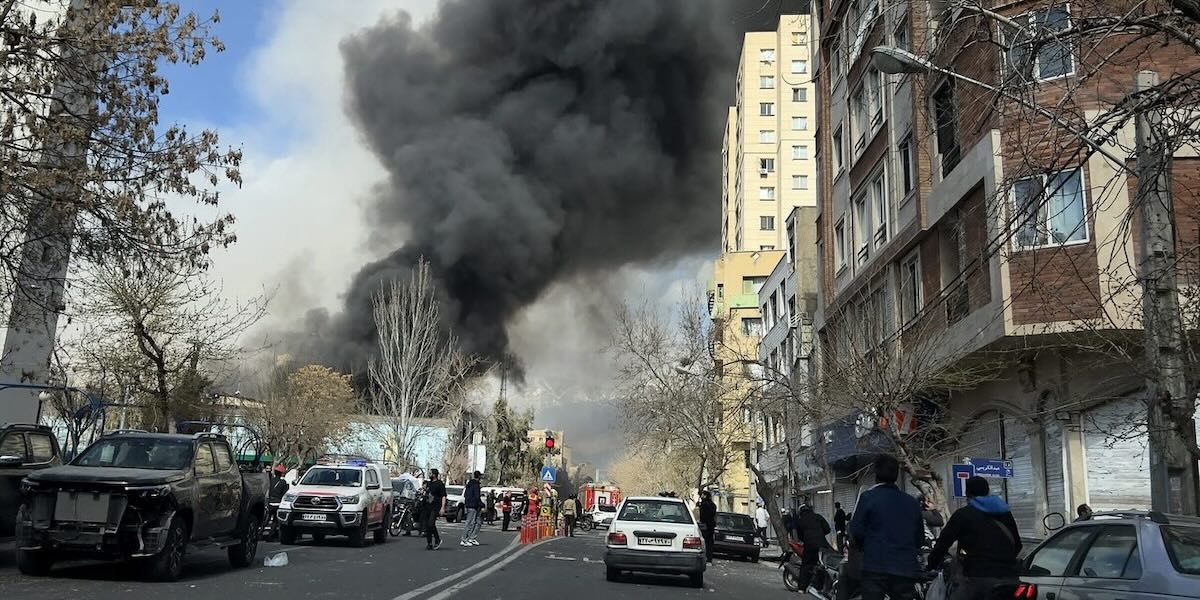
Residents in Tehran on the first days of US-Israeli airstrikes, in March 2026 [Avash Media]
The clear coordination between Iran and its proxies in the Middle East, but also the recent degradation of this proxy model poses a threat of nuclear terrorism in the case that the Iranian regime gets and consolidates its targeted nuclear capabilities. The US and Israeli are committed to avoid an Iranian nuclear bomb because it would multiply the regional security challenges, push other countries to get it as well, and, which is the focus of this article, increase the risk of nuclear terrorism if the weapon ends in the hands of non-state militias.
President Trump launched the February 2026 strikes on Iran with the stated purpose of preventing the country from building a nuclear weapon. But as the conflict unfolded, the alleged aim seemed to shift almost entirely toward the far-reaching military, geopolitical, and economic consequences. The media coverage moved from the killing of the Supreme Leader, Ali Khamenei, to retaliatory missile barrages and the spread of offenses to nearby countries and to the closing of the Hormuz Strait choking global oil supplies. The lack of a clear strategy by the US administration along the mediatization of the conflict, made the centre of controversy fade into the background of the very war it supposedly started.
However, it would be inaccurate to assume that the threat posed by the Iranian nuclear programme is anything new to geopolitics of the Middle East. In fact, the nuclear programme represents the inflection point that has led Iran into conflict, either with its neighbours or western countries, such as the United States and Israel. And while the Iranian regime argues that the enrichment of uranium is used for civilian and legitimate purposes, the US and Israeli reaction has been no other than scepticism, based on proven suspicions.
The threat of a nuclear Iran
The acquisition of nuclear capabilities by Iran represents a plethora of major threats to international security and world politics as a whole. Scholars argue that nuclear proliferation in the Middle East will have main effects. First, a change in the power structure of the region, which some argue may aid the balance of power creating a bi-polar nuclear system between Israel and Iran following Kenneth Waltz structuralism; while others explain that the Middle East does not follow a bi-polar structure: other middle powers such as Turkey and Saudi Arabia may pursue nuclear capabilities to deter the latent nuclear-Iran.
However, the focus of this article is a second threat, probably more worrying: the threat of a nuclear-powered international terrorism. The use of proxies by Iran like Hezbollah in Southern Lebanon and the Houthis in Yemen to respond to Israeli and US attacks, is neither new nor unstudied. But with the rise of the Iranian nuclear programme marginal groups get one step closer to the acquisition of nuclear weapons, changing the paradigm of traditional nuclear conflict, deterrence and non-proliferation.
History of the nuclear programme and 2026
The Iranian nuclear programme is not a new aspiration by the Iranian governments; it was born before the 1979 Revolution and the confrontation with the United States and Israel. Iran’s first nuclear programme initiative was launched in the 1950s under Shah Mohammad Reza Pahlavi, as part of the US ‘Atoms for Peace’ programme under the Eisenhower administration. In 1957 the International Atomic Energy Agency (IAEA) was created in order to “ensure that nuclear technology is used only for peaceful purposes and to help Member States use this remarkable technology to improve the well-being and prosperity of their people.” In 1967 the Tehran Nuclear Research Centre was established and equipped with a 5-megawatt research reactor supplied by the United States.
Iran signed the Nuclear Non-Proliferation Treaty in 1968 and ratified it in 1970, making its programme subject to IAEA oversight. In the 1970s the Shah aimed the construction of 23 nuclear power stations by 2000, and envisioned nuclear energy as central in Iran’s future, stating that “petroleum is a noble material, much too valuable to burn (...) Nuclear energy could theoretically alleviate some of Iran’s dependence and free up more oil and natural gas for export.” Construction on reactors at Bushehr began with German assistance, and US and European companies scrambled for contracts. However, after the rupture of Western-led nuclear programmes that came with the 1979 Islamic Revolution and the military capabilities gained in the Iran-Iraq War (1980-1988), Iran’s aspirations changed.
Away from the IAEA during the 1990s, Iran rebuilt the nuclear infrastructure aiming at a nuclear fuel cycle: mining, conversion, and enrichment of uranium. Illegal transfer of nuclear materials and technologies from Pakistan’s uranium enrichment capabilities and a complex international network of experts, suppliers, and front companies including Libya, North Korea, aided Iran in the process of rebuilding its capabilities.
Regardless of diplomatic crises and US sanctions during the 2000s and early 2010s Iran continued its uranium enrichment. By the summer of 2013, Iran had installed more than 18,000 of its first-generation IR-1 centrifuges and 1,300 more advanced centrifuges, across its enrichment sites. According to the IAEA, it had also amassed a stockpile of about 9,700 kg of uranium enriched up to 5% and 370 kg enriched up to 20%. These figures pressed to the 2015 nuclear agreement, known as the Joint Comprehensive Plan of Action (JCPOA).
The JCPOA and UNSC Resolution 2231 aimed to cap enrichment at 3.67%, production at 300 kilograms, operation of reactors by periods of 10 and 15 years along the lifting of sanctions by the US, the Security Council and the EU. Bur after President Trump withdrew from the JCPOA in 2018, the enrichment was resumed and accelerated to 20%, the installation and operation of more advanced centrifuges was resumed as well, and the production of uranium metal was initiated. President Biden’s attempts to resume the deal were unsuccessful.
Nuclear terrorism and Iranian proxy model
The acquisition of Weapons of Mass Destruction by terrorist groups has been seen as one of the worst theatres for international security. In this sense, nuclear terrorism is categorized into three distinct classes of scenarios, each posing unique security threats:
1) The first involves acquired weapons or improvised nuclear devices (INDs), where terrorist groups might build a device using stolen special nuclear materials, such as highly enriched uranium to obtain a functional weapon through state complicity.
2) The second class involves radiological dispersal devices (RDDs), and radiological exposure devices (REDs). Unlike a nuclear explosion, these devices use conventional explosives or proximity to spread contamination, where success for a terrorist may simply be the creation of widespread social and psychological panic rather than mass casualties.
3) And the third is the sabotage of major nuclear facilities. A successful attack on a nuclear installation, such as a power plant, could result in radioactive dispersal comparable in severity to a megaton explosion.
The risk of nuclear terrorism comes from the clear coordination between Iran and its proxies in the region, but also from the degradation of the proxy model in 2026. Formerly known as the ‘Axis of Resistance’ the use of groups like Hezbollah, the Houthis and Iraqi militias have been tools to project power while avoiding direct confrontation. By 2026, however, this network entered a phase of fragmentation and erosion.
Hezbollah, once the regional vanguard, suffered massive military attrition, leadership decapitation, and the loss of its Syrian logistical backbone with the fall of Bashar al-Assad in 2024. The Houthis went through international strikes and financial strangulation that forced them into a state of strategic retrenchment and organizational survival. And Iraqi militias have disaggregated into competing factions that increasingly prioritize local political survival over coordinated service to Tehran.
The weakening of these groups reduces Iranian-led stability, creates security vacuums and unmanaged power gaps where fragmented militia cells or remnants may be inclined to pursue radiological or nuclear materials as a desperate means of maintaining relevance. The increased reliance on nuclear capabilities increases the stakes for state-level conflict, which can lead to unauthorized or misinformed nuclear use if command structures fail.
Additionally, weakened non-state actors may no longer seek a battlefield victory but rather the creation of social and psychological panic. The sabotage of nuclear facilities can produce severe radioactive contamination offering a high-impact alternative for groups that can no longer sustain conventional warfare. And as the Middle East enters a “new era for nuclear energy,” more facilities are becoming potential targets and the sale of weapons on the black market increase the risk of complicity by insiders as a primary method for the successful sabotage of a nuclear facility.
Beyond the enrichment line
The significance of Iran’s nuclear programme extends far beyond the immediate military confrontation of 2026. While the conflict has been defined by leadership decapitations, regional escalation, and economic disruption, these developments should not obscure the deeper strategic challenge posed by the continued erosion of nuclear non-proliferation norms in the Middle East. The international community will need to confront a security environment shaped not only by state rivalries, but also by the fragmentation of traditional proxy networks, the expansion of civilian nuclear infrastructure across the region, and the growing risk that non-state actors exploit vulnerabilities in nuclear governance.
Looking forward, the focus of international security is not whether Iran’s nuclear ambitions will continue to influence regional politics, but how it will adapt its institutions, deterrence strategies, and non-proliferation mechanisms to prevent a future in which nuclear risks become increasingly decentralized and difficult to contain.