
En la imagen
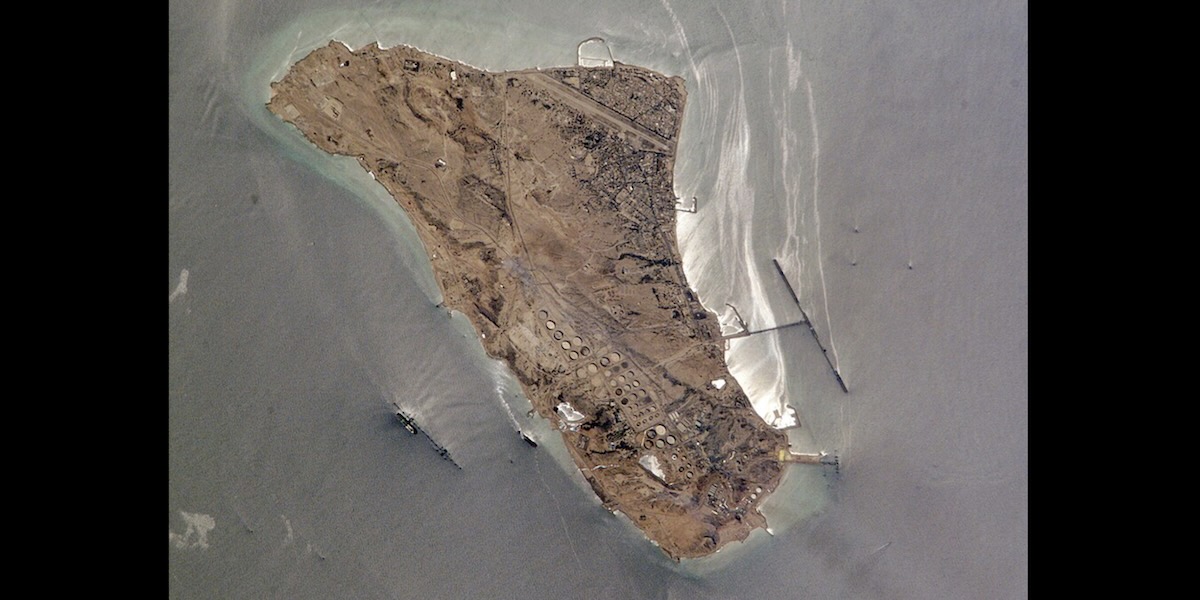
A 2010 satellite image of Kharg Island
On February 28, 2026, the United States launched Operation Epic Fury against Iran, marking the start of the 2026 Iran War. The operation saw US Air Force and Navy aircraft striking several targets across Iran in conjunction with the Israeli Air Forces’ Operation Roaring Lion. In the opening salvos, Iran’s Supreme Leader Ali Khameni was killed, and several Iranian military installations were destroyed. Furthermore, the Strait of Hormuz saw reciprocal blockades by the US Navy and Iran, as well as Iranian missile and drone attacks against US and Allied installations in the region. A total of eighteen US servicemembers have lost their lives in the ongoing conflict and hundred more wounded.
As of August of 2026, the war has remained in state of Iranian missile strikes against US bases while US airstrikes hit Iranian installation near the Strait of Hormuz, which has become a battle zone between US and Iranian blockades. All the while rounds of negotiations between the belligerents continue.
On several occasions, President Trump has threatened to strike Kharg Island, and other vital Iranian installations if no deal was secured regarding the Strait of Hormuz and Iran’s Nuclear Program, opening the possibility of a major escalation in the conflict. But how would a US Military operation against Kharg Island turn out? The objective of this article is to analyze how US Military Operations by US Central Command (CENTCOM) may be conducted against Kharg Island and how it could secure the US either a victory or another long, drawn-out ground war in the Middle East.
Kharg Island
Located in the Persian Gulf, just 25 kilometers or 15 miles off the coast of Southern Iran, Kharg Island is a geographically small island, no bigger than a third of Manhattan. Despite this, the island holds the lifeline of Iran’s economy, responsible for 90% of Iran’s crude oil exports. Furthermore, the island also fields an airfieldand several Liquified Natural Gas (LNG) facilities. These conditions make Kharg Island an asset for the Iranian Regime and an important target for the US as seen by the airstrikes conducted against Kharg Island’s military installations. For the US, neutralizing Iran’s oil economy will increase greater pressure on the regime to secure a deal by putting a clock on the ability of Iran’s economy to sustain the war effort, and as such could be for the US, the chance to win the war.
Air campaign and naval blockade
The first option for CENTCOM to neutralize Kharg Island would be an escalation of the ongoing airstrikesagainst Iran by the US Navy aircraft carriers in the Persian Gulf, joined by a naval blockade of the Strait of Hormuz. The objectives of these strikes, conducted by US Navy F/A-18E/F ‘Super Hornets’ and F-35 ‘Lightning II’ aircraft operating from the aircraft carriers in the Gulf and from Tomahawk missiles launched from Arleigh Burke class destroyers would be aimed at preventing Iran from exporting oil and limit its ability to wage war, by targeting its oil facilities, fuel depots, and vital infrastructure. US Air Force and Marine Corps air assets could also be used to strike Iranian targets in Kharg Island to ensure the US strikes with overwhelming force. However, for the operation to be effective, US Forces would have to target Iran’s oil facilities, something that Trump has threatened to do on multiple occasions but has not gone through with, fearful of a larger escalation in the gulf.
As of July 14, 2026, US CENTCOM has reportedly twenty US warships in the Persian Gulf in support of operations against Iran, with two aircraft carriers operating in the CENTCOM area of responsibility. These carriers are the USS ‘Abraham Lincoln’ (CVN-62) and the USS ‘George H W Bush’ (CVN-77). The United States would likely have to mobilize additional forces to the region, including F-15E ‘Strike Eagle,’ F-16 ‘Fighting Falcons,’ A-10 ‘Thunderbolts,’ and support aircraft such as KC-135 refueling aircraft and Unmanned Aerial Vehicles (UA Vs) to assist in the operation.
Amphibious landing
A more direct, though riskier option to neutralize Kharg Island would be an amphibious landing by US Forces. On multiple occasions, Trump has threatened that the US might take control of Kharg Island if a deal was not achieved. Such an operation on the island would have to be conducted by US Marines to capture critical installations on the island. The US forces landing on the island would do so under the cover of aircraft and naval bombardment, similar to the landings conducted by the US Marines during WW2. Several analysts, retired military commanders, and even Trump have stated that the option for taking the islands is on the table for the US.
The operation would US Marines deploying via helicopter such as the V-22 ‘Osprey’ or Amphibious Assault Vehicles (AAV) from the amphibious ships in the Gulf. The Marines would also likely deploy the LAV-25s from their Light Armored Recon Battalions to act as armor support, as the Marine Corps no longer field the M1 ‘Abrams’ Main Battle Tanks (MBTs) or M2 ‘Bradley’ Infantry Fighting Vehicles (IFVs) after the reorganizations in 2021 as part of Force Desing 2030 program, which saw the deactivation of all US Marine Tank Battalions. If the US decides to deploy such vehicles, they will have to come from US Army units, such as the 1st Cavalry Division and the 1st Armored Division.
The airfield on the island is likely be seized by US Airborne units such as the 82nd Airborne Division, 101stAirborne Division or the 75th Ranger Regiment, units specifically trained to launch airborne assaults upon airfields, as seen by the combat jump by the 82nd Airborne in Panama against Torrijos-Tocumen airport during Operation Just Cause in 1989.
A more limited ground incursion that the Trump Administration might consider, would be a commando raid. Such operation would be conducted by US Special Forces against Kharg Island and would involve a smaller force. Rather than a full-scale invasion, the operation would see US Forces raiding key targets on the island before withdrawing after achieving their objectives. Such operations would likely involve units of the Navy SEALs or the Marine Raider Regiment securing vital installations to prevent their destruction by Iranian Forces, as well as the capture prisoners, and intelligence gathering.
In addition to the commando force securing the target, other ground forces will be necessary to hold the perimeter around the target, as seen by US Operations during the Global War on Terror, with the 75th Ranger Regiment likely to play a role. However, this duty could be entrusted to regular forces, as seen during the 2003 operation in Iraq to capture Saddam Hussein’s sons: Uday and Qusay. During said operation, the 101stAirborne held the perimeter around the compound while Delta Force operators tried to secure the target building in a gun battle that ultimately led to the death of Saddam’s children after they refused to surrender.
The risks and benefits
A successful US occupation of the island or military campaign would see Iran losing the upper hand in the negotiations, with its economy crippled by sanctions, airstrikes, and loss of access to oil revenue, Teheran would have to negotiate and potentially agree to most of the US demands. However, the operation carries several risks, both militarily and politically.
If CENTCOM launches airstrikes against oil infrastructure in Kharg, it could lead to an escalation in the conflict. Iran would likely retaliate against oil infrastructure in other Gulf countries. Since the start of the conflict, Iran has launched strikes against US installations across the region, including US CENTCOM base in Al Udeid Air Base in Qatar, strikes that have shown that the US cannot stop the Iranians from damaging their assets. Iran also targeted several Gulf countries using missiles and drones and Iranian proxies have threatened to get involved in the conflict. However, such Iranian strikes risk bringing retaliatory strikes from US Allies in the Gulf, as seen by reports that Kuwait and Bahrain bombed Iran in retaliation for Iranian strikes on its territory.
Such an escalation in the conflict would see economic hardship inflicted on oil markets in the region and elsewhere, as was seen in the US, Europe, and Latin America after the Iranian blocked the Strait of Hormuz and new round of US airstrikes in July of 2026.
From a military perspective, the operation carries considerable risks. First, an air campaign against the island, would place US strike aircraft at the risk of being shot down Iranian anti-aircraft weapons, risking taking lossesin a scenario not to dissimilar to the American air campaign over North Vietnam, Operation Rolling Thunder.
Such an event is a possibility, as seen by the shootdown of an F-15 E ‘Strike Eagle’ pilot and his Weapon System Officer (W.S.O) belonging to the 494th Fighter Squadron over Southern Iran in April of 2026, and the subsequent rescue operation by US Air Force Pararescuemen and U.S Navy SEALs. A repeat of such a situation would be more complex to resolve. The rescue mission in April, shows that such an operation is risky, as seen by the number of American aircraft lost during the operation, either damaged by the Iranians or destroyed by US forces to avoid their capture.
Furthermore, the shootdown of American aircraft would erode US morale, and the capture of an American airman could cause the US to escalate the conflict or negotiate with Iran, as was feared during the F-15 E shootdown. On the other side, a successful rescue mission would increase morale among US forces and public.
For a ground operation, there are several challenges that must be surpassed before attacking. First, the US would have to deploy additional forces in theater to reinforce the Marine Expeditionary Unit (MEU) in the region. An MEU is roughly a Marine battalion with a helicopter unit for transport and amphibious vehicles. Further US Marine units would have to be sent to the theater to have enough forces to capture and hold the island. Alongside this, the US would need to bring in additional US Navy assets to support the operation.
However, the deployments of such forces and assets, such as armored vehicles, tanks, landing craft, or ground units such as the 101st Airborne Division or Rangers, are likely to cause attention and warn both friend and foe alike that a ground operation is being prepared in the region, with Kharg Island as a likely target, making maintaining the element of surprise a considerable challenge. US intelligence would also have to conduct reconnaissance of the island before an operation, and gather intelligence, with the risk that Iran may detect said attempts and reinforce its troops in preparation for the invasion.
Another problem would be the taking of the airfield on the island. Airfield seizure operations are risky as the troops would be jumping directly on the enemy positions to guarantee the element of surprise. These operations tend to see considerable number of injuries from the combat jump and casualties from enemy defenders, as seen by the US Ranger airborne assault in Granada during Operation Urgent Fury or the US Navy SEAL assault on Punta Paitilla Airport during Operation Nifty Package, part of the 1989 US invasion of Panama.
Furthermore, Iranian forces in command centers and military barracks are likely to put stiff resistance to the invading US forces, as seen by the heavy fighting in La Comandancia between US Forces and the Panamanian Defense Forces in 1989.
Amphibious landings, as seen by the operations conducted by the US Marines in Tarawa, Peleliu, Iwo Jima or Okinawa during WW2, show that such missions will see considerable losses for the attacker, despite massive air and naval bombardment before and after the initial landings. The US may encounter heavy opposition from die hard Iranian forces such as the Iranian Revolutionary Guard Corps (IRGC). The US experience in the 2003 invasion of Iraq, where the Saddam Fedayeen militia proved to be a greater opposition than the Iraqi Army or Republican Guard, shows that such a force must not be underestimated.
Furthermore, the US Navy can be expected to take heavy losses and suffer constant attack from Iranian drones. The British experience in the Falklands, where Argentine A-4 ‘Skyhawks’ attacked British ships at low altitude in San Carlos Bay (Bomb Alley) show that the landing force may face challenges to maintain a stable supply line for the troops. The US Navy is likely to face attack by Kamikaze drones, no different than the onslaught faced by the Navy in Okinawa by the Japanese in 1945.
An occupation of the island would see the US having to handle sporadic attacks by leftover elements of the regime and militias opposed to the US, as seen by Noriega’s Dignity Battalions in Panama or the insurgencythe US and the Coalition was forced to contend with in Iraq from 2003 to 2011.
The US would suffer losses while executing the landing operation, and afterwards and put US Forces at risk of Iranian missile and drone attacks, two scenarios the US public is wary of, as seen by the reluctance of the American public to send in troops to military operations overseas, especially in the Middle East after the 2003 Operation Iraqi Freedom.
Furthermore, the US may be forced to remain in Kharg Island, staying there for a long period of time in order to force Iran to negotiate, with the risk that China or Russia may begin to make economic encroachments when the US leaves the islands.
Conclusions
We can conclude, based on the information available, that Kharg Island may be the key for the US to secure a deal with Iran, though any move into the island would greatly escalate the conflict in the region, and risk dragging the United States into a total war in the region. Furthermore, any operation into the region carries considerable military risks, particularly regarding US Military casualties, enemy opposition, and the challenges for the US to make effective preparations to strike the island. Although a US ground operation to capture the island remains a possibility, we can conclude that any operations against Kharg Island by the United States would occur as a last resort, with the air campaign and naval blockade as the most likely scenarios and, with a little less of likelihood, the possibility of limited raids into the island.