
En la imagen
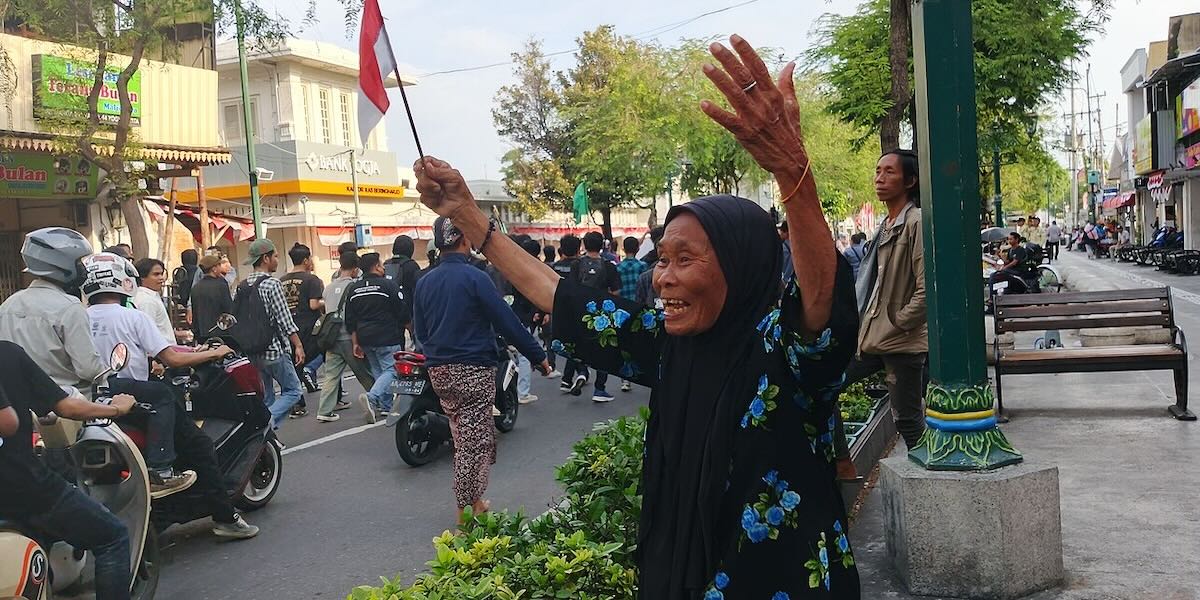
Demonstration in Yogyakarta, in Indonesia, on September 1, 2025 [Meniirtjakarintan]
Indonesia has experienced numerous waves of protest throughout its history, but only a few are as politically significant as the mobilizations that the country saw in 2025. Thousands of furious protests swarmed cities, as national policies indicate a democratic backslide in the country. There is the perception that Indonesia’s democratic structures, proudly built after former president Suharto’s resignation in 1998, are at risk. Are the new youth protests capable of renewing democracy just like they were able to do in the past?
The government’s alleged mismanagement under Indonesia’s current president, Prabowo Subianto, has incited countless student protests across the country, who took to the streets for several months in 2025, specially in August and September. Although the protests have already subsided, a question arises. Is history repeating itself with the spirit of ‘democraci’ (democracy) or ‘reformasi’ reawakening, with students and youth organizations once again standing up against a repressive government, just as they did in 1998?
By analyzing Indonesia’s past cycles of resistance, and the current situation under President Prabowo, this article argues that a new democratic change in Indonesia remains possible. Indonesia’s success of the Reformasi movement in 1998 and the declining state legitimacy of Prabowo’s presidency could create a space for the protesters to push back and revive Reformasi 2.0.
Political foundations of the state [1948-1998]
The Liberal or Constitutional period, ranging from 1948 to 1959, was primarily characterized by the rivalrybetween two political streams in Indonesia, the Abangan and the Santri. The results of the 1955 general election led to the popularity of the Abangan-governed political parties. The prominence of the Abangan extended into the subsequent era, the Guided era, with Indonesia’s first president, Sukarno, also being a part of this political culture.
During the period leading up to the Guided Democracy era, Sukarno’s political viewpoint was heavily influenced by the Japanese and Dutch occupations in Indonesia. After long and oppressive Dutch invasions, he was eventually detained in 1933. During this time and afterwards, Sukarno crafted his own nationalist ideology of Marhaenism, infused with anti-imperialist and anti-capitalist sentiment. With his grand political return in 1945, Sukarno introduced five key principles, known as Pancasila, which are incorporated in the 1945 Constitution of Indonesia and represent what makes up today's official state philosophy. Pancasila principles incorporate: belief in the one and only god; just and civilized humanity; unity of Indonesia; democracy through consensus and social justice for all Indonesian people.
The new constitution adopted in 1950 brought economic instability, which urged Sukarno to formalize a Guided Democracy ranging from 1959 to 1965. The Guided Democracy era was primarily dominated by Sukarno himself, the Partai Komunis Indonesia party (PKI), and the army, all of which were rooted in the abangan cultural tradition. The leadership of the three main actors came to an end in 1965. The idea of the army to ‘guide’ politics during this era foreshadowed later discussion of whether the military should be involved in civilian security, something that is now again debated under Prabowo, especially after the ratification of the Indonesian National Armed Forces Law, allowing more military officers to occupy civilian government positions.
The army did eventually ‘guide’ Indonesia under Soeharto’s New Order from 1966 to 1998. The regime appointed Abangan-dominated generals whose main targets were communists and political Islam. To successfully target the enemies of the regime, Soeharto’s regime unified Indonesia under the Pancasila ideology, eliminating any other religious branch in the state. The New Order governance was rooted in military alliances, technocrats, and business elites, including Chinese and foreign capital, again showcasing similar features to the leadership of Prabowo today in favouring the elites.
The Reformasi movement of 1998 made Soeharto resign. By successfully ending years of military rule in the country, Indonesia entered a period of more civil liberties, competitive elections, and the creation of democratic institutions. This transition happened mainly due to the organized network of students and mass organizations.
The Reformasi movement of 1998
The 1998 Reformasi movement is an instance of mass resistance against repressive regimes in Indonesia and proves that it is again possible in 2025.
‘Reformasi total’ (complete reform) summarized the student movement that ended the 30-year rule of Suharto’s dictatorial regime. Student radicalism dates back to the 1970s, when organized university student protests commenced the movement of protest politics (aksi).
During Suharto’s violent New Order, despite the constant shutdowns of protest politics movements and the Indonesian left, student advocacy endured and remained the strongest force of opposition. From the 1970s onwards, the student insurgency grew and gained the support of the Indonesian peasantry, allowing the mass student movements to evolve into organized political organizations, such as the People’s Democratic Party.
With the continuous rise of student radical groups, Suharto’s rule reached a boiling point during the 1997 Asian Financial Crisis, unveiling the regime’s economic failures and inciting further social unrest in the country. 1998 brought a landslide of student protests, occupying campuses, confronting the military, and enunciating a clear political demand: the fall of Suharto. And he did, on the 21st of May 1998, but only after the brutal killing of four students at the University of Trisakti. The long-standing political demands of the young protesters have been fulfilled, and Indonesia entered an era of democratic reform.
Yet the post-Suharto transition was not immune to elite capture. Oligarchs, like Prabowo, retained power. To this day, the political structure of Indonesia is dominated by politico-business alliances between the military and Chinese businesses. Admitting the return of an illiberal New Order in Indonesia and Prabowo’s attempt to dismantle democratic institutions in Indonesia, it cannot be ignored that the Reformasi period has brought major democratic gains for the country and forever altered the relationship between the state and the Indonesian people. Reformasi allowed the freedom of speech, political pluralism, and revealed the weakeninglegitimacy of state coercion. The erosion of coercive legitimacy is the greatest achievement of Reformasi, and it can pave the way for future political movements, like the mass protests of 2025.
The Reformasi movement achieved a democratic transition thanks to its organization. The democratic transition involved organized student protests, civil society, and organizations. Coordinated and structuredpolitical movements produce more dependable transitions within a state. In contrast to mismanaged uprisings, which are more prone to state intervention.
Protests in 2025
History repeats itself in Indonesia as the political upheavals of the 90s are resurfacing under Prabowo in the 21st century. Increasing military interventions, intra-elite conflicts, and budget cuts have generated nationwide protest rallies. Throughout 2025, the protests followed in three waves of unrest. The first protests commenced in February, initiated by the All-Indonesian Students’ Union, additionally supported by dispersed student groups. This initial phase was perhaps the most subtle of the demonstrations, as a majority of them were cancelled, although still heavily supported by students.
In March of 2025, protests erupted once more with the ratification of a revised Indonesian National Armed Forces Law, increasing the ability of the government to appoint military officers to civilian positions. This sparked commotion in the country as many aspects of the revised legislation reflected those of Suharto.
The roots of the burning 2025 August protests can be found in Pati, a regency in Central Java. The Pati regency demanded the resignation of Regent Sudewo, after a 250% rise in property taxes, and the slashing of budgets imposed by Prabowo’s administration. Consequently, the August protests culminated in the death of Affan Kurniawan an ‘ojek’ (motorcycle taxi driver), after he was struck by a police tactical vehicle belonging to the Brimob Metro Jaya police unit, a crucial turning point in the public dissatisfaction with the Indonesian Members of the House, and triggered a rapid expansion of demonstrations nationwide.
Democratic reform is possible
The purpose is to showcase the strength of public outrage that can arise if a government is slowly shifting away from democratic values. The younger generations of Indonesia can quickly identify the patterns of authoritarian consolidation. If a democratic reform was possible during the Reformasi movement, it is possible in the 21st century. Elements of decreasing legitimacy of state coercion, the spirit of Reformasi, and the importance of structured political organization serve as a beacon of hope that democratic reform is possible in Indonesia.